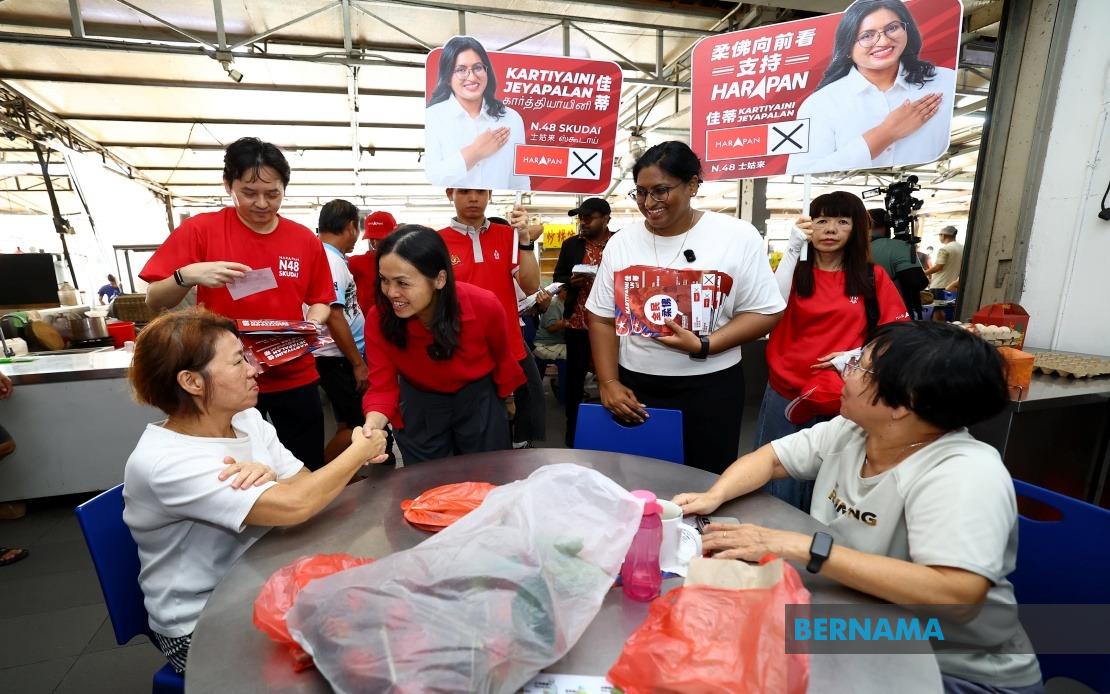
Johor's Democratic Action Party chairman Teo Nie Ching has made an impassioned appeal to voters—particularly those working or studying away from home—to prioritize returning to cast their ballots in the state election scheduled for this Saturday. Speaking in Johor Bahru, the Deputy Communications Minister underscored the significance of participating in the democratic process, framing it as a privilege that deserves serious engagement from all eligible citizens regardless of their location.
Teo's appeal drew strength from a series of remarkable examples demonstrating the determination of overseas-based Malaysians to participate in the electoral process. She recounted the story of a voter in Queensland, Australia, who went to considerable lengths at the airport trying to find someone willing to hand-carry his postal ballot back to Malaysia after discovering that courier services could not guarantee timely delivery before the July 11 deadline. These anecdotes served to underscore her broader message: that voters in less distant locations, such as nearby Kuala Lumpur or Singapore, should recognize the privilege they enjoy and make similar efforts to participate.
Another compelling case involved a postgraduate student undertaking studies in China who incurred additional expenses exceeding RM1,000 to change her flight booking specifically to return for voting day. Meanwhile, a voter in the United States invested considerable effort to identify a Malaysian citizen who could witness her completion of the postal voting procedures, ensuring compliance with electoral requirements. Teo presented these narratives not merely as human interest stories, but as evidence of how voters far from home genuinely value their individual vote in ways that those closer to home sometimes take for granted.
The DAP leader's comments came during a campaign visit to Kampung Baru Skudai, where she met with local residents alongside Kartiyaini Jeyapalan, the Pakatan Harapan candidate contesting the Skudai state assembly seat. This ground-level engagement reflects the broader campaign strategy being pursued by opposition parties as voting day approaches, with particular focus on mobilizing support in urban and suburban constituencies.
Beyond voter mobilization, Teo raised serious concerns about the circulation of false information in the final stages of the election campaign. She specifically cautioned the public against being misled by fabricated news stories or counterfeit social media accounts deliberately designed to deceive voters. Her warning touched on a critical challenge facing Malaysian elections: the speed and ease with which misinformation can propagate through digital channels, often faster than factual information can correct it.
To combat this threat, Teo advocated for greater digital literacy among the electorate, promoting what she termed a "verify before you share" culture. This approach places responsibility on individual users to authenticate information before contributing to its dissemination through their own networks. She emphasized that while the internet facilitates rapid information distribution, this same capability means false information travels with alarming speed. Her advice was direct: if uncertainty exists about content's accuracy, the responsible action is simply not to share it further.
Parallel efforts are underway to encourage voters in Singapore—a significant constituency given the large number of Johor residents who work across the causeway. Kartiyaini revealed that Pakatan Harapan's election machinery has intensified its push to remind these cross-border workers of their voting obligation. The campaign extends beyond merely encouraging attendance at polling stations; it aims to build awareness about the importance of state-level elections in shaping Johor's developmental trajectory and policy direction.
As part of this targeted outreach, Kartiyaini and other party leaders positioned themselves at the Sultan Iskandar Building Customs, Immigration and Quarantine Complex from 5 am, engaging directly with workers crossing into Singapore. The strategy also involved boarding buses transporting workers across the causeway to deliver their message in a more personal setting. According to Kartiyaini, this ground-level engagement has generated positive responses, with party officials expressing optimism that this momentum would translate into higher voter turnout at the ballot box.
The significance of these mobilization efforts becomes clearer when considering the scale of the election. The 16th Johor state election will draw approximately 2.7 million registered voters to the polls across 56 state assembly constituencies. This substantial electorate will determine the composition of the state government for the coming term, making the outcome consequential for Johor's governance and policy implementation. Kartiyaini's assertion that state elections carry equivalent importance to general elections reflects a broader effort to counter the perception that state-level votes matter less than federal-level decisions.
The emphasis on state-level significance carries particular weight given Malaysia's federal structure, where state governments retain considerable autonomy over matters including land development, local economic policies, and state-specific welfare programs. A responsive and proactive state administration can implement changes directly affecting residents' daily lives, from infrastructure development to service delivery. This framing aims to elevate public perception of the election's importance beyond abstract democratic participation toward tangible improvements in governance quality.
The combination of Teo's voter mobilization message and Kartiyaini's ground campaign illustrates how opposition parties are attempting to maximize participation ahead of polling day. The focus on overseas and cross-border voters represents a strategic recognition that significant portions of Johor's electorate work outside state boundaries, requiring special outreach efforts to ensure their voices are heard. Simultaneously, the warnings against misinformation address a meta-level threat to electoral integrity: the pollution of the information environment itself.

