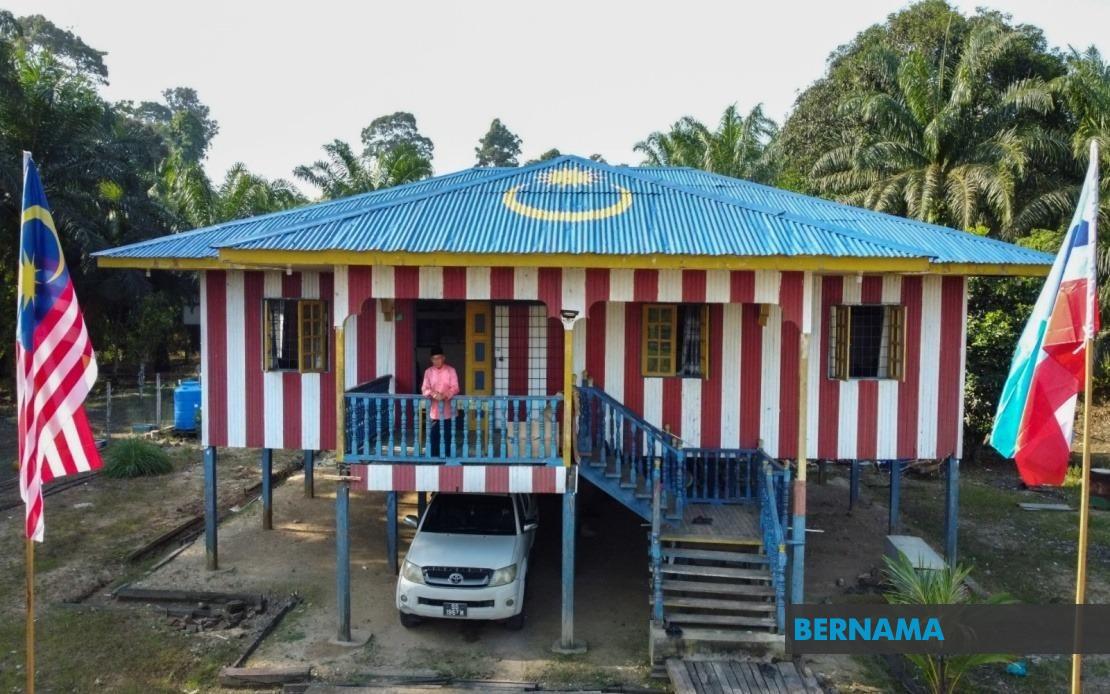
In the Sandakan district of Sabah, a modest wooden house at Batu 15 on Jalan Labuk has become an unmistakable landmark of national devotion. Painted entirely in the colours of the Jalur Gemilang—red, white, blue and yellow—the residence named Teratak Gemilang stands as a physical manifestation of one man's enduring love for Malaysia, drawing curious visitors and photographers, particularly during festive national occasions.
The architect of this unconventional tribute is Mohd Halikin Angga, a 68-year-old entrepreneur who embarked on his decorative mission in 2004, driven by a desire to preserve the spirit of patriotism that typically fades once National Day celebrations conclude. What began as a reaction to witnessing flags discarded or damaged after festivities evolved into an elaborate, decades-long project that has fundamentally altered the appearance of his family home. The deep-blue roof, crowned with a golden-yellow crescent moon and 14-pointed star, immediately commands attention, while bold red and white stripes dominate the wall panels, with multiple Jalur Gemilang flags positioned prominently throughout the compound.
Mohd Halikin's motivations extend beyond mere aesthetic expression. The decision to paint his house emerged from personal reflection about his parents, who lived through Malaysia's colonial period. He explained that witnessing flags being taken down after celebrations triggered a poignant realisation about the impermanence of public patriotic displays, prompting him to create a permanent, private monument to national identity. This personal connection to independence struggles and his parents' generation shaped the philosophical foundation for Teratak Gemilang's creation.
Inside the residence, visitors encounter more than decorative nationalism. The interior functions as a gallery celebrating Malaysia's political leadership, with the living room displaying portraits spanning from Tunku Abdul Rahman Putra Al-Haj through to the current Prime Minister, alongside images of the Yang di-Pertuan Agong and the Yang di-Pertua Negeri Sabah. Among Mohd Halikin's most prized possessions is a historic photograph documenting Tunku Abdul Rahman's 1961 meeting with twenty North Borneo leaders to discuss Malaysia's formation—an image he discovered in a newspaper during an Umrah flight in 2005 and obtained permission from cabin crew to preserve and frame.
Mohd Halikin's commitment to national pride extends into intimate family decisions. Three of his seven children bear the names of prominent national figures: his eldest is named after Tun Dr Mahathir Mohamad, his second after Tun Abdullah Ahmad Badawi, while his sixth child, Nur Zahirah, is named after the 13th Raja Permaisuri Agong. For Mohd Halikin, naming practices carry profound significance beyond convention, representing a deliberate strategy to ensure the next generation remembers and appreciates the contributions of past leaders. He views names as vessels of hope, connecting descendants to the nation's political heritage.
Over more than twenty years, Teratak Gemilang has evolved from a solitary expression of individual patriotism into an informal cultural landmark within Sandakan. Visitors frequently stop to photograph the residence, particularly during August and September when national sentiment peaks. The property has transcended its original purpose as a private dwelling to become a community talking point and a visual anchor for discussions about national identity in Sabah.
Mohd Halikin remains steadfast in his commitment to maintaining the house's patriotic appearance indefinitely. He views the ongoing preservation of Teratak Gemilang not merely as personal stubbornness but as a responsibility to sustain the spirit of patriotism he believes is essential for national cohesion. His vision extends beyond his own lifetime, focusing on the symbolic impact the residence might exert on future generations exposed to its display.
Looking toward Malaysia Day 2026 and Sabah's continuing development, Mohd Halikin harbours hopes that Teratak Gemilang might serve as an inspiration for strengthening unity among Sabah's diverse, multiracial population. In a state characterised by remarkable ethnic pluralism, the residence represents one individual's attempt to articulate a unifying national narrative through visual means. His aspiration reflects broader contemporary conversations within Malaysia about integrating diverse communities around shared civic values.
The phenomenon of Teratak Gemilang raises interesting questions about how ordinary citizens conceptualise and express patriotism in modern Malaysia. Unlike institutional displays or government-sanctioned monuments, Mohd Halikin's house represents grassroots, self-funded patriotic expression—a personal investment in national symbolism that continues across two decades without official recognition or financial support. This dimension distinguishes his approach from conventional civic commemoration, suggesting alternative frameworks through which individuals might engage with national identity in increasingly pluralised societies.
For Malaysian readers, particularly those in Sabah and Sarawak, Teratak Gemilang embodies a specific regional perspective on national belonging. The residence demonstrates how East Malaysian citizens, living geographically distant from Peninsular Malaysia's power centres, actively construct and maintain connections to national identity through intimate, localised interventions. Mohd Halikin's project implicitly argues that patriotism need not be passive consumption of state-mandated nationalism but rather active, creative participation in defining what national identity means within specific communities.
The sustained maintenance of Teratak Gemilang also speaks to generational transmission of values. By naming children after national leaders and curating historical photographs, Mohd Halikin attempts to embed national consciousness within his family structure. This intergenerational strategy suggests how individual households become sites where national identity is reproduced, contested, and reimagined across time.
As Malaysia approaches significant commemorative dates in 2026, stories like Teratak Gemilang offer alternatives to top-down narratives about national unity. They illustrate how citizens at the grassroots level conceptualise their relationship with the nation-state, invest emotional and material resources into patriotic expression, and hope these investments might influence broader social consciousness. Mohd Halikin's two-decade commitment demonstrates that patriotism, for some Malaysians, remains a deeply personal, creatively expressed, and persistently maintained value—one that transcends official calendars and finds permanent expression through everyday domestic spaces transformed into monuments of national sentiment.

