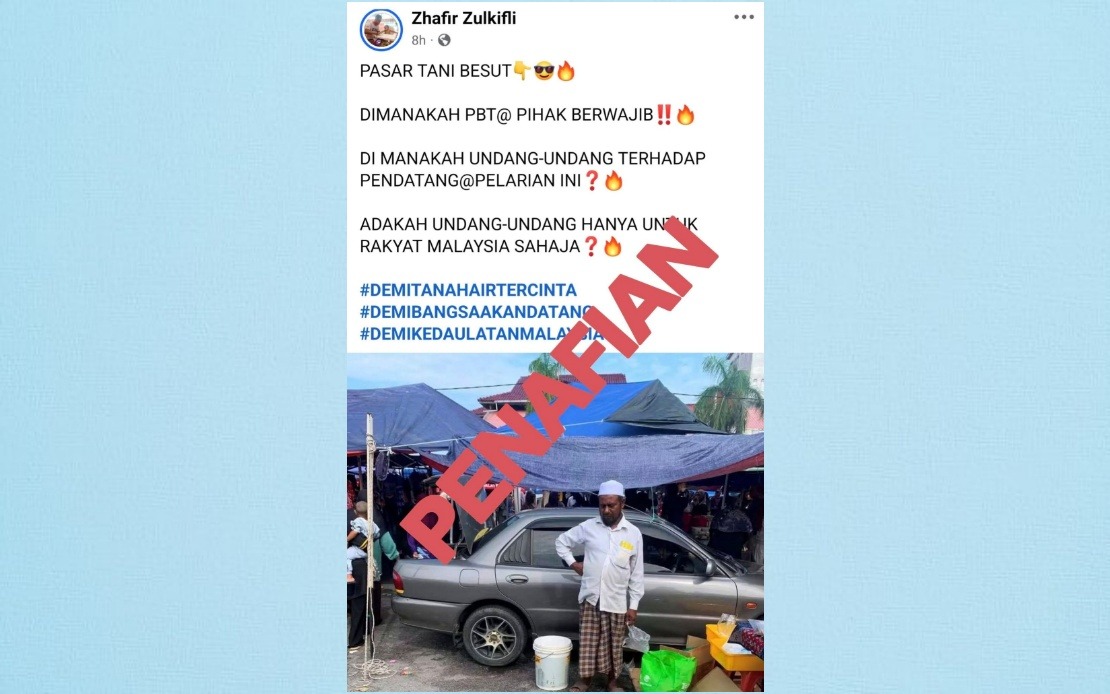
The Terengganu Federal Agricultural Marketing Authority has moved swiftly to address mounting concerns about foreign participation in local farmers' markets, issuing a formal statement denying that any such traders operate under its jurisdiction. The denial came after a Facebook post featuring images of a man purportedly selling vegetables at a Besut morning market sparked considerable online debate about who should be permitted to conduct commerce at these community trading venues.
According to FAMA's clarification, the viral incident that triggered the social media storm actually took place at Kuala Besut Morning Market, a facility entirely separate from those managed by the agricultural authority. This distinction carries significant weight for the agency's regulatory standing and the public's understanding of how farmers' markets in Terengganu operate under different administrative frameworks. The authority emphasised that such markets fall outside its operational purview and therefore outside its responsibility to enforce trading regulations.
Terengganu FAMA's supervisory mandate currently extends only to two specific farmers' markets within the Besut district. The first operates under the Jerteh Farmers' Market banner, welcoming sellers every Thursday between 7 am and 1 pm, while the second, Alor Lintang Farmers' Market, holds its trading sessions each Saturday during the same morning window. These scheduled, regularised operations reflect the authority's commitment to structured commerce that serves both local producers and consumers seeking fresh agricultural products.
The incident underscores a broader challenge facing Malaysian market administrators: distinguishing between venues they directly manage and those falling under separate municipal or community authority. The confusion generated by the viral post illustrates how quickly unverified claims can spread across social platforms, potentially damaging the reputation of agencies responsible for quality and compliance oversight. For Terengganu FAMA, the statement represents an opportunity to reassert its regulatory standards and the eligibility criteria governing participation in its facilities.
Markets across Malaysia have increasingly become focal points for debates surrounding fair trading practices and local protections. The appearance of non-citizen traders at these venues raises legitimate questions about verification mechanisms, documentation requirements, and the enforcement of existing regulations. These concerns reflect broader anxieties among local communities about economic participation and resource allocation, particularly in states like Terengganu where agricultural livelihoods remain significant for many families.
The regulatory environment governing farmers' markets involves multiple layers of administration. Local councils, state agricultural authorities, and federal agencies all exercise different aspects of oversight. Understanding these distinctions matters considerably for both traders seeking to operate legitimately and for consumers wanting assurance about market standards. FAMA's intervention in this case demonstrates the importance of rapid, clear communication when misinformation threatens institutional credibility.
Terengganu's agricultural sector depends significantly on the integrity of its distribution channels. Farmers' markets serve as critical venues where producers can interact directly with consumers, maintaining pricing transparency and product quality control. When public confidence in these spaces is challenged by unverified claims, the foundation of trust between market administrators and participating producers can weaken. FAMA's prompt response reflects an understanding that institutional credibility in agricultural commerce cannot afford ambiguity.
The social media landscape has fundamentally altered how grievances and concerns circulate within communities. A single post can reach thousands within hours, generating substantive public discussion before facts are verified. For government agencies accustomed to traditional communication channels, this presents ongoing challenges in crafting responsive strategies. FAMA's decision to issue a formal statement rather than remaining silent represents an acknowledgment of modern communication realities.
Looking forward, the incident highlights the value of transparent trader verification systems at farmers' markets. Malaysian authorities might consider implementing more accessible documentation of permissible traders, perhaps through public registries or clearer on-site identification protocols. Such measures would simultaneously protect legitimate traders from unfounded accusations and provide consumers with confidence in the venues where they purchase essential goods. For Southeast Asian markets broadly, establishing uniform standards for foreign trader participation could reduce the kind of confusion that occurred in Terengganu.
The Kuala Besut Morning Market situation, by remaining outside FAMA's direct management, places responsibility for regulatory enforcement with whichever local authority holds jurisdiction. This distribution of accountability, while administratively logical, can create perception gaps when different standards exist across adjoining venues. Residents and traders alike may struggle to understand which rules apply where, and which agencies hold ultimate responsibility for compliance. Clear institutional mapping of these responsibilities serves the entire market ecosystem.

