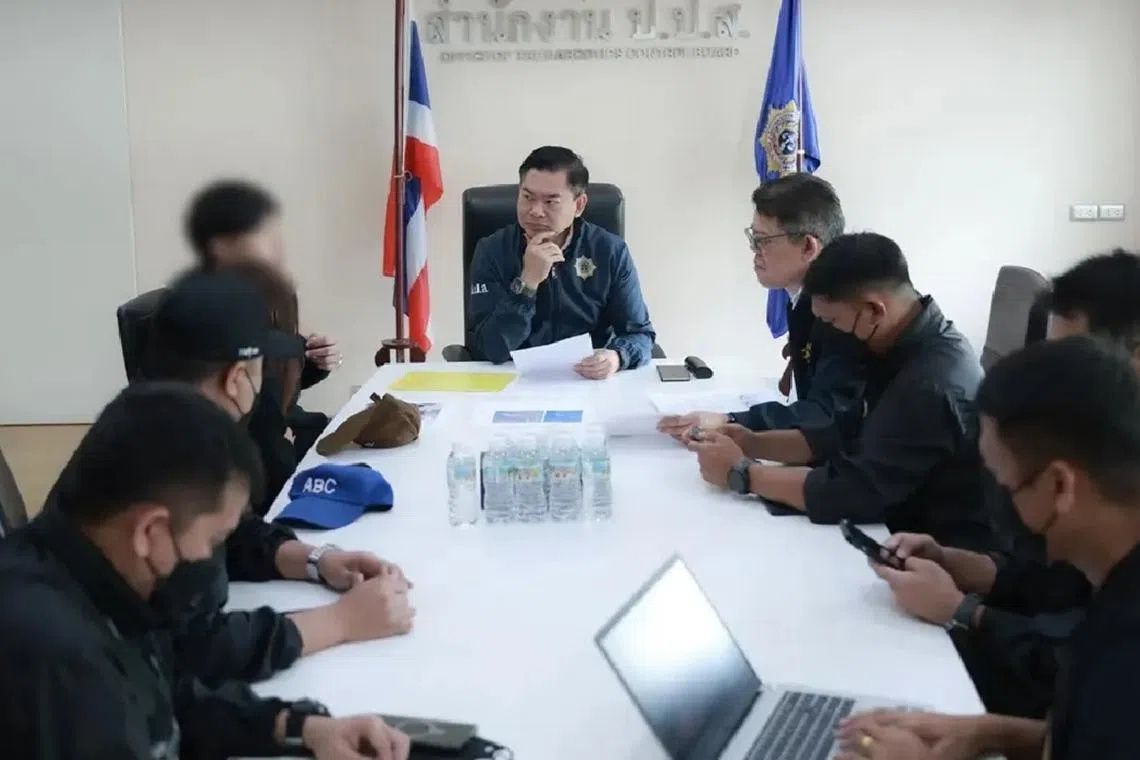
Authorities in Thailand are intensifying their investigation into an alleged international drug-smuggling conspiracy after Australian police arrested a Thai airline employee with heroin concealed in her luggage. Police Major Suriya Singhakamol, secretary-general of the Office of the Narcotics Control Board (ONCB), disclosed on Wednesday that initial assessments from Australian counterparts reveal a sophisticated concealment operation, with the contraband hidden within only two of twelve bags that comprised the shipment. One bag alone contained approximately 900 grams of suspected heroin, officials said, though laboratory confirmation from Australian authorities remains pending.
The discovery underscores the evolving methods employed by transnational drug networks operating across Southeast Asia and beyond. Rather than distributing narcotics uniformly throughout a parcel, the smugglers employed what appears to be a deliberately deceptive strategy: embedding heroin directly into the fabric of just two bags while leaving the remaining ten as apparent decoys. This calculated approach suggests operational sophistication and an understanding of law enforcement inspection protocols. Thai officials initially assessed the combined contents of the two compromised bags at no more than two kilograms, though they await definitive laboratory results to confirm the precise quantity and purity of the seized substance.
The investigation has expanded significantly beyond the initial arrest, with Thai authorities now mobilising multiple agencies to dismantle what they believe is an organised criminal enterprise spanning multiple countries. The ONCB has established close coordination with the Australian Federal Police, recognising that the scale and complexity of this operation demands international cooperation. Thai Customs Department, the Department of Special Investigation, and the Australian Federal Police have formally integrated their efforts under a joint operation designated Task Force Storm, reflecting the seriousness with which officials view the network's activities and reach.
A critical phase of the investigation involves identifying the courier who physically delivered the parcel to the crew member. One delivery rider, operating what appeared to be a legitimate logistics service, voluntarily approached the ONCB to establish his innocence after becoming concerned about his involvement. Through meticulous examination of closed-circuit television footage and careful comparison of physical details, investigators determined the rider was unconnected to the actual delivery. The timeline proved conclusively different: the suspicious parcel arrived on June 22 around midday, whereas the cooperative rider had delivered an entirely separate shipment the following day at approximately 5 p.m. Furthermore, the packaging differed markedly—the drug parcel was a large brown cardboard box, while the rider's delivery was a smaller black plastic container. Clothing and helmet colour also diverged, with CCTV footage showing the actual courier wearing a black helmet, contrasting with the volunteer's white helmet and yellow shirt.
The search for the genuine delivery rider continues as authorities work to trace the supply chain backwards toward the network's organisers. Equally significant is the hunt for an individual operating under the Facebook account name "Rose," who allegedly orchestrated the parcel delivery through a Facebook group. Thai officials recognise that this online persona likely represents either a recruiter or intermediary rather than the network's apex, though identifying the actual person behind the account represents a crucial investigative breakthrough that could unlock the broader conspiracy. The ONCB has committed substantial resources to this digital investigation, understanding that online recruitment platforms have become increasingly central to drug-trafficking operations throughout the region.
The geopolitical and geographic context of this case reflects established patterns of narcotics trafficking in Southeast Asia. Police Major Suriya acknowledged that substances including crystal methamphetamine, heroin, and methamphetamine pills originate from the Golden Triangle—the notoriously lawless border region where Thailand, Laos, and Myanmar converge. However, the sophisticated packaging and concealment methods detected in this shipment could have been executed in either a neighbouring country or within Thailand itself, suggesting the network maintains operational capacity throughout the region. This flexibility in logistics and manufacturing represents a significant challenge for law enforcement, as dismantling such distributed operations requires intelligence and cooperation spanning multiple jurisdictions and governmental systems.
The case carries particular implications for Malaysia and the broader Southeast Asian region, as it demonstrates how established air transportation networks and crew mobility can be exploited for drug distribution. Airline employees, with legitimate reasons to cross international borders frequently and access cargo systems, present attractive targets for recruitment by trafficking organisations. The sophistication of the concealment method—embedding drugs within fabric itself—suggests the network includes individuals with technical expertise and access to manufacturing capabilities. For Malaysian authorities, the case serves as a reminder that narcotics threats transcend simple border interdiction and require proactive intelligence sharing, investigation of recruitment networks, and monitoring of both physical and digital trafficking infrastructure.
On the afternoon of July 1, senior ONCB officials conducted detailed discussions with Australian Federal Police representatives to synchronise investigative strategies and exchange critical intelligence on the network's suspected structure and operational methods. The cooperation reflects the practical reality that modern drug trafficking operates without regard for national sovereignty, requiring law enforcement agencies to adopt similarly transnational approaches. The joint investigation specifically aims to identify the network's leadership and senior operators rather than focusing solely on lower-level couriers and transporters, recognising that sustainable disruption requires targeting the decision-makers and organisers who direct operations and maintain supply chains.
The investigation's progression will likely influence how Thai and regional authorities approach airline security, crew vetting, and international parcel trafficking oversight. The revelation that a crew member—a position typically considered trustworthy and low-risk—was compromised demonstrates that criminal networks actively recruit across occupational categories and organisational hierarchies. Transport-related employment, whether aviation, maritime, or ground logistics, offers multiple vulnerability points that traffickers systematically exploit. As the investigation progresses and authorities work to map the network's full scope, they will accumulate intelligence about recruitment methods, payment structures, and distribution networks that could inform broader enforcement strategies throughout Thailand, Australia, and Southeast Asia.

