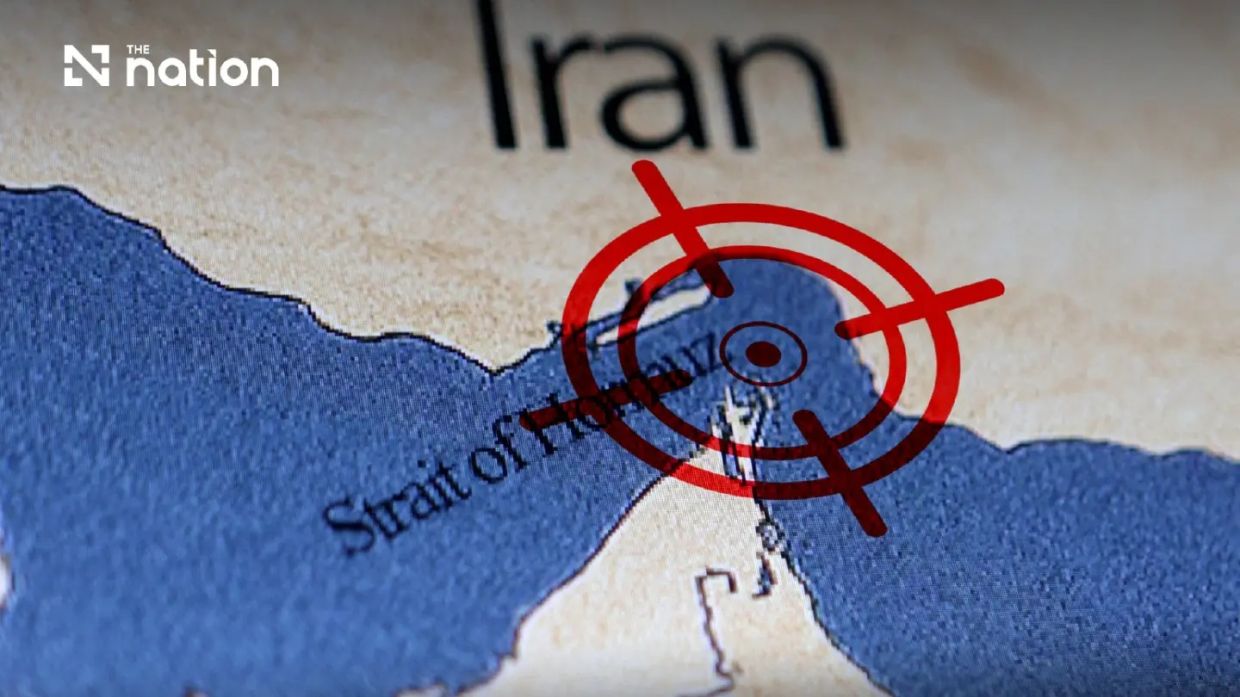
A merchant vessel flying the Thai flag has reportedly come under attack from Iranian military forces while transiting the strategically vital Strait of Hormuz, according to Iran's semi-official Tasnim news agency. The incident represents the latest flashpoint in an intensifying confrontation between American and Iranian forces that now directly threatens commercial shipping in what remains one of the world's most economically vital waterways. Thai authorities have not yet provided confirmation of the attack, nor have independent maritime monitoring organisations or the vessel's operators, leaving key details about the incident unverified at this stage.
The Tasnim report offers minimal specifics about the alleged incident, declining to name the vessel, identify its operator, describe its cargo, confirm its destination, or clarify the nationalities of those aboard. Whether the ship sustained damage or whether crew members were harmed remains unclear from the available information. This lack of transparency exemplifies the broader information vacuum surrounding maritime incidents in the Hormuz region, where claims from Iranian military sources often circulate without independent verification and where commercial operators frequently withhold details for security reasons.
The reported attack on the Thai vessel forms part of a broader pattern of alarming incidents now occurring with greater frequency in the Strait of Hormuz. Tasnim separately reported that two oil tankers experienced explosions and caught fire after attempting to navigate waters that Iranian media characterised as a minefield located in the strait's southern section. The Islamic Revolutionary Guard Corps Navy claimed responsibility for these incidents, asserting that the waterway had become "extremely unsafe" and remained completely closed due to what it termed American aggression. Such statements reflect an escalating rhetoric designed to deter commercial shipping from using the route.
These maritime disruptions occur against a backdrop of intensified military operations by the Iranian Revolutionary Guards. The IRGC claimed it had intercepted four oil tankers allegedly attempting passage through the Strait of Hormuz with American military support, ordering the vessels to remain stationary during what it described as a joint missile-and-drone operation. The IRGC Navy issued a direct warning to shipowners, instructing them to heed Iranian military notices rather than depend on security assurances provided by United States forces. Like the Thai vessel incident, crucial details about these four tankers—their identities, locations, registry information, and current condition—remain undisclosed.
The implications of sustained disruptions to Hormuz traffic extend far beyond the immediate region. The Strait of Hormuz functions as the conduit for roughly one-third of globally traded seaborne petroleum and represents an irreplaceable component of the international energy supply chain. Any prolonged interruption to shipping flows through this chokepoint would inevitably drive up freight charges and maritime insurance premiums, potentially strain global energy supplies, and create upward pressure on commodity prices worldwide. For Malaysia and other Southeast Asian economies reliant on stable energy costs and unimpeded trade flows, such disruptions carry direct economic consequences.
These maritime tensions have coincided with the United States launching its seventh consecutive night of military strikes against Iranian targets. American Central Command announced via its X social media account that the latest operation commenced at 7pm Greenwich Mean Time on Friday, corresponding to 3pm Eastern Standard Time. The US military characterised the aerial campaign as intended to "continue degrading Iran's military capabilities," though CENTCOM neither provided a detailed accounting of specific targets nor disclosed the full extent of damage inflicted. This sustained bombing campaign marks a significant escalation in direct military confrontation between the two powers.
Iranian officials have reported that preceding American strikes caused damage to civilian infrastructure across the nation's southern regions, including bridges, airports, electrical power facilities, and railway infrastructure. Foreign Minister Abbas Araghchi stated that three people killed in an American attack on a bridge in Bandar Khamir counted among eight total deaths from overnight US strikes. Additionally, Tasnim cited a deputy governor of Bushehr province alleging that the United States had attacked an Iranian oil tanker moored at Kharg Island. These claims, sourced entirely from Iranian state officials and state-aligned media outlets, remain unverified by independent observers, making it difficult to assess damage scale or casualty figures with confidence.
Iran has responded to these American military operations with retaliatory strikes of its own, claiming to have attacked American assets and military installations across multiple Gulf states. Iran's military stated it had targeted US facilities in Bahrain, Jordan, Kuwait, and Qatar. Qatari authorities confirmed that their armed forces successfully intercepted an incoming Iranian attack, though one child suffered injury from falling debris generated by the interception. Iran also claimed responsibility for additional attacks on other American-linked military sites distributed across the broader Gulf region, though the extent of damage from these strikes remains murky and largely dependent on contradictory statements from various parties.
These duelling military operations have provoked considerable apprehension that the conflict could metastasise into a wider regional conflagration. The Persian Gulf hosts significant American military presence, with personnel and facilities distributed across multiple allied nations, creating numerous potential flashpoints for escalation. The Islamic Revolutionary Guard Corps Navy further claimed responsibility for shooting down an American MQ-9 reconnaissance drone over Bushehr, Iran's principal port city, using what it described as a newly developed air-defence system integrated into Iran's broader air-defence architecture. The United States has not yet confirmed any loss of an MQ-9 drone in this location, creating another factual dispute in an environment already saturated with competing and unverified claims.
The convergence of the reported Thai vessel attack, the tanker incidents in disputed waters, and the escalating cycle of military strikes and counterstrikes demonstrates the acute dangers now confronting both civilian and commercial maritime operations. The Strait of Hormuz, already one of the world's most sensitive geopolitical zones, has become increasingly unstable as American and Iranian military forces operate in closer proximity and with greater intensity. For Malaysian shipping interests and Southeast Asian economies dependent on stable energy supplies and predictable maritime commerce, the situation demands careful monitoring and contingency planning. The absence of clearly defined rules of engagement, combined with the opacity of incident reporting and the involvement of multiple military forces operating under conflicting command authorities, creates an environment where accidents can easily spiral into broader military confrontations.

