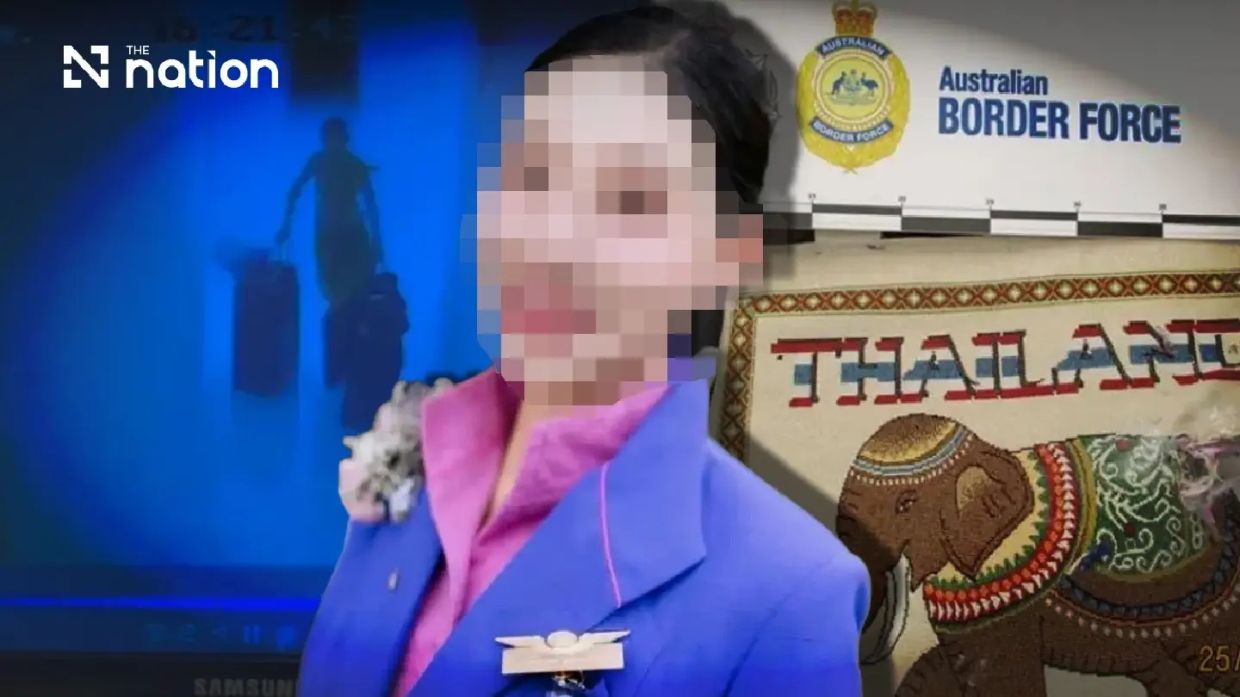
The arrest of a Thai flight attendant carrying 900 grammes of heroin at Melbourne Airport has triggered a sprawling international investigation centred on what Thai authorities believe is an elaborate transnational smuggling network with deep roots in the Golden Triangle. The woman, detained in Australia, remains under investigation as Thai security agencies work with Australian counterparts to establish whether she was knowingly involved or exploited by sophisticated criminal organisers who specifically target airline workers and frequent international travellers.
According to Areepak Ngernbamroong, deputy secretary-general of the Office of the Narcotics Control Board (ONCB), the investigation has evolved from a single arrest into a multi-agency operation spanning Bangkok, Melbourne, and multiple Southeast Asian jurisdictions. Three to four connected arrests made in Bangkok yielded over 26 kilogrammes of heroin, prompting the Department of Special Investigation (DSI) to assume command of the case and treat it as a major organised crime matter rather than a simple drug possession incident. The escalation reflects official concern that the flight attendant's case represents merely one thread in a much larger criminal enterprise.
What distinguishes this operation is the deliberate targeting methodology. Metropolitan Police officers discovered that the network operates through social media deception, creating fake profiles and sending mass messages to flight attendants and other frequent international travellers. The scammers offer payments—often modest sums—in exchange for carrying parcels across borders, exploiting the mobility and relative anonymity of airline staff. The scheme divides drug delivery into two channels: postal shipments and direct hand-to-hand transactions, providing redundancy and reducing detection risk. This combination of digital manipulation and logistical sophistication suggests an organisation managed by experienced criminals rather than opportunistic smugglers.
The recipient in Australia, identified as "Dear," a Thai national with a decade-long residence in the country, appears central to the Australian operation's success. Thai authorities have obtained the individual's real identity and established that similar deliveries have occurred multiple times through this same contact, suggesting an established pattern rather than a one-off transaction. The AFP has been tasked with determining whether Dear operated independently or as part of a broader Australian distribution network, and crucially, identifying who the final recipients of the narcotics were destined to be. This investigative focus hints at suspicions that Melbourne may serve as a significant distribution hub for Southeast Asian heroin flowing into Australian markets.
The flight attendant's own role remains deliberately ambiguous—a status that may work in her favour legally but complicates the investigation. Her boyfriend told authorities that she received a parcel box containing elephant-pattern bags, which she opened and inspected before packing into her suitcase. Finding nothing initially, she proceeded with the bags to Australia where customs detected the heroin. The X-ray examination at Bangkok airport failed to detect anything unusual, suggesting either sophisticated concealment or last-minute insertion of drugs. The timing gap between her inspection and departure created a window during which drugs could have been added without her knowledge, a detail that investigators cannot yet resolve.
Financial documentation muddies the picture further. Thai police recovered information suggesting a payment of 8,800 baht (US$264) was discussed, yet bank records show no corresponding transactions to the flight attendant. Alternative reports mention two separate transfers of 1,700 baht each, supposedly tied to package receipt and ticket availability, yet her account contains no evidence of these funds. Areepak acknowledged that investigators lack clarity on the payment structure, making it impossible to determine whether the modest sums involved genuinely incentivised deliberate participation or whether the woman was simply oblivious to any compensation arrangement.
The delivery rider's own account adds another layer of uncertainty. He claimed this represented his fourth or fifth similar delivery assignment, yet the first time he had worked with this particular flight attendant. This detail could support the defence that she was a random, unknowing target chosen from a rotating roster of potential couriers rather than a trusted conspirator brought into the operation. Conversely, it might indicate that the network deliberately rotates participants to reduce the likelihood of detection through pattern recognition by authorities or airline security systems. Thai investigators have not yet determined whether the rider's account reflects innocent ignorance on the flight attendant's part or calculated operational security by the smuggling ring.
The connection to the Golden Triangle underscores how drug trafficking routes and methods shift in response to enforcement pressure. The ONCB deputy secretary-general explained that as Thai authorities intensified interdiction efforts in the traditionally high-risk northern border regions, trafficking networks pivoted eastward toward the north-east, exploiting the porous Mekong River boundary with Laos. The routes through Nakhon Phanom, Bueng Kan, Loei, and Nong Khai present particular challenges because the river narrows at these locations while the frontier stretches extensively, making continuous surveillance prohibitively resource-intensive. Most intercepted narcotics arrive pre-packaged before being transferred between criminal cells, suggesting a degree of compartmentalisation that protects higher-level organisers from exposure.
The heroin in the flight attendant's luggage may represent only a single operational line within this vastly more extensive organisation. By routing narcotics through airline workers rather than conventional cargo or mail systems, smugglers achieve several strategic advantages: plausible deniability through claims of manipulation, reduced scrutiny since personal baggage receives less intensive screening than commercial shipments, and rapid deployment of product to distant markets. The Australian operation appears particularly significant, suggesting the network has developed established distribution infrastructure on that continent rather than merely using it as a transshipment point.
Thailand's ongoing coordination with Australia and Laos adds a diplomatic dimension to what might otherwise appear a straightforward narcotics investigation. Thai authorities have already transferred evidence to the Australian Federal Police and Thai consular officials, positioning the flight attendant's legal defence as a matter requiring consular support. Areepak's repeated emphasis that Laos is not neglecting interdiction efforts—despite drugs flowing through its territory toward Thailand—reflects the sensitivity surrounding bilateral narcotics cooperation in the region. Any suggestion that Laotian authorities are complicit or negligent could complicate ongoing intelligence-sharing arrangements that Thailand depends upon for monitoring the Golden Triangle's output.
The investigation's trajectory suggests Thai prosecutors face a difficult evidentiary burden. The flight attendant's status remains that of detainee rather than accused precisely because authorities cannot yet definitively establish her knowledge or intentionality. The gaps in financial records, the delay between her inspection of the bags and their arrival in Australia, and the delivery rider's statement that this was his first assignment to her—all create ambiguities that experienced defence counsel will vigorously exploit. Thai authorities' decision to provide evidence to the AFP and consulate specifically to support her legal defence signals recognition that this individual may ultimately be prosecuted in Australia under Australian law, making their investigative cooperation more about establishing context than building culpability.
For Malaysian observers, this case illustrates vulnerabilities within Southeast Asia's aviation security architecture. If Thai airline workers can be targeted through social media with modest payments to carry contraband, similar schemes likely threaten Malaysian carriers and other regional airlines. The network's sophistication in targeting social media profiles combined with their ability to overcome airport X-ray screening suggests that Malaysian authorities should examine whether comparable smuggling attempts have targeted their own flight crews. The case also demonstrates how enforcement successes in one corridor simply redirect trafficking toward alternative routes and methodologies rather than degrading overall supply, a sobering reality for all governments attempting to manage the region's persistent heroin production in the Golden Triangle.

