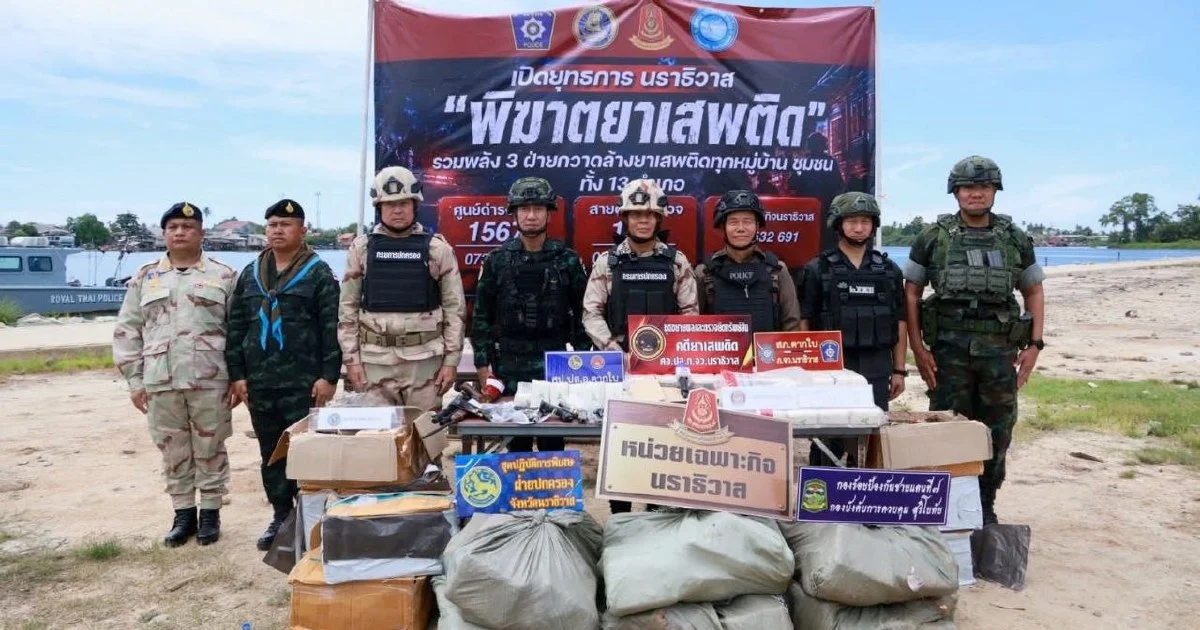
Thai law enforcement agencies have disrupted a significant cross-border narcotics operation through the arrest of 233 individuals suspected of involvement in major drug trafficking networks across Narathiwat province. The month-long enforcement campaign, conducted in the Thai-Malaysian border region, has yielded substantial intelligence regarding trafficking connections that extend into Malaysian territory, reflecting the increasingly complex nature of Southeast Asian drug smuggling operations.
The scale of the operation underscores the persistent challenge facing Thai and Malaysian authorities in combating organised crime syndicates that exploit the porous borders between the two nations. Narathiwat, a strategically positioned province in Thailand's deep south, has long served as a transit point for narcotics moving throughout the region. The province's geography, with its proximity to Malaysia and multiple informal crossing points, has made it an attractive corridor for trafficking groups seeking to move contraband across international boundaries with minimal detection.
Among those arrested are individuals suspected of maintaining direct operational links with Malaysian traffickers, suggesting a well-established supply chain that coordinates activities on both sides of the border. Such cross-border connections are particularly concerning for regional law enforcement, as they indicate sophisticated criminal infrastructure capable of navigating multiple jurisdictional systems and leveraging the complexities of international cooperation to evade detection. The discovery of Malaysia-linked suspects during the Thai operation provides valuable evidence of how trafficking networks operate as transnational enterprises rather than isolated criminal groups confined to single countries.
The month-long nature of the Thai crackdown demonstrates an increasingly proactive approach to counter-narcotics work in Southeast Asia, moving beyond reactive responses to criminal activity toward sustained, intelligence-led operations targeting entire networks simultaneously. This methodology, which requires coordination across multiple police units and sustained resource commitment, has proven more effective at dismantling trafficking infrastructure than traditional enforcement approaches. By maintaining pressure over an extended period, authorities can identify secondary and tertiary connections within networks, leading to more comprehensive arrests.
For Malaysian authorities, the revelation of local connections to this Thai-based operation carries significant implications. Malaysia sits at a critical juncture in Asia's drug trade, serving as both a transit country for narcotics bound for international markets and a destination market itself. The involvement of Malaysian traffickers in operations conducted across the border highlights how easily criminal networks exploit Malaysia's geographical position and port infrastructure to move drugs through the region. This finding should prompt Malaysian law enforcement to intensify scrutiny of trafficking routes connecting the two countries, particularly along the Kelantan border region proximate to Narathiwat.
The estimated value of RM1.2 million in drugs represents substantial contraband by regional standards, reflecting the commercial scale at which these networks operate. Such figures underscore that trafficking organisations are managing operations involving millions of ringgit in narcotics annually. The financial scale incentivises recruitment of low-level operatives, corrupts officials, and finances further criminal activities, creating a self-perpetuating cycle that authorities must actively disrupt through sustained enforcement pressure.
Intelligence gathered during the Thai operation should facilitate enhanced information-sharing between Malaysian and Thai law enforcement agencies, particularly regarding the identities and operational methods of traffickers identified during the crackdown. Regional cooperation mechanisms, including joint task forces and intelligence exchanges, provide frameworks through which both nations can leverage findings from cross-border operations to strengthen their respective domestic enforcement efforts. The effectiveness of such cooperation remains variable, however, and requires political commitment to prioritise drug enforcement alongside other security concerns.
The involvement of suspected Malaysian traffickers in Thai-based operations also illuminates the regional dimension of Southeast Asian drug markets. Trafficking groups increasingly operate across multiple countries, establishing supply chains that move product from production areas in the Golden Triangle or Golden Crescent through processing facilities and transit points in Thailand, Malaysia, and Singapore before reaching final markets. Understanding these networks as interconnected systems rather than isolated national problems is essential for developing effective counter-strategies.
For Malaysian citizens, the arrest of local traffickers abroad serves as a stark reminder of the severe legal consequences associated with involvement in international drug trafficking. Thai courts impose harsh penalties for trafficking offences, including lengthy prison sentences and, in extreme cases, capital punishment. Malaysian nationals convicted of serious drug offences in foreign jurisdictions have limited recourse to diplomatic assistance, making prevention of initial involvement the most effective protection against catastrophic legal outcomes.
The ongoing challenge of border trafficking between Thailand and Malaysia reflects broader difficulties in policing Southeast Asia's permeable frontiers. Despite advances in surveillance technology and inter-agency cooperation, trafficking networks continue to identify vulnerabilities in enforcement systems. Addressing this problem requires not only increased police resources but also attention to underlying factors that facilitate smuggling, including poverty in border communities, limited economic opportunities, and weakness in governance structures that allow corruption to flourish.
Both Thai and Malaysian authorities have indicated commitment to enhanced cooperation on narcotics enforcement, yet sustained political will and adequate funding remain essential for translating commitments into results. The arrest of 233 suspects represents a significant tactical success, but the fundamental architecture of trafficking networks—their ability to adapt, recruit replacements, and shift operations—ensures that single operations, however extensive, cannot alone resolve trafficking challenges. Long-term success requires sustained institutional investment in intelligence capacity, inter-agency coordination, and cross-border cooperation mechanisms.

