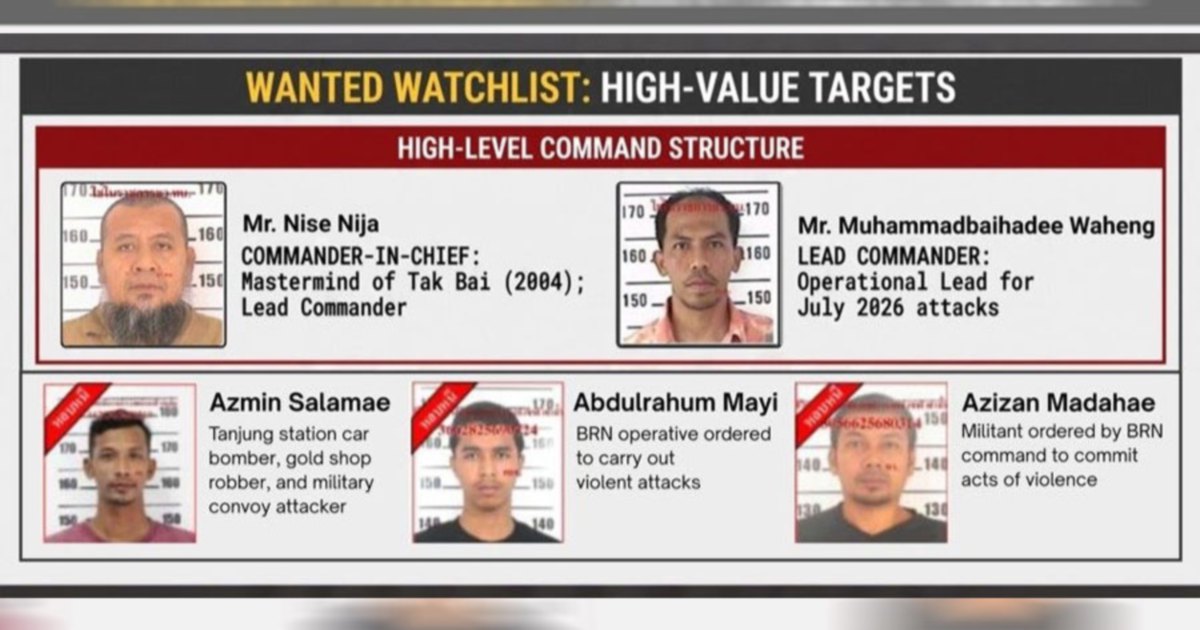
Thai law enforcement agencies have widened their investigation into a deadly attack on a government security post, issuing arrest warrants for five individuals suspected of orchestrating the ambush that occurred on Bukit Sami Municipal Road in the Tanjong Mas area of Ra-ngae district, Narathiwat, on July 22. The escalating security incident underscores the persistent instability in Thailand's restive southern provinces, where armed groups have conducted sporadic attacks on state personnel and infrastructure for decades.
The ambush represents another flashpoint in the long-running insurgency affecting Thailand's three southernmost provinces—Narathiwat, Yala, and Pattani. These regions, which were historically part of the Pattani kingdom before incorporation into Thailand in the early twentieth century, have experienced recurring cycles of violence linked to separatist movements and criminal networks. The incident on Bukit Sami Municipal Road demonstrates that despite years of counterinsurgency operations and peace dialogue attempts, militants continue to target security checkpoints and government personnel.
Narathiwat province, bordering Malaysia, has become a focal point for security concerns affecting the broader Southeast Asian region. The province's strategic location near Kota Baru in Kelantan makes incidents there particularly significant for Malaysian authorities and residents, as violence or instability can influence cross-border dynamics and affect communities on both sides of the international boundary. Malaysian law enforcement agencies typically coordinate with Thai counterparts regarding security matters in this sensitive frontier zone.
The decision to issue formal arrest warrants signals that Thai investigators have gathered sufficient evidence to identify the five suspects and believe they possess credible leads on their whereabouts. Thai police and military units in the southern region typically employ a combination of intelligence gathering, witness testimony, and forensic analysis to construct cases against suspected militant operatives. The formal warrant process represents an escalation from initial investigative phases toward active apprehension efforts.
Security checkpoints throughout Thailand's southern provinces serve as critical infrastructure for government control and intelligence gathering. However, they remain vulnerable to coordinated attacks by armed groups familiar with local terrain and security patterns. Personnel manning these posts face constant risks despite protective measures, making each incident a reminder of the operational challenges faced by Thai security forces in maintaining order across dispersed, often remote areas with challenging geography.
The timing and nature of the July 22 attack may provide clues to investigators about the perpetrators' identity and motivation. Different militant factions operating in the region employ varying tactics and demonstrate different levels of organizational sophistication. Some attacks reflect spontaneous opportunism, while others suggest careful planning and resource allocation by structured insurgent groups. Thai authorities typically analyse attack patterns to distinguish between various factions and adjust counter-operations accordingly.
This incident occurs within a broader context of intermittent violence that has claimed thousands of lives since the insurgency intensified in 2004. While the intensity of attacks has fluctuated over the years, security forces report that militants retain the capacity to strike government targets despite sustained counter-terrorism operations. The persistence of such violence reflects the complex interplay of historical grievances, religious identity, separatist aspirations, and criminal opportunism that characterise the southern conflict.
For Malaysian observers, the Narathiwat incident carries particular relevance given Malaysia's role as a regional stakeholder in southern Thailand's stability. Over the years, Malaysia has hosted peace talks between the Thai government and rebel groups, provided humanitarian assistance to displaced persons, and cooperated on cross-border security matters. Violence in Narathiwat can influence migration patterns, refugee flows, and the broader regional security environment that affects Malaysian national interests.
The arrest warrant issuance indicates that Thai police believe they can make progress through conventional law enforcement channels. However, past experience suggests that apprehending suspects in remote areas with sympathetic populations presents significant operational challenges. Effective arrests typically require careful intelligence work, coordination between different security agencies, and sometimes negotiated surrenders rather than forceful captures that might provoke wider community backlash.
International observers note that sustainable resolution of southern Thailand's violence requires addressing underlying political, economic, and social grievances alongside security operations. However, progress on comprehensive peace agreements has remained halting despite multiple negotiation attempts. The pattern of continued attacks suggests that significant segments of the militant community remain unconvinced by current government approaches to conflict resolution.
As Thai authorities conduct their manhunt for the five suspects, the incident will likely influence security operations and intelligence priorities across the southern provinces in coming weeks. Malaysian security agencies may also enhance monitoring along border areas, given the potential for suspects to flee across the international boundary if pursued aggressively. The case demonstrates how security challenges in one country can create ripple effects affecting neighbouring nations and requiring coordinated regional responses.
The investigation's outcome—whether resulting in arrests, intelligence gains, or operational disruptions—will contribute to the broader assessment of how effectively Thai security forces can address militant threats in the region. Each successful prosecution may deter some attacks, while failure to apprehend suspects could embolden armed groups. The five individuals now sought remain at large, and their capture would represent a tactical victory for Thai law enforcement in their ongoing struggle against insurgent violence in the troubled south.

