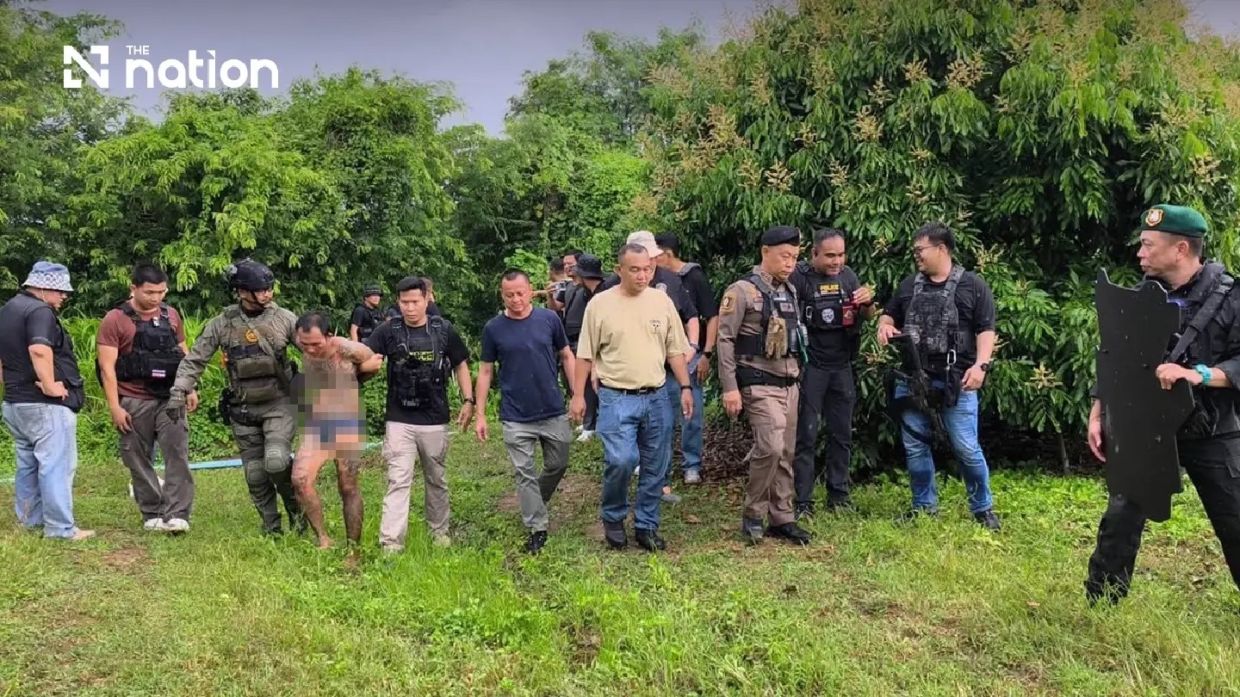
Thai police in Chonburi are examining what appears to be a coordinated series of murders spanning two separate incidents that have claimed the lives of five people: a pair of Russian siblings and a three-member Thai family. Two suspects identified as Pong and Thong are currently in custody facing questioning, whilst investigators actively search for two other alleged participants believed to remain in the immediate vicinity. The murders are believed connected by a consistent modus operandi—perpetrators impersonating law enforcement officers—and a shared motive centring on the theft of vehicles from their victims.
The discovery of two bodies buried together in a wooded section of Huai Yai subdistrict initially sparked the broader investigation. The deceased Russian siblings were identified as Diana Nazimova, aged 22, and her brother Roman Nazimova, who was only 17 years old. The subsequent uncovering of additional remains in a nearby coconut plantation revealed the bodies of three Thai nationals: Wichian, a 53-year-old man, Chantana, aged 50, and Nichapha, an 18-year-old woman. Relatives of the Thai family had reported them missing to Huai Yai police on 27 June after losing all contact with them. The convergence of evidence from both burial sites pointed investigators toward a shared criminal enterprise rather than isolated incidents.
According to police statements, the modus operandi employed in both killings followed a remarkably similar pattern that underscores the calculated nature of the crimes. The suspects would arrive at locations, present themselves as police officers conducting official searches, and then physically restrain their victims before transporting them to secluded wooded areas. In the case of the Russian siblings, investigators determined that the male victim sustained gunshot injuries whilst the female victim bore evidence of severe physical trauma. Forensic examination of the Thai family's remains indicated the male victim also suffered gunshot wounds, though preliminary medical assessments found no indications of sexual assault in either case.
The vehicle theft element emerges as the apparent financial motivation driving these killings. In the Russian siblings' case, police allege the suspects targeted a motorcycle, which was subsequently hidden and later dismantled to obscure evidence and facilitate the sale of component parts. However, when public attention intensified around the disappearances, the suspects allegedly buried the motorcycle parts rather than risk attempting to sell them. Similarly, in the Thai family murder, the perpetrators allegedly commandeered the family's pickup truck, with one of the suspects claiming during interrogation that the vehicle was intended for use in transporting illegal narcotics—a claim authorities have not yet independently verified through investigation.
The suspects have provided conflicting accounts regarding their respective roles and the circumstances surrounding the violence, adding layers of complexity to the ongoing investigation. Thong has allegedly claimed that Pong bore primary responsibility for the violent actions, whilst Pong has reportedly asserted that the male victim in the Russian case actively resisted their actions and that the female victim died accidentally during a physical struggle. These competing narratives remain unverified allegations under investigation, and police authorities under Pol Lt Gen Chatchai Surachetphong, commissioner of Provincial Police Region 2, have indicated that several portions of the suspects' statements align with physical evidence gathered at the crime scenes.
One particularly troubling dimension of the case involves Thong's alleged justification for participation in the murders. According to reports from interrogation, Thong claimed he acted under duress, fearing that Pong might harm his family members if he refused to participate in the crimes. This defence raises important questions about the dynamics within the alleged criminal group and whether coercion played a role in the criminal enterprise. Meanwhile, investigators are actively reviewing Pong's background history, particularly noting that he had been released from prison merely two months before the killings occurred, suggesting the possibility of rapid recidivism or a resumption of criminal activity following his release.
The investigation has now expanded to consider whether the four identified individuals—Pong, Thong, Ball, and another associate—might be connected to additional unsolved crimes beyond these two cases. The combined death toll of five victims has prompted authorities to examine their arrest records, associates, and movements more broadly. Police allege that these four individuals coordinated the attack on the Thai family's residence, arriving late at night, restraining the parents, and apprehending the daughter when she returned from a convenience store visit. All three family members were then transported away in their own pickup truck, which would later be seized by the perpetrators.
The ongoing manhunt for the two remaining alleged accomplices represents a critical phase of the investigation. Police sources have stated their belief that Ball and Fluke—the two suspects not yet in custody—remain in the Chonburi area and are under close surveillance. The decision to maintain surveillance rather than immediately apprehend suggests either insufficient evidence for formal charges at this stage or operational tactics designed to identify additional connections or accomplices through continued monitoring. As forensic evidence continues to be processed and compared against the suspects' statements, the investigation may yet expand further.
For regional observers, this case underscores persistent security challenges in Thailand's eastern provinces and raises concerns about organised criminal networks operating with apparent impunity. The deliberate impersonation of police officers by these suspects represents a particularly egregious violation of public trust and institutional authority. The presence of Russian nationals among the victims also highlights the international dimensions of criminal activity in Thailand and the potential involvement of foreign organised crime networks or transnational criminal enterprises. As Malaysia and other Southeast Asian nations grapple with similar challenges of organised crime and corruption, the evolution of this investigation will likely provide valuable intelligence for regional law enforcement agencies working to combat sophisticated criminal syndicates operating across borders.

