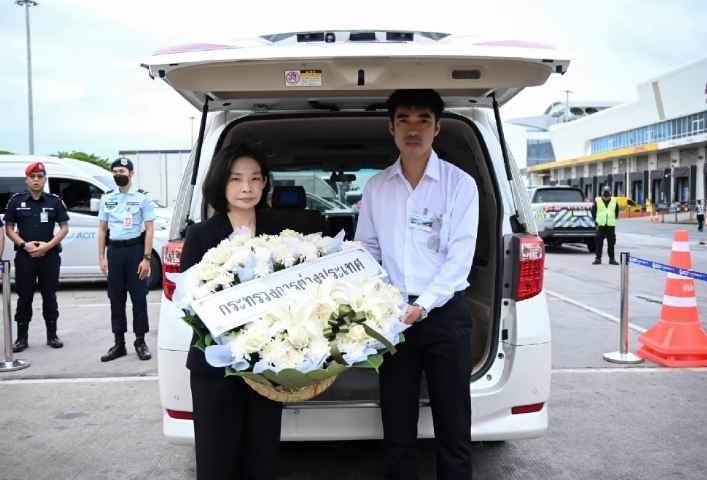
Thailand's Ministry of Foreign Affairs has completed the repatriation of travel content creator Bavorntat Pengsuk, the widely followed YouTuber known online as 'Hlun Solo', following his unexpected death in the Georgian capital last month. The 27-year-old expired in Tbilisi on 14 July, prompting coordinated diplomatic efforts to return his remains to his family and homeland. Deputy Prime Minister and Foreign Minister Sihasak Phuangketkeow delegated Prathuangtip Sirivithes, acting director-general of the Department of Consular Affairs, to lead the reception process upon the remains' arrival in Thailand, according to Jaithai Upakarnitikaset, spokesperson for the ministry and director-general of its Department of Information.
The repatriation marks the conclusion of weeks of diplomatic coordination between Thai officials and Georgian authorities. The Royal Thai Embassy in Ankara initiated contact with Bavorntat's family, local Georgian government bodies, and other stakeholders immediately upon learning of his death. This proactive engagement proved essential in navigating what the Foreign Ministry characterised as administrative obstacles that had initially delayed the return of the remains. Embassy personnel travelled to Tbilisi without delay to investigate the circumstances surrounding his death, manage the practical complexities of international repatriation, and apply pressure on Georgian counterparts to expedite procedures that had stalled.
Bavorntat's case reflects the broader challenges facing families when loved ones die abroad, particularly in distant or unfamiliar jurisdictions. As a popular content creator with a substantial following, his death generated significant public attention in Thailand, intensifying expectations that authorities would act swiftly. The Foreign Ministry's hands-on approach—including direct embassy intervention and high-level ministerial coordination—underscores how Thailand's diplomatic machinery mobilises for cases involving prominent citizens. For Malaysian travellers and content creators operating across Southeast Asia and beyond, the incident illustrates the importance of maintaining strong consular support networks and clear communication channels with embassy officials when tragedy strikes overseas.
Following arrival in Thailand, Bavorntat's family determined that a comprehensive forensic examination would be necessary before proceeding with funeral arrangements. This decision reflects standard medical and legal practice in cases where the exact cause of death requires clarification, particularly when the deceased has been abroad and subjected to different investigative protocols. The forensic process will establish definitive medical facts, potentially ruling out complications or clarifying circumstances that remain unclear. Such examinations are routine in Thailand's judicial and medical systems and provide families with complete understanding of what occurred.
Once the forensic investigation concludes, the body will travel to Bavorntat's birthplace in Somdet district, located in Kalasin province in northeastern Thailand. This journey homeward carries profound cultural significance in Thai tradition. His family plans to conduct full Buddhist funeral rites according to religious custom, allowing the community to pay respects and participate in ceremonies that mark the passage from life and guide the deceased's spiritual transition according to Thai Buddhist doctrine. These rituals, conducted within the family's hometown context, represent the final stage of honouring Bavorntat's life and legacy.
Bavorntat had built a substantial online presence through travel content creation, documenting journeys and experiences that resonated with audiences across Thailand and Southeast Asia. His decision to travel extensively and share those adventures through digital platforms reflected a broader generational trend of tourism combined with content monetisation—a lifestyle increasingly common among young Southeast Asians. His presence in Georgia, a destination that has grown more accessible to Thai tourists in recent years, reflected the widening geographic scope of travel influencers seeking novel locations and fresh content opportunities. The tragic circumstances of his death abroad serve as a sobering reminder of the vulnerabilities faced by independent travellers, regardless of their fame or financial resources.
The Foreign Ministry's coordination in this case also demonstrates Thailand's commitment to consular support for its nationals overseas. By positioning high-level officials to oversee reception procedures and deploying embassy staff to manage practical logistics, authorities signalled that Thai lives abroad remain a priority concern. This approach contrasts with scenarios in some countries where repatriation processes move more slowly or receive less official attention. For Thai citizens and their families confronting similar tragedies, the precedent established here—combining rapid diplomatic engagement, direct investigation, and ministerial oversight—sets a standard for official responsiveness.
The incident has broader implications for travel safety and digital content creation as professions. As more young people in Thailand and across Southeast Asia pursue careers in digital media, travel vlogging, and online content creation, questions about insurance, emergency protocols, and official support structures become increasingly relevant. While Bavorntat's case involved exceptional government engagement due to his public profile, it raises awareness about what services and protections should be available to ordinary Thai travellers facing emergencies or deaths abroad. Families, embassies, and online platforms are gradually developing clearer frameworks for addressing such incidents, informed partly by high-profile cases like this one.
The repatriation also underscores evolving regional connectivity and the reality that Southeast Asians increasingly travel far beyond their home countries. Georgia, located at the intersection of Europe and Asia, has become an accessible destination for tourists seeking relatively affordable experiences and novel environments. Thai travellers have increasingly ventured to the Caucasus region, viewing it as an emerging frontier for adventure and content creation. The challenge for diplomatic services across the region lies in ensuring adequate consular capacity and responsiveness across expanding geographic footprints of their nationals' travels, a reality that Bavorntat's case has brought into sharper focus.

