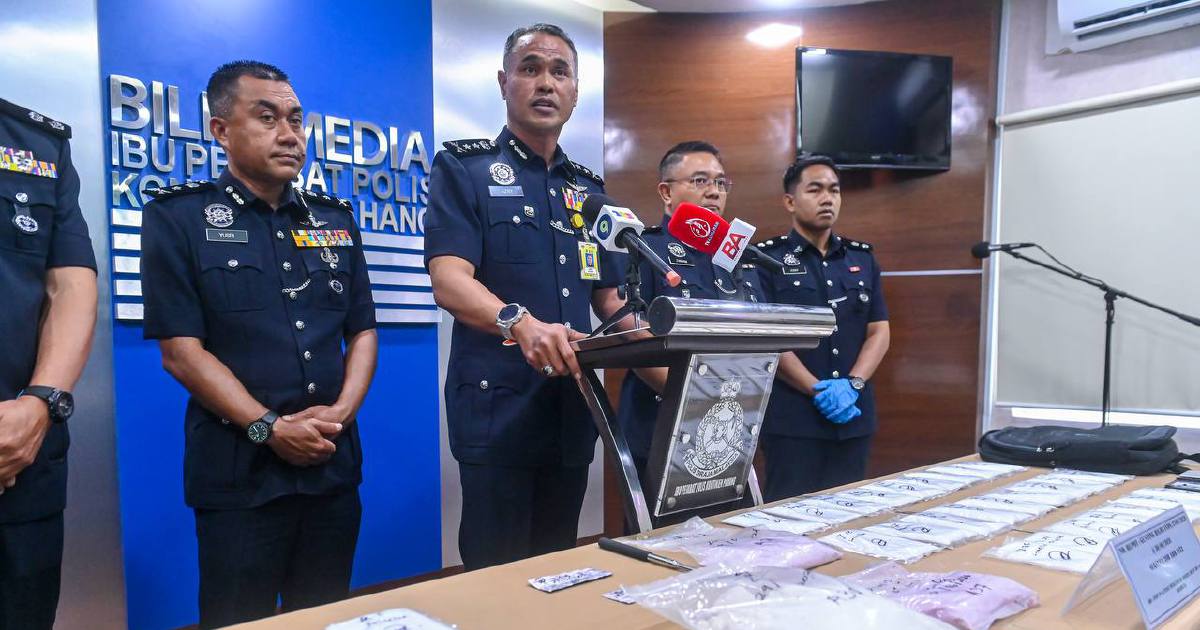
Authorities in Pahang have apprehended a Thai national and her partner following a significant narcotics seizure in the Bentong district. The arrests unfolded in Genting Permai, where enforcement officers recovered contraband estimated at RM728,000, marking another notable success in the region's ongoing battle against organised drug trafficking.
Investigators allege that the couple had been functioning as couriers within a broader drug distribution network for approximately three months prior to their detention. The operational structure suggests a coordinated, longer-term arrangement rather than isolated criminal activity, indicating the involvement of established trafficking infrastructure. This pattern of engagement over an extended timeframe points to the sophistication of the syndicate they allegedly served, which often employs multiple operatives across different roles to insulate leadership from direct law enforcement exposure.
The Bentong location holds particular significance within Malaysia's drug enforcement landscape. Positioned between Kuala Lumpur and the East Coast, the district serves as a critical transit corridor where traffickers frequently attempt to move narcotics between major urban centres and distribution points. The geography makes interception efforts challenging, as multiple routes and local knowledge can facilitate evasion. Genting Permai specifically represents a residential area where illicit operations can blend into legitimate community activity, making surveillance and intelligence gathering essential components of effective policing in such zones.
The RM728,000 valuation reflects the street value of confiscated substances, providing a quantifiable measure of the bust's impact on local supply networks. Such seizures represent not merely the removal of products from circulation, but also significant financial losses to criminal enterprises. For syndicates operating on thin operational margins and dependent on consistent revenue flows, interruptions of this magnitude can disrupt planned distribution schedules and create internal friction as subordinates attempt to account for losses.
Their alleged role as couriers underscores a common trafficking organisational model. Syndicates typically recruit relatively expendable personnel to handle the highest-risk aspects of operations—the physical transportation and delivery of contraband. By positioning couriers at the front line, senior traffickers maintain distance from direct involvement, making prosecutorial success more difficult. Couriers are often selected based on perceived vulnerability to recruitment pressure, whether through debt obligations, substance dependence, or family circumstances. The recruitment of a Thai national suggests international dimensions to the operation, possibly indicating a broader supply chain extending into sources beyond Malaysia's borders.
The three-month operational window provides investigators with a temporal framework for expanding their enquiries. During this period, the couple presumably completed multiple runs or deliveries, creating opportunities for additional intelligence gathering. Colleagues, recipients, and associates within the network may be identifiable through transaction records, communications data, or surveillance information accumulated during the investigation phase. Malaysian law enforcement agencies have demonstrated increasing sophistication in mapping such networks through financial analysis and digital forensics, potentially enabling dismantling of wider structures beyond the immediate arrests.
This arrest contributes to broader enforcement efforts addressing transnational drug trafficking through Southeast Asia. Thailand remains a significant source jurisdiction for narcotics entering Malaysian markets, particularly for stimulant-type substances. The involvement of a Thai national in a Malaysian-based courier operation reflects the permeable nature of borders in the region and the mobility of criminal actors across jurisdictions. Cooperation between Thai and Malaysian law enforcement agencies, while improving, remains essential for addressing root supply issues and disrupting trafficking at source.
The detention also highlights the operational risks courierss accept for relatively modest compensation compared to the profits reaped by higher-level participants. Individuals recruited into such roles frequently receive payment substantially lower than the street value of products they transport, creating an economically vulnerable workforce upon which trafficking enterprises depend. Legal consequences for courier-level operators typically prove severe, with mandatory minimum sentences for drug trafficking creating powerful deterrent effects, yet recruitment continues as economic desperation and supply-side pressure drive persistent demand for movement services.
Enforcement successes like this depend on intelligence development and coordinated operations between multiple policing divisions. The Bentong arrest likely resulted from months of investigation, informant development, or surveillance operations undertaken by Pahang state police or federal task forces. The specificity of the location—Genting Permai—suggests targeted enforcement rather than random searches, indicating that officers possessed prior knowledge or intelligence regarding suspicious activity in that area. Such targeted approaches prove more cost-effective than blanket enforcement strategies.
Further investigative progression will focus on tracing the supply chain both upstream toward primary sources and downstream toward end-distribution points. Interrogations of the arrested individuals will attempt to establish network structure, identifying other participants, storage locations, and financial arrangements. Police will likely pursue asset tracing to identify criminal proceeds and disrupted business infrastructure. Court proceedings will determine whether charges carry mandatory death penalties, life imprisonment, or lesser sentences depending on drug quantities and involvement classifications.
The seizure reinforces that Malaysia remains an attractive transit and distribution jurisdiction for traffickers despite strengthened enforcement measures. The profits generated from large-scale movements, combined with porous borders and high local demand, create persistent vulnerabilities. Regional cooperation frameworks, shared intelligence mechanisms, and coordinated enforcement operations across ASEAN member states represent essential components of any comprehensive response to trafficking challenges that inevitably transcend national boundaries.

