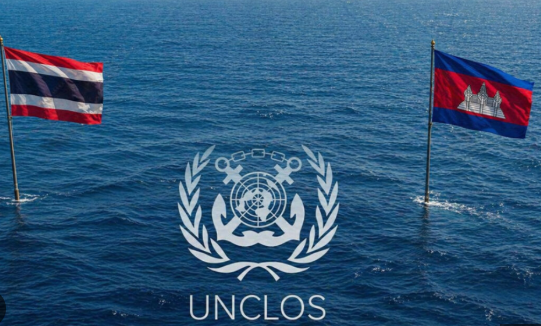
Thailand has formally accepted Cambodia's bid to resolve their Gulf of Thailand maritime boundary dispute through compulsory conciliation under the 1982 United Nations Convention on the Law of the Sea, though Bangkok has made clear it views the process as advisory rather than legally definitive. The Thai Ministry of Foreign Affairs submitted its formal response on June 19, following Cambodia's June 2 notification, positioning conciliation as a framework to facilitate dialogue rather than replace direct country-to-country talks. This carefully calibrated stance reflects Thailand's determination to maintain negotiating leverage while demonstrating commitment to international dispute resolution mechanisms that have become increasingly important in Southeast Asian maritime affairs.
The composition of the conciliation commission reveals how both nations are approaching this technical but politically sensitive process. Thailand appointed Deputy Prime Minister and Foreign Minister Sihasak Phuangketkeow as its Agent, signalling the dispute's strategic importance at the highest levels of government. Supporting him is Songchai Chaipatiyut, Thailand's ambassador to Kuwait and a former senior official at the Department of Treaties and Legal Affairs, whose appointment underscores Bangkok's emphasis on legal expertise. Thailand's two nominated conciliators—Judge Albert J Hoffmann of South Africa and Judge Rudiger Wolfrum of Germany—were described by the ministry as internationally recognized experts in maritime law, a selection that balances regional concerns about bias by choosing non-Asian jurists.
The procedural mechanics established under UNCLOS Annex V create a structured but ultimately advisory framework. The four conciliators appointed by both Thailand and Cambodia have 30 days to select a fifth chair, after which the full commission will have approximately 12 months to produce its report and recommendations. This timeline, while extensible by mutual consent, reflects international best practices for conciliation processes that must balance thorough investigation with the practical demands of resolving disputes affecting resource development and regional stability. Thai officials have been explicit that conciliators function as neutral facilitators rather than judges, tasked with understanding the dispute's context and identifying common ground rather than imposing legal conclusions.
Thailand's insistence that the conciliation process remains non-binding reflects deeper concerns about maintaining control over resource development decisions in contested waters. The Gulf of Thailand contains significant natural gas and hydrocarbon reserves that have long been central to both nations' energy security and economic calculations. By characterizing the conciliation outcome as recommendations for future negotiation rather than binding determinations, Thailand preserves its ability to reject proposals it deems unfavorable to its interests or incompatible with its legal position. This distinction carries substantial weight in Southeast Asia, where maritime disputes often involve overlapping claims to economically valuable seabeds and where smaller nations remain wary of international processes that might subordinate bilateral leverage to multilateral authority.
A fundamental point of contention between the parties concerns the conciliation's scope. Thailand has consistently maintained that the process should address exclusively maritime boundary delimitation—the technical question of where one country's claims end and another's begin. Cambodia, meanwhile, appears to view conciliation as an opportunity to address broader maritime cooperation issues, including provisional arrangements for joint resource development and equitable benefit-sharing arrangements. This disagreement echoes long-standing tensions in the region about whether maritime disputes should be resolved purely through legalistic boundary-drawing or whether they should incorporate development and resource-sharing considerations that reflect the actual interests driving the dispute.
The recent termination of the 2001 Memorandum of Understanding, which the Thai Cabinet approved in May, provides important context for understanding why Cambodia pursued the UNCLOS route. That agreement, referred to in Thailand as MoU 44, had offered a framework for managing overlapping maritime claims to the continental shelf for a quarter-century, yet produced minimal concrete progress. Prime Minister Anutin Charnvirakul attributed the cancellation to stagnation rather than deteriorating relations, presenting the decision as a structural reset designed to move beyond a framework that had become inadequate. However, the termination also reflected Bangkok's frustration with an arrangement that had constrained its freedom of action while yielding little tangible advancement toward resolving the underlying boundary question.
Thailand's stated commitment to using UNCLOS as a common reference point for future negotiations suggests Bangkok views the convention less as a binding legal framework and more as a shared vocabulary for technical discussion. Both nations are now parties to UNCLOS, creating mutual obligations to pursue peaceful resolution of maritime disputes, yet Thailand's interpretive approach treats the convention as establishing principles and procedures while preserving substantial national discretion in implementation. This reflects a broader Southeast Asian pattern of adopting international conventions while maintaining considerable flexibility in interpretation and application, particularly regarding disputes with economic significance.
Cambodia's decision to invoke compulsory conciliation, framed as a desire for peaceful resolution through international law, presents Bangkok with a calculated diplomatic challenge. By accepting the process, Thailand demonstrates commitment to international legal norms and avoids appearing obstructionist, considerations that matter in regional perception and in relations with third parties concerned about maritime stability. Simultaneously, by continuously emphasizing the non-binding character of any recommendations, Thailand signals that conciliation constitutes one avenue among many rather than a pathway toward predetermined outcomes. This dual positioning allows Bangkok to participate in the international process while maintaining its negotiating posture and ultimately requiring bilateral agreement for any resolution.
The appointment of experienced legal specialists and internationally respected maritime experts by both sides indicates serious engagement with technical substance, yet the non-binding framework suggests the conciliation process will function more as enhanced mediation than as quasi-judicial determination. The conciliators will examine maritime law principles, historical claims, geographical features, and equitable considerations, producing recommendations that could theoretically shape negotiating positions. However, without binding authority, either party can ultimately reject recommendations deemed incompatible with core interests. For Malaysia and other Southeast Asian observers, this case demonstrates how even UNCLOS procedures can accommodate continued bilateral leverage, a pattern likely to influence how regional states approach maritime dispute resolution.
The broader implications for Southeast Asian maritime stability remain uncertain. If conciliation produces recommendations acceptable to both parties, it could establish a framework for joint development or boundary delimitation that would reduce ambiguity and support investment in offshore resource development. If recommendations prove unacceptable to either side, the process might merely clarify positions without advancing resolution, potentially leaving the dispute in an extended holding pattern. Thailand's careful positioning—accepting conciliation while refusing to be bound by its outcomes and reserving bilateral negotiation as the ultimate forum—reflects the fundamental tension between desire for international legitimacy and determination to preserve national agency in resolving disputes that carry significant economic and strategic weight.