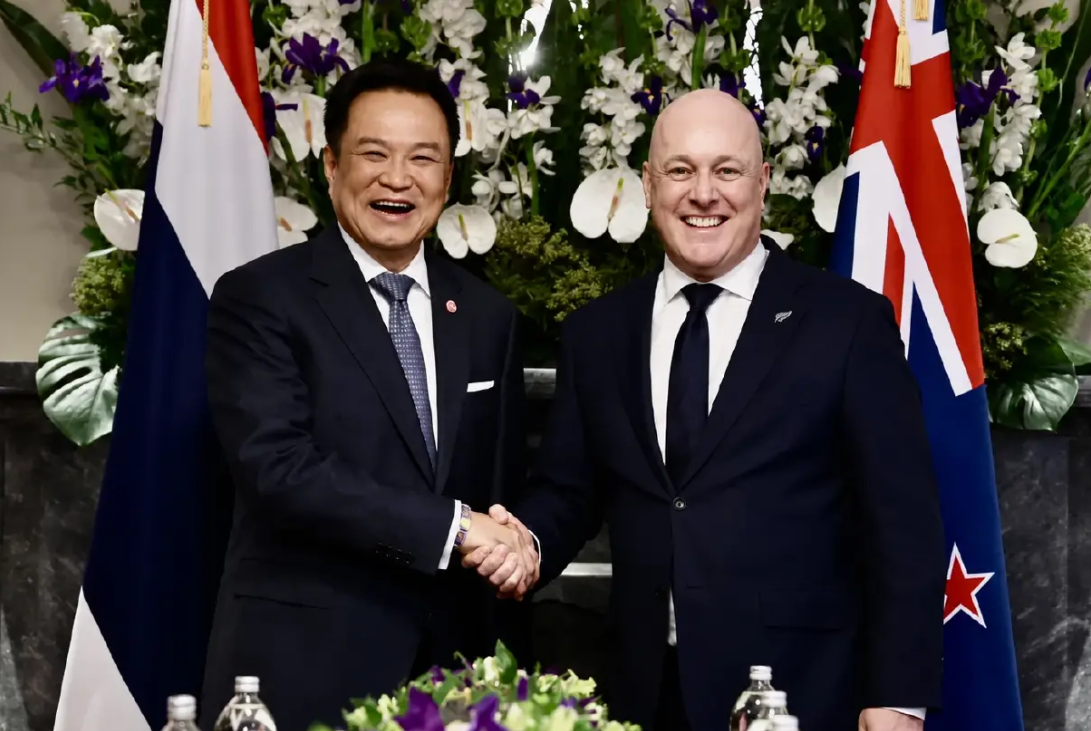
Thailand and New Zealand have taken a significant step in deepening their diplomatic relationship by formalising a strategic partnership, marking a watershed moment as the two nations commemorate seven decades of formal relations. Prime Minister Anutin Charnvirakul and his New Zealand counterpart Christopher Luxon signed the Joint Declaration on the Strategic Partnership during bilateral talks at Government House in Wellington on Friday, establishing a framework intended to unlock new opportunities across multiple sectors. The upgrade reflects both nations' commitment to moving beyond traditional cooperation into a more comprehensive and mutually beneficial engagement that addresses contemporary regional challenges and economic opportunities.
Central to this partnership elevation is an ambitious economic agenda. The two countries have committed to tripling their current bilateral trade volumes to reach US$7.5 billion—approximately 246 billion baht—by 2045, a target that underscores the considerable untapped potential in their commercial relationship. This goal reflects confidence in both economies' growth trajectories and the complementary nature of their industries, particularly in agriculture, food processing, and technological innovation. To facilitate this expansion, both governments will deepen the Thailand–New Zealand Closer Economic Partnership, a mechanism designed to remove barriers and create more attractive conditions for business investment and entrepreneurial activity across borders.
The strategic partnership framework rests on four interconnected pillars that address the full spectrum of bilateral engagement. The political and security dimension prioritises coordinated responses to transnational challenges that threaten stability in both nations and the broader Indo-Pacific region. Thailand and New Zealand have agreed to enhance cooperation on combating transnational crime networks, tackling the proliferation of sophisticated online scams that increasingly target citizens in both countries, and addressing human trafficking through improved law-enforcement coordination. This security cooperation reflects recognition that organised crime and illicit activities transcend borders and require integrated intelligence-sharing and operational alignment between police and intelligence agencies.
Economic and innovation cooperation forms the second pillar, positioning both nations to benefit from emerging global opportunities. Beyond traditional trade expansion, the partnership emphasises innovation ecosystems, food security resilience, energy transition initiatives, and the development of sustainable agriculture practices that can serve as models for the broader Asia-Pacific region. New Zealand's expertise in agricultural sustainability and environmental stewardship aligns well with Thailand's agrarian base and growing investment in green technologies. The focus on the circular economy and conservation initiatives reflects shared values regarding environmental protection while maintaining economic viability—a balancing act increasingly central to development strategies across Southeast Asia.
Education and cultural exchange constitute the third pillar, recognising that durable international relationships are built on people-to-people connections and mutual understanding. The partnership envisages expanded cooperation in skills development, capacity-building programmes, and academic exchanges that expose professionals and students in both countries to international best practices. Cultural initiatives and educational scholarships will strengthen the human dimension of the relationship, creating networks of individuals with direct experience of each other's societies. For Malaysia and the broader region, this educational focus serves as a reminder of how bilateral partnerships can enhance human capital development and foster cross-cultural competence essential for navigating an interconnected world.
The fourth pillar encompasses regional and multilateral frameworks, positioning the Thailand–New Zealand partnership within the broader architecture of Asian regionalism and global governance. Both nations have committed to enhanced coordination through Mekong cooperation mechanisms, ASEAN-led forums, Asia-Pacific Economic Cooperation structures, and other international organisations. This commitment reflects understanding that bilateral relationships gain additional resonance and impact when aligned with regional initiatives. For Southeast Asian observers, this dimension is particularly significant as it demonstrates how middle powers can leverage their participation in multilateral frameworks to amplify their influence while contributing constructively to regional stability and prosperity.
The resumption of direct aviation services between Bangkok and Auckland represents a tangible manifestation of partnership elevation, with Thai Airways targeting March 2027 for restoration of the route. This connectivity initiative addresses a critical gap in the current travel infrastructure linking Southeast Asia to the Southwest Pacific. Direct flights will reduce journey times significantly, lowering costs for tourists, business travellers, and students, thereby facilitating the people-to-people connections both governments prioritise. The route is expected to catalyse increased visitor numbers, support trade transactions through reduced transaction costs, and enable educational institutions to develop stronger institutional partnerships. For Malaysia, the restoration of this service underscores how regional connectivity investments can generate spillover benefits for neighbouring economies through enhanced tourism competition and business opportunities.
Anutin's explicit commitment to pursuing earlier restart of the route demonstrates political will to accelerate the partnership's tangible benefits. The timing of March 2027 appears achievable but represents a compressed timeline requiring coordination between civil aviation authorities, airline operations, and airport infrastructure providers. Should this timeline accelerate, it would reflect how elevated political relationships can translate into accelerated implementation of infrastructure projects. The aviation connectivity initiative also supports Thailand's broader tourism diversification strategy, as New Zealand tourists represent a valuable market segment with strong purchasing power and preference for authentic cultural experiences and sustainable tourism practices.
Security cooperation dimensions deserve particular attention for Malaysian analysts. The bilateral agreement between the Royal Thai Police and New Zealand Police on partnership and mutual information exchange establishes mechanisms for coordinating responses to transnational challenges. The explicit focus on online scams reflects a shared vulnerability to sophisticated criminal networks operating across borders. New Zealand's advanced cybercrime investigation capabilities and Thailand's regional positioning create synergies valuable for addressing digital security threats affecting businesses and citizens throughout Southeast Asia. This cooperation model could potentially be extended or adapted through ASEAN frameworks to create more comprehensive regional responses to cybercrime.
Thailand's pursuit of OECD membership, with New Zealand's explicit endorsement, adds a dimension relevant to understanding Thailand's development aspirations and positioning within the global economy. OECD membership would signal Thailand's commitment to international standards on governance, transparency, and economic policy, while granting access to technical assistance and peer review mechanisms. New Zealand's support—as an OECD member with regional influence—carries weight in Thailand's advocacy efforts. For Southeast Asia, Thailand's potential OECD accession would represent significant institutional evolution, as it would make Thailand the first OECD member in mainland Southeast Asia, potentially reshaping regional economic governance dynamics.
The four cooperation documents signed during the visit span diverse domains: cultural cooperation, civil service education coordination, police partnerships, and private-sector collaboration between Chata Instruments Company Limited and Aeroqual Limited. This portfolio reflects comprehensive engagement beyond diplomatic declarations, with concrete institutional arrangements facilitating ongoing cooperation. The inclusion of private-sector agreements demonstrates how government-level strategic partnerships create enabling conditions for commercial relationships. The cooperation documents between education and civil service bodies will build capacity among Thai officials and educators, enhancing professional standards across both countries.
The 70th anniversary of diplomatic relations provides historical context for this partnership elevation. Decades of stable, if relatively low-profile, relations have created foundation for deeper engagement. The formal recognition of this anniversary alongside the strategic partnership announcement reflects both governments' desire to mark this milestone while signalling commitment to an expanded future. For regional observers, this timing illustrates how anniversary commemorations can serve as natural inflection points for relationship recalibration, enabling governments to propose ambitious new initiatives within a framework of historical continuity.
Looking forward, the Thailand–New Zealand Joint Plan of Action for 2026–2030 provides operational roadmap for translating strategic partnership commitments into measurable outcomes. The five-year timeframe allows sufficient duration for meaningful progress while creating accountability mechanisms through regular review processes. The explicit framing of partnership benefits for ordinary citizens—through tourism, education opportunities, employment in trade-related sectors, and cultural enrichment—suggests both governments recognise that sustainable international partnerships must deliver tangible improvements to citizens' lives. For Malaysia and other Southeast Asian nations, this partnership model offers instructive lessons regarding how middle-power diplomacy can leverage historical relationships and complementary capacities to generate mutual benefits while contributing to regional stability and prosperity.

