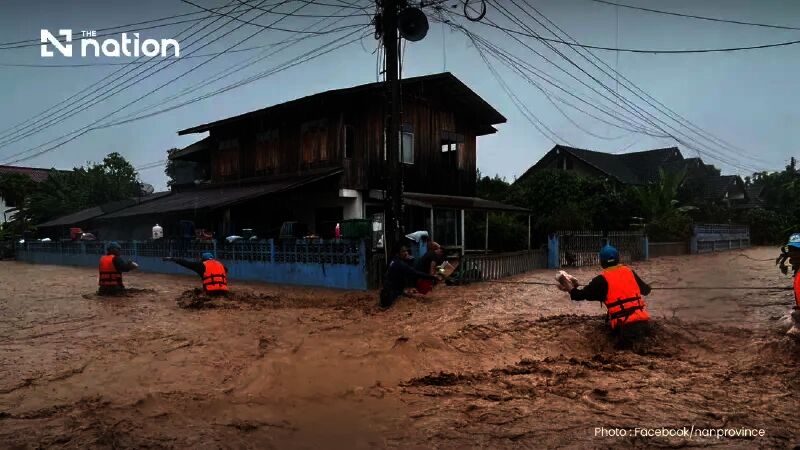
Thailand's government has formally designated Nan province in the north as a disaster zone following sustained heavy rainfall that has triggered dangerous flash flooding across the region. The declaration came as authorities simultaneously issued alerts for Phayao and Lamphun provinces, signalling the scale of the meteorological threat facing Thailand's northern tier. Government spokesperson Rachada Dhnadirek confirmed the announcement on Wednesday, describing rapidly deteriorating conditions that have severed critical road links and necessitated the evacuation of residents from vulnerable areas.
Prime Minister Anutin Charnvirakul, currently undertaking an official visit to Australia, has remained engaged with the unfolding crisis by issuing comprehensive directives to all relevant agencies and the armed forces to participate actively in disaster response operations. Despite being overseas, Anutin has maintained close monitoring of the situation and instructed that response mechanisms be activated swiftly to protect affected communities. The prime minister's continued involvement underscores the seriousness with which the Thai government is treating the flooding emergency, even as international commitments proceed.
The government's operational strategy centres on deploying response teams and heavy machinery to high-risk zones before incidents fully materialize, with particular emphasis on water drainage in areas with a history of recurrent inundation. This proactive positioning reflects lessons learned from previous monsoon seasons and acknowledges the predictability of flooding in certain geographical pockets. By positioning resources ahead of peak danger periods, authorities aim to minimize the lag time between flood onset and relief intervention, a critical factor in preventing casualties and infrastructure damage.
Prioritizing human welfare, Anutin has stressed that life preservation and public safety must supersede all other considerations, with vulnerable populations—including elderly residents, bedridden patients, and young children—requiring heightened protective attention. The directive also mandates rapid damage assessments across impacted zones and continuous surveillance of rainfall patterns and water level fluctuations to enable timely public warnings. This emphasis on data-driven early alerting reflects modern disaster management principles that have proven effective in reducing preventable deaths during hydrometeorological events.
The Meteorological Department's seasonal forecast for August had already signalled elevated risk, predicting widespread thunderstorms accompanied by heavy precipitation and strong winds capable of generating exactly the cascade of hazards now materializing: flash floods, surface runoff, and potential riverbank overflows. Such forecasting provides a critical window for pre-event mobilization, allowing governors and local officials to position equipment, establish evacuation routes, and prepare shelter facilities before conditions reach critical severity. The alignment between meteorological predictions and actual events demonstrates the value of advanced warning systems in the Southeast Asian context.
Deputy Prime Minister Yodchanan Wongsawat, who holds portfolio responsibility for northern flood management, has issued an urgent executive order to the governors of Nan, Phayao, and Lamphun directing comprehensive preparedness measures across all three provinces. This bureaucratic escalation signals movement from advisory caution to mandatory compliance with emergency protocols, compelling provincial administrations to activate all available resources and contingency plans. The explicit naming of responsible officials creates clear lines of accountability and ensures that local leadership cannot claim ambiguity about federal expectations.
Authorities have extended hazard warnings across a geographical expanse encompassing northern, north-eastern, and central Thailand, indicating that the rainfall system affecting Nan represents part of a broader regional weather pattern rather than a localized phenomenon. The extended geographical scope means that flood preparedness measures cannot be confined to border provinces alone; instead, communities across multiple regions must maintain heightened vigilance. Residents have been warned to anticipate flash floods, runoff accumulation, and landslide risks through Friday, establishing a specific temporal window during which danger levels remain elevated.
The flooding situation carries particular significance for Southeast Asia's regional stability and development agenda. Thailand's northern provinces contain important agricultural zones, hydroelectric infrastructure, and cross-border trade corridors that serve wider regional economic networks. Extended flooding disrupts supply chains, damages crops, and strains electricity generation capacity—effects that ripple outward to neighbouring Laos, Myanmar, and Malaysia through interconnected economic relationships. For Malaysian readers and businesses with Thai interests, such disruptions warrant attention as potential sources of regional supply volatility.
The disaster declaration mechanism itself reflects Thai administrative systems designed to unlock additional resources, facilitate inter-agency coordination, and potentially qualify affected areas for national reconstruction funds. Once declared, disaster zones gain priority access to central government resources and can request military assistance for rescue operations without standard bureaucratic delays. This framework, though sometimes criticized for political dimensions in other contexts, represents a functional tool for rapid response mobilization when genuine emergencies occur.
Looking forward, the experience will likely inform discussions within Thailand and across Southeast Asia regarding climate adaptation strategies and infrastructure resilience. As monsoon patterns grow increasingly volatile and precipitation events intensify, the region faces mounting pressure to invest in enhanced drainage systems, early warning technology, and community preparedness programmes. For Malaysia, which faces analogous monsoon flooding challenges, Thailand's response frameworks offer both cautionary lessons and potentially replicable management approaches worth studying through regional cooperation mechanisms.

