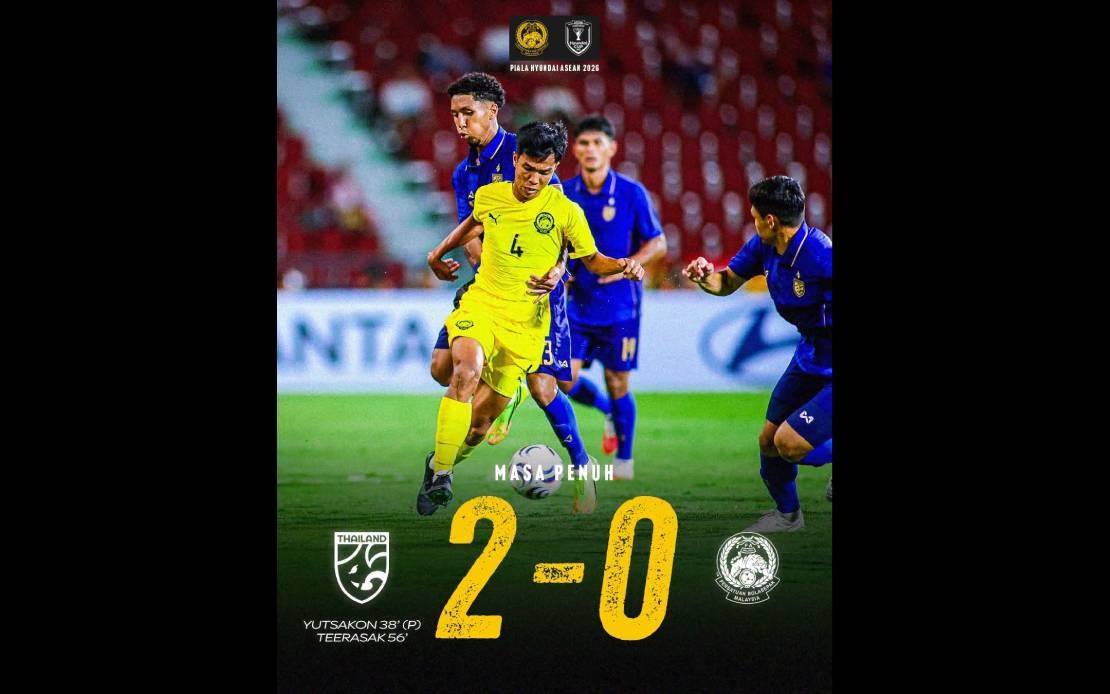
Thailand's seven-time championship pedigree proved decisive on Saturday as the hosts dismantled Malaysia's unbeaten run in the 2026 ASEAN Cup with a commanding 2-0 victory at the Rajamangala Stadium in Bangkok. The result in Group B has fundamentally altered the tournament's trajectory, transforming what appeared to be Malaysia's procession toward the semi-finals into a tight, unpredictable race that will demand perfection from both Southeast Asian powerhouses in their remaining matches.
The match unfolded as a tactical affair initially, with Malaysia demonstrating attacking intent and carving out several dangerous openings against a Thailand side content to remain compact and seek opportunities on the break. The Malaysian forwards Paulo Josue and Muhammad Syafiq Ahmad consistently moved into threatening positions throughout the opening period, yet Thailand goalkeeper Kampon Phatomakkakul proved immovable between the posts, producing a succession of athletic saves that kept the visitors at bay. This defensive resilience from the host nation reflected careful preparation and the organizational discipline that has underpinned Thailand's seven championship reigns in this competition.
Thailand's back line, anchored by the commanding presence of defenders Nattapong Sayriya and Manuel Tom Bihr, operated with impressive coherence and concentration. These two players essentially suffocated Malaysia's attacking outlets through positioning and timely interceptions, rarely allowing the visitors' forwards the space or time to execute their preferred movements. The defensive setup prevented Malaysia from converting their early dominance into meaningful goal-scoring chances, a critical factor in contests where defensive solidity can frustrate attacking teams into unforced errors.
The breakthrough arrived in the 32nd minute following a pivotal moment of Malaysian vulnerability. Centre-back Muhammad Ubaidullah Shamsul Fazili committed a fatal miscalculation in the penalty area, bringing down attacking midfielder Kakana Khamyok in circumstances that left South Korean referee Kim Woosung with no option but to point to the spot. A Video Assistant Referee review confirmed the infraction, and Thailand's striker Yotsakon Burapha stepped up six minutes before halftime to convert the penalty with clinical composure, sending Muhammad Azri Ab Ghani the wrong direction to establish a 1-0 advantage at the interval.
Thailand emerged from the break with renewed purpose and intensity, maintaining relentless pressure on the Malaysian defence while systematically advancing their attacking shape. The hosts created numerous opportunities that tested the reflexes and positioning of goalkeeper Muhammad Azri Ab Ghani, keeping Malaysia on the back foot for extended periods. This second-half dominance reflected Thailand's experience in knockout-style group configurations, where controlling momentum and maintaining intensity separates champions from contenders.
The decisive second goal arrived in the 56th minute when substitute Worachit Kanitsribumphen demonstrated the clinical finishing that often distinguishes successful tournament campaigns. His perfectly weighted pass found Teerasak Poeiphimai in a completely unmarked position, and the forward made no error with his finish to extend Thailand's advantage to 2-0. By this stage, Malaysia's earlier territorial control had evaporated entirely, replaced by a desperate scramble to prevent further damage.
Though Malaysia mounted spirited attempts to reduce the deficit during the closing stages, Thailand's defence remained disciplined and intact, preserving their clean sheet to secure all three points. The performance will provide Thailand's coaching staff with valuable footage and confidence as they navigate the remainder of the competition, demonstrating that the team possesses both the technical quality and mental resilience to handle pressure situations.
The victory has created a genuinely open Group B race that now demands tactical recalculation from all participating nations. Thailand moved to the summit on goal difference with six points, technically level with Malaysia but possessing a game in hand—a significant advantage in a five-team group where fixture congestion and cumulative fatigue become tactical variables. Myanmar and the Philippines occupy third place jointly on three points, while Laos remain scoreless. The semi-finals will be contested by the top two finishers from each group, meaning Malaysia retains clear qualification paths despite the setback.
Malaysia will seek redemption and restoration of their playoff position when they face the Philippines on August 8 at the Kuala Lumpur Football Stadium in Cheras. This match represents an opportunity for Harimau Malaya to reassert their credentials as serious tournament contenders and respond to the psychological blow of their first defeat. However, the defeat serves as a stark reminder that championship-caliber opponents like Thailand demand perfect execution across ninety minutes—a standard that Malaysia will need to meet consistently if they are to progress toward a title challenge.
The result equally demonstrates that ASEAN Cup fixtures retain genuine unpredictability and competitive intensity regardless of seeding or recent form. Thailand's resurgence as a credible Group B threat injects narrative complexity into the tournament's remaining matches and suggests that the semi-final picture will be determined by which teams demonstrate mental resilience, tactical flexibility, and the capacity to maintain performance standards across multiple fixtures. For Malaysian supporters and analysts, the defeat represents both setback and opportunity—a chance to evaluate squad depth, tactical options, and mental fortitude against one of the region's established powerhouses before the knockout stages demand flawless execution.

