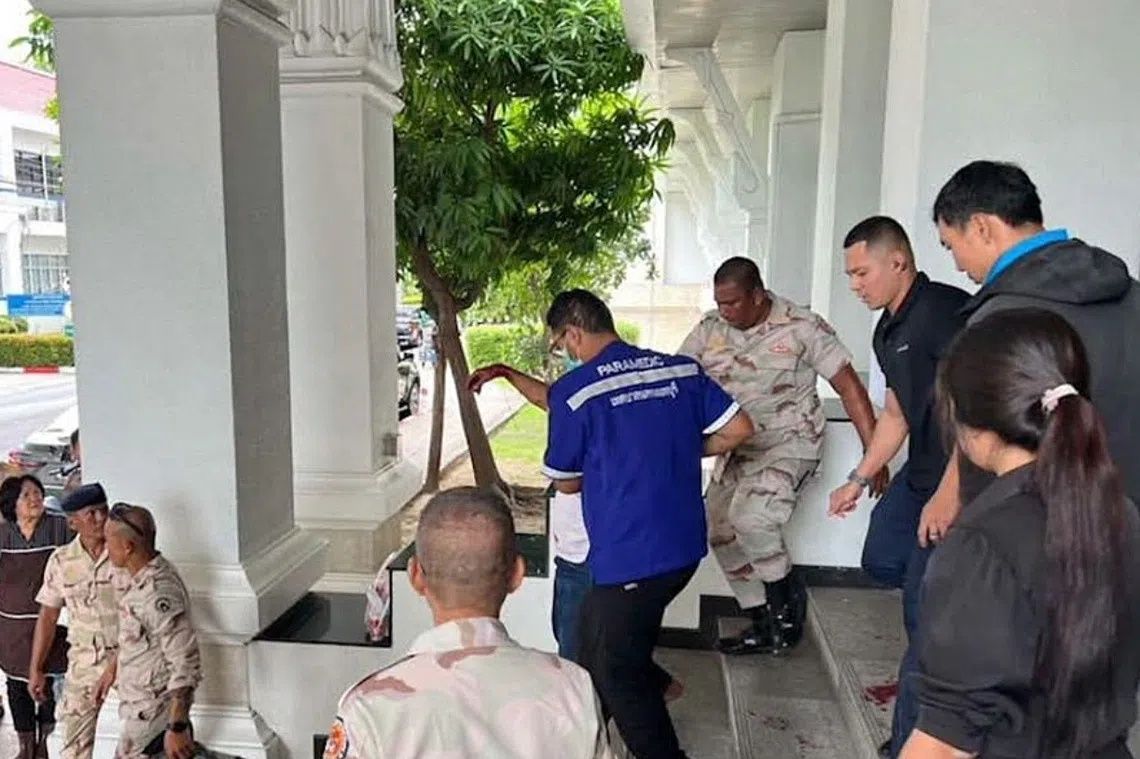
Thailand faces mounting scrutiny over its gun control framework after a second shooting erupted on Monday at a provincial government office on Bangkok's outskirts, only three days after a catastrophic school massacre that claimed nine lives and left the nation reeling. The rapid succession of incidents has thrust firearms legislation to the forefront of national discourse and exposed persistent vulnerabilities in the country's security infrastructure.
Authorities identified the Monday perpetrator as a former lawmaker who opened fire at a government facility, striking a senior provincial official and his driver. Major General Dejrapee Kongdee, the provincial police commander, confirmed that two people sustained wounds in the attack and were transported to hospital for emergency treatment. Officers swiftly apprehended the suspect at the scene, preventing further casualties. The incident underscored a troubling pattern of violence erupting within government institutions, raising questions about protection protocols for public officials and institutional security.
The shooting comes just seventy-two hours after one of Thailand's deadliest mass casualty events in recent memory unfolded at Debsirin Nonthaburi School. On Friday, a fourteen-year-old boy first fatally shot his grandparents before embarking on a rampage through the school grounds, killing nine people and injuring more than twenty others. The incident marked Thailand's most lethal mass shooting in nearly four years, shocking a society that has experienced periodic gun violence but rarely at such a scale. The teenager ultimately turned the weapon on himself, concluding the horrific spree that devastated families and communities across the province.
The proximity of these two incidents has ignited intense debate about whether Thailand possesses adequate legislative mechanisms to prevent firearms from reaching individuals who pose risks to public safety. Gun ownership in Thailand requires permits and registration, yet enforcement remains inconsistent, and private armories are often poorly secured. Legal firearms in civilian hands number in the hundreds of thousands, creating a substantial pool from which weapons can be diverted through theft, familial access, or negligent storage. The ease with which both perpetrators—a teenager and a former elected official—obtained functioning weapons suggests systemic failures in tracking and controlling firearms distribution.
Prime Minister Anutin Charnvirakul has signalled his government's determination to strengthen gun regulations in response to the school shooting, pledging enhanced restrictions on civilian firearm ownership and possession. His administration faces pressure from bereaved families, civil society organizations, and international observers who point to the comparative success of stricter gun policies in neighbouring countries. The timing of the Monday shooting, occurring as the government contemplates legislative reforms, may accelerate legislative momentum and reduce potential political resistance to tighter measures.
Schools across the province resumed operations on Monday, but the return to normalcy proved markedly different from previous routines. Educational institutions implemented enhanced security protocols, including the installation of metal detectors at entry points and intensified screening procedures for visitors and students. These visible safety measures reflect institutional anxiety about potential future incidents and represent a sharp departure from Thailand's traditionally open campus environments. Parents and educators expressed concern that such heavy-handed security measures, while necessary in the immediate aftermath, could establish a permanent atmosphere of fear and suspicion within learning environments.
The sequence of events has drawn comparisons to mass shooting episodes in other nations and prompted analysts to examine whether Thailand exhibits risk factors associated with gun violence epidemics. Unlike countries with pervasive gun ownership cultures, Thailand's mass shootings have often involved individuals with documented grievances or mental health crises who gained access to weapons through family members or professional connections. The two most recent incidents fit this pattern—the school shooter reportedly had access through family channels, while the Monday attacker's previous status as a lawmaker may have facilitated his weapon acquisition.
International observers monitoring Thailand's response have noted the potential for the government to use the crisis as political justification for expansive security measures that extend beyond firearm regulation. Previous security emergencies in Thailand have occasionally resulted in surveillance expansions or restrictions on civil liberties that persist long after immediate threats subside. Civil rights advocates urge policymakers to pursue narrowly tailored responses focused specifically on preventing dangerous individuals from accessing firearms, rather than broad population-level restrictions that could erode personal freedoms.
Regional governments across Southeast Asia are watching Thailand's policy response with considerable interest. Several nations in the region face similar challenges balancing public safety with citizens' rights to legal firearms ownership, and the legislative approaches Thailand adopts may influence neighbouring countries' own deliberations. Countries like the Philippines and Myanmar have grappled with comparable issues around gun violence and civilian firearm access, making Thailand's regulatory evolution potentially instructive for regional security planning.
The cultural and political dimensions of this crisis extend beyond technical policy considerations. Thailand's gun culture differs substantially from Western contexts, with firearms traditionally associated with rural hunting and self-defence rather than ideological or recreational uses. This distinction suggests that Thais may prove more receptive to restrictions on civilian ownership than populations where guns occupy more central positions in national identity. The government's stated commitment to tighter controls reflects recognition that public sentiment currently favours enhanced regulation, creating a potentially rare window for legislative change.
As investigation continues into both the school and government office shootings, evidence may illuminate systemic vulnerabilities that permitted access to firearms in both cases. Security audits of provincial government facilities may reveal inadequate protocols, while educational institution reviews could identify gaps in background verification procedures for individuals with firearm access within school communities. These findings will likely inform specific legislative proposals and administrative reforms designed to prevent future incidents through multiple layers of prevention rather than single-point interventions.

