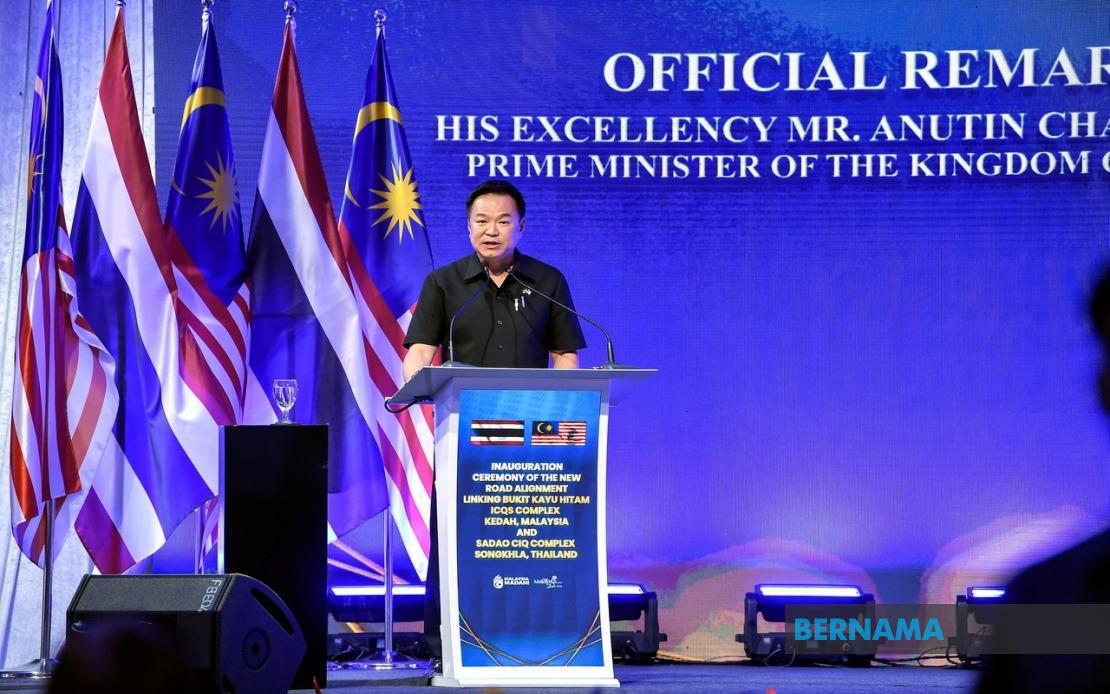
Thailand's government has reaffirmed its determination to close critical gaps in the region's transport network, with Thai Prime Minister Anutin Charnvirakul declaring that the kingdom will systematically address remaining connectivity challenges that currently impede the efficient flow of commerce and people across Southeast Asia. Speaking at the official inauguration of a newly constructed road alignment connecting Malaysia's Bukit Kayu Hitam facility with Thailand's Sadao checkpoint, Anutin positioned the infrastructure project as a cornerstone of broader regional integration efforts that extend far beyond the bilateral relationship between Bangkok and Kuala Lumpur.
The new road alignment represents the culmination of coordinated planning between Thai and Malaysian authorities to streamline border crossing procedures at what has become the busiest checkpoint along their shared frontier. By reducing bottlenecks at this critical juncture, both nations anticipate substantial improvements in the speed and reliability of goods transit, directly benefiting businesses operating across the Thailand-Malaysia supply chain. The project exemplifies how pragmatic infrastructure investment can translate political commitments into tangible economic gains for neighbouring countries, a principle that holds particular relevance for Southeast Asian nations seeking to deepen integration through the ASEAN framework.
Anutin's vision extends substantially beyond the immediate Malaysia-Thailand context, explicitly acknowledging the potential for this corridor to serve as a gateway for commerce flowing between Malaysia, Thailand, China, and Russia. This ambitious framing suggests that Bangkok perceives the land route through Malaysia as increasingly viable for transcontinental trade, particularly as alternative shipping lanes face disruption and cost pressures. For Malaysian policymakers and businesses, this statement carries significant implications regarding Kuala Lumpur's emerging role as a transit hub connecting East Asia with South Asia and beyond, positioning the country as indispensable to regional value chains.
The bilateral connectivity initiative encompasses multiple frontier zones across southern Thailand and northern Malaysia. In addition to the Bukit Kayu Hitam-Sadao alignment, both governments have prioritised further development of crossing points at Songkhla-Kedah, Satun-Perlis, and Narathiwat-Kelantan. This multi-pronged approach acknowledges that no single border checkpoint can absorb the full volume of cross-border movement and that distributed infrastructure reduces pressure on any individual facility. The strategy also reflects recognition that border regions possess distinct economic characteristics and trade patterns, with tailored connectivity solutions offering greater returns than uniform approaches.
The economic potential of these border zones has long remained underutilised, constrained by aging infrastructure and bureaucratic procedures that impose substantial transaction costs on traders. By systematically upgrading transport links and harmonising border protocols, both Thailand and Malaysia seek to unlock dormant commercial dynamism in peripheral regions. Northern Malaysian states and southern Thai provinces have historically lagged their respective countries' core economic zones, yet their geographic positioning makes them logical nodes in emerging supply chains connecting major Asian markets. Enhanced connectivity could catalyse manufacturing relocation, agricultural trade expansion, and tourist flows that would benefit local populations directly.
The bidirectional nature of the improved corridor warrants emphasis, as Anutin specifically noted that benefits would accrue to Thai and Chinese exporters gaining faster access to Malaysian, Singaporean, and Indonesian markets. This reciprocal framework contrasts sharply with historical patterns of asymmetric transport development, wherein infrastructure investments primarily served the interests of dominant economic players. By emphasising mutual advantage, both governments have constructed a politically sustainable rationale for continued investment and cooperation, reducing the likelihood that changing political circumstances would undermine long-term infrastructure commitments.
Prime Minister Datuk Seri Anwar Ibrahim's presence at the inauguration ceremony underscored Malaysia's commitment to the initiative and his administration's broader strategy of positioning the country as a vital regional node. Anwar has consistently articulated a vision of Malaysia as an indispensable connector state, leveraging its geographic position and existing infrastructure networks to capture disproportionate value from regional trade flows. The border infrastructure project aligns precisely with this strategic objective, transforming what could otherwise remain a peripheral junction into a prioritised commercial artery. Malaysian private sector actors, particularly those engaged in logistics, manufacturing, and trading, stand to benefit substantially from reduced border transit times and associated cost savings.
The formal discussion of outstanding procedural issues between Thai and Malaysian authorities reflects mature bilateral management of cross-border complications. Rather than allowing administrative friction to persist indefinitely, both governments have committed to systematic resolution of border procedures that currently create friction. Such discussions typically address visa facilitation, goods classification standards, quarantine protocols, and customs clearance timelines. Progress on these fronts, though less visible than physical infrastructure, often generates more substantial economic benefits for traders and travellers than symbolic opening ceremonies.
For Malaysian businesses, particularly small and medium enterprises engaged in cross-border commerce, the improved connectivity carries immediate practical significance. Faster border transit translates directly into reduced working capital requirements, as goods spend less time in transit and at checkpoints. Lower logistics costs improve competitiveness against firms based in other Southeast Asian countries, potentially tilting comparative advantage in Malaysia's favour. Agricultural producers, automotive parts manufacturers, and agricultural processors in northern Malaysia stand to benefit particularly acutely from these improvements.
The initiative also carries subtle implications regarding Malaysia's strategic positioning within the broader geopolitical context of Southeast Asia and the wider Asian region. By strengthening transport connections northward into Thailand and beyond to China, Malaysia reinforces its role as a crossroads between different Asian regions and economic systems. This positioning enhances Kuala Lumpur's diplomatic flexibility and economic options, reducing overdependence on any single trading partner or regional alignment. From this perspective, the border infrastructure project represents not merely technical cooperation but a strategic investment in Malaysia's long-term economic independence.
Regional observers have noted that similar connectivity initiatives across Southeast Asia tend to generate positive spillover effects extending beyond direct trade impacts. Improved transport links historically correlate with increased personal mobility, facilitating academic and professional exchanges that deepen human networks and institutional connections between countries. Tourism flows typically expand substantially when border crossing procedures become less onerous, generating foreign exchange earnings and employment in hospitality sectors. Cultural understanding between Thai and Malaysian citizens benefits from reduced barriers to cross-border movement, potentially supporting longer-term political stability and cooperation.
The commitment by both governments to future connectivity projects suggests recognition that the current initiative represents merely a foundation upon which more ambitious infrastructure can be constructed. Both nations have indicated willingness to explore additional border crossings, improved maritime connections, and rail links that could further integrate their economies. This long-term perspective contrasts favourably with the shorter timeframes that often characterise bilateral relations, suggesting genuine institutional commitment to deepening integration regardless of political transitions in either capital.
Moving forward, the success of the Bukit Kayu Hitam-Sadao alignment will likely influence both governments' enthusiasm for subsequent projects and their willingness to commit resources to additional initiatives. Should the new road alignment deliver demonstrable improvements in trade efficiency and cross-border movement, momentum will develop for accelerated implementation of the remaining planned connections. Conversely, if complications emerge during operational phases, both governments may become more cautious regarding future commitments. The practical implementation phase will therefore prove crucial in determining whether this cooperative framework can sustain political support and deliver genuine economic benefits to participating communities.

