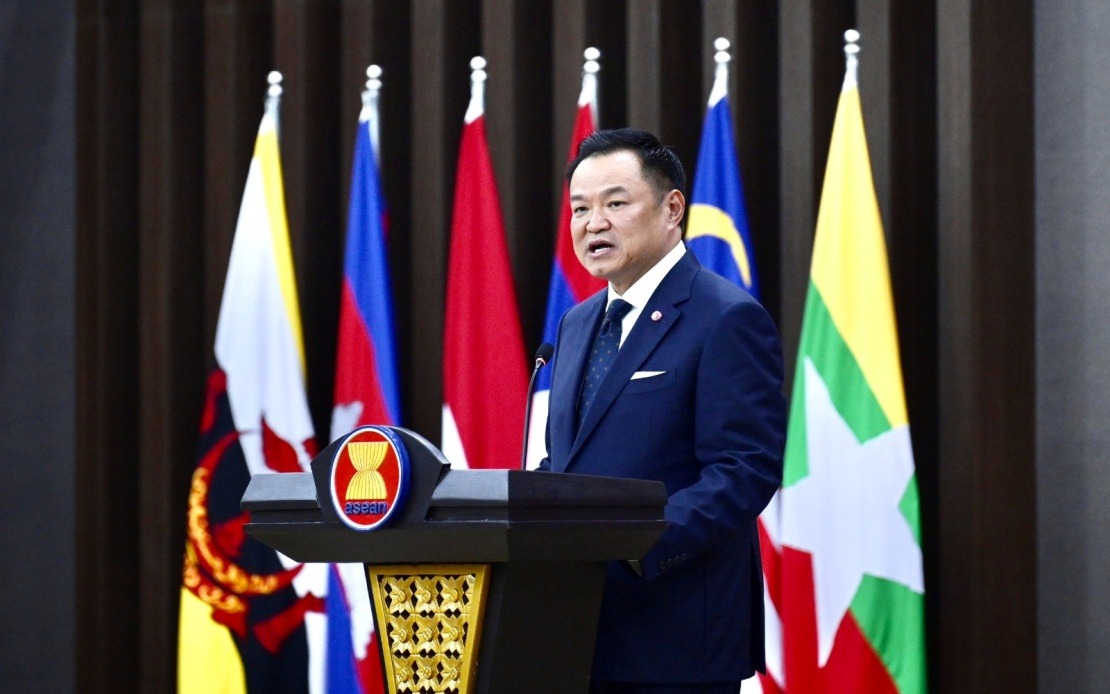
Thai Prime Minister Anutin Charnvirakul has articulated an ambitious three-part blueprint for ASEAN's trajectory, emphasising the need for enhanced regionalism, fortified resilience against global turbulence and tangible improvements in citizens' lives across the ten-nation bloc. Speaking at the ASEAN Secretariat in Jakarta during his official visit to Indonesia, Anutin underscored that regional problems demand regional remedies—a philosophy that reflects growing recognition within Southeast Asia that unilateral approaches cannot adequately tackle the interconnected challenges of geopolitical tension, economic volatility, technological disruption and security threats facing the member states.
The fundamental thrust of Anutin's argument rests on a compelling observation: no single ASEAN nation possesses sufficient capacity to independently address the cascading crises emanating from great power competition, supply chain vulnerabilities, energy scarcity and digital transformation. This framing carries particular resonance for Malaysian policymakers, as it validates the principle of collective action through ASEAN's institutional structures—structures that smaller and medium-sized economies like Malaysia have long championed as essential counterweights to bilateral pressure from larger powers. By positioning regional cooperation as necessity rather than preference, Anutin signals that ASEAN's value proposition to its members now extends beyond diplomatic convening to genuine problem-solving capacity.
Crucially, Anutin's vision encompasses a recalibration of ASEAN's operational norms. He advocated for applying the bloc's cherished principles of consensus and non-interference with greater flexibility, a carefully calibrated suggestion that seeks to preserve ASEAN's institutional identity while acknowledging that rigid adherence to these doctrines can paralyse decision-making on urgent matters. This tension between principle and pragmatism represents a persistent challenge for ASEAN governance, particularly when addressing humanitarian crises or regional security flashpoints where consensus proves elusive. The proposal for measured flexibility offers a pathway for ASEAN to respond more decisively without abandoning the cooperative spirit that underpins its cohesion.
Thailand's Prime Minister grounded his vision in concrete priorities that directly impact Southeast Asian prosperity and stability. Fortifying regional supply chains assumes critical importance given the ongoing diversification of global manufacturing away from China and the opportunities this creates for ASEAN nations to capture greater value in electronics, automotive and semiconductor industries. Enhanced food and energy security addresses existential concerns for import-dependent economies throughout the region, where geopolitical disruptions can rapidly trigger commodity price spikes affecting millions. Accelerating digital connectivity and preparing young people for technology-driven economies acknowledges the demographic and structural shifts reshaping Southeast Asia, where youth bulges present both opportunities and risks if education systems fail to adapt.
An important element of Anutin's address involved expanding ASEAN's engagement architecture with emerging powers and Global South nations. This approach recognises that the bloc's strategic autonomy depends partly on cultivating alternative partnerships beyond traditional relationships with Western powers and China. For Malaysia, already pursuing multifaceted foreign policy engagement, such diversification aligns with established doctrine while potentially opening new avenues for trade and investment flows. The emphasis on middle powers suggests ASEAN is positioning itself as a natural convenor for non-aligned countries navigating contemporary great power competition.
Regarding Myanmar, Anutin reaffirmed Thailand's commitment to ASEAN's Five-Point Consensus while proposing what he termed "calibrated re-engagement"—a diplomatic formulation that attempts to balance the bloc's stated opposition to the military coup with pragmatic acceptance that sustained isolation produces neither humanitarian improvement nor political progress. The reported visit by the International Committee of the Red Cross to Aung San Suu Kyi was highlighted as validation of this approach, suggesting that quiet diplomacy and selective engagement can yield incremental gains. This stance reflects Thailand's particular regional interests as Myanmar's neighbour and reflects Thai frustration with the five-point consensus's limited effectiveness in ameliorating the humanitarian crisis.
Thailand's bilateral relationship with Cambodia also featured in Anutin's address, with both countries reaffirming commitment to rebuilding mutual trust and maintaining dialogue while settling disputes according to international law. This emphasis on peaceful conflict resolution through established legal frameworks carries significance for the broader Southeast Asian architecture, where maritime disputes, shared river management and transnational issues require mechanisms for non-violent dispute settlement. Thailand's readiness to open a new chapter with Cambodia suggests accumulated grievances are being addressed through dialogue rather than confrontation, a model potentially applicable to other bilateral tensions within ASEAN.
Anutin's Jakarta visit carries additional symbolic weight as the first official visit by a Thai prime minister to Indonesia in 15 years, reflecting either a previous rupture in bilateral relations or competing priorities that diverted Thai leadership attention. His designation as Thailand's 32nd prime minister in September 2025 places him in a position to reshape Thailand-Indonesia relations at a critical juncture when both nations grapple with distinct internal challenges yet share fundamental interests in regional stability and prosperity. Indonesia, as ASEAN's largest economy and designated chair of the ASEAN Secretariat, holds outsized influence over the bloc's strategic direction, making bilateral coordination between Bangkok and Jakarta essential.
Looking toward ASEAN's 60th anniversary next year, Anutin signalled Thailand's intention to play a more assertive role in shaping the bloc's future trajectory. This aspiration reflects Thailand's historical position as a founding ASEAN member and its desire to reclaim initiative in regional policymaking after years of internal political turbulence and domestic preoccupation. For Malaysia and other ASEAN partners, Thailand's renewed commitment to active regionalism presents opportunities for collaborative leadership on shared priorities, provided Bangkok's domestic political situation stabilises sufficiently to enable sustained external engagement.
The emphasis on measuring ASEAN's success through tangible benefits to ordinary citizens rather than merely institutional achievements represents a philosophical shift toward outcomes-based evaluation. Rather than celebrating ASEAN agreements as diplomatic victories, this approach demands demonstrable improvements in citizens' economic opportunities, personal security, and access to justice and services. Such reorientation particularly matters for Malaysia, where public scepticism toward regional organisations has grown as citizens question whether ASEAN membership delivers concrete improvements to their quality of life. Anutin's framing invites ASEAN to justify its continued relevance through measurable performance rather than procedural legitimacy.
Thailand's call for ASEAN to act preemptively rather than reactively—to prepare against crises before they materialise—reflects lessons from recent regional experiences including pandemic preparedness failures and sluggish responses to climate-related disasters. Establishing robust early warning systems, maintaining strategic reserves, and maintaining integrated surveillance capabilities across borders could enhance collective resilience, though implementing such measures requires surrendering elements of national sovereignty that some ASEAN members remain reluctant to relinquish. The tension between proactive regionalisation and defence of state prerogatives will likely dominate ASEAN discussions for years ahead.

