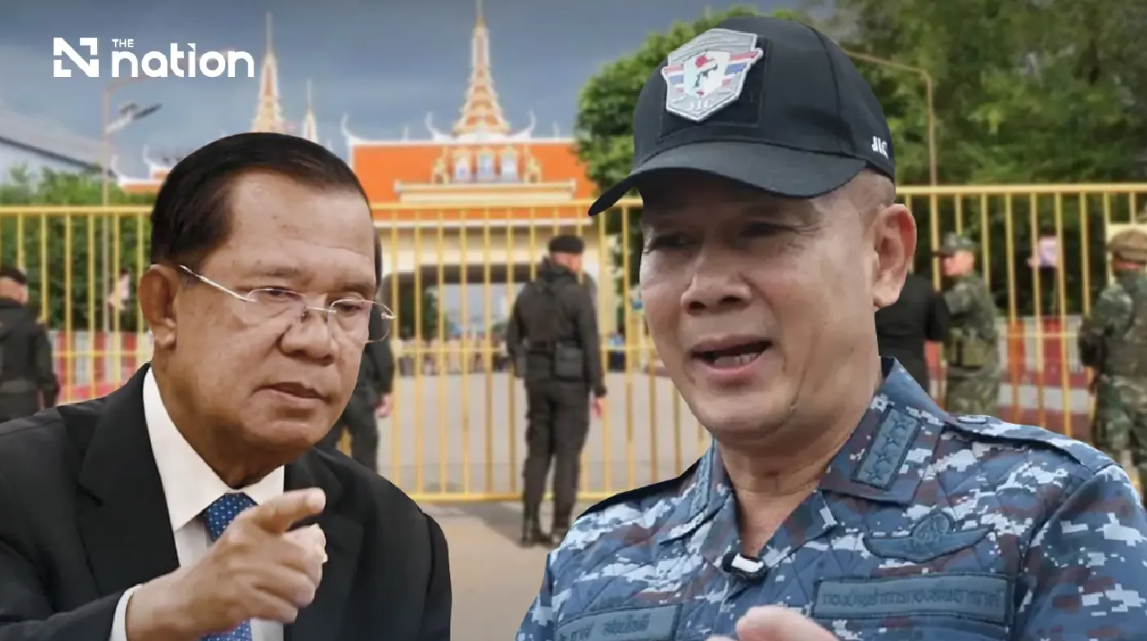
Thailand has pushed back strongly against Cambodian Senate President Hun Sen's assertions that Bangkok weaponised its crackdown on online scam operations to disguise military territorial expansion along their shared border. Air Chief Marshal Prapas Sonjaidee, head of the Joint Information Centre on the Thailand-Cambodia Situation, issued the rebuttal on Friday, arguing that such serious allegations raised on international platforms must be grounded in independently verifiable facts rather than political rhetoric.
The dispute reflects escalating tensions between the neighbouring countries over a border region that has become a flashpoint for conflicting narratives about military positioning, civilian harm and the legitimacy of armed responses. Hun Sen characterised Thailand's actions as "modern warfare," blending security operations against criminal networks with what Cambodia claims is creeping territorial encroachment. This framing conflates two fundamentally distinct issues, according to the Thai official, who argued that determining whether a location harbours scam operations is analytically separate from assessing whether that same area serves military purposes.
Prapas's response underscores a broader frustration with how the dispute is being litigated through competing claims rather than methodical examination of evidence. He contended that if buildings or zones were indeed being used to station troops, store weapons or coordinate military operations, such usage should be evaluated under relevant international and domestic law. However, Thailand disputes the foundation of Hun Sen's accusations, maintaining that Cambodia initiated armed action that affected Thai civilian populations, prompting a defensive response rather than unprovoked occupation.
The sequencing of events has emerged as a critical flashpoint in this diplomatic standoff. Prapas stressed that any credible account of armed conflict must begin with the initial military action, not with a subsequent response. According to Thailand's account, Cambodia was first to deploy weapons in ways that endangered Thai civilians and military personnel. Rather than trading accusations across international forums, both nations should systematically compare their respective evidence, including timestamps, geographic coordinates and chronological reconstructions of events. This methodical approach, the Thai official suggested, would establish facts capable of withstanding independent scrutiny.
The occupation accusation directly challenges Thailand's positioning along the border. Prapas referenced the joint ceasefire agreement both nations signed, which stipulates that forces must remain at positions established when the ceasefire took effect, refrain from advancing toward each other and pursue de-escalation. Under this framework, maintaining forces in agreed locations does not constitute occupation. Thailand argues that adhering to a mutually signed agreement cannot simultaneously be recharacterised as territorial seizure without dismantling the entire foundation of bilateral conflict management.
Crucially, Prapas argued that border demarcation disputes should be resolved through established bilateral mechanisms rather than military positioning or unilateral political declarations. Neither military forces nor media narratives should determine border lines; instead, the mechanisms both countries have accepted must function without political pressure. This insistence on procedural separation reflects Thailand's broader argument that the border question remains distinct from ceasefire arrangements and must be addressed through proper diplomatic and technical channels.
The civilian protection dimension of this dispute adds humanitarian weight to the disagreement. Prapas endorsed the principle that civilians on both sides deserve equal protection, emphasising that Thai and Cambodian children, schools and communities must all remain safe from military action. However, he argued that any genuine assessment of civilian harm requires examining evidence from both nations—including weapon types, fire directions, targeting coordinates and timing. Critically, he contended that civilian areas must not be deliberately used to shield military operations, thereby placing non-combatants at elevated risk. This principle, he maintained, should bind all parties equally.
Hun Sen's invocation of information and psychological warfare as tools supposedly being deployed against Cambodia highlights how this border dispute has evolved into a battle over narrative control in the digital age. Prapas acknowledged that information warfare and disinformation are authentic 21st-century challenges requiring serious response. Yet he argued that countering such tactics through additional accusations merely perpetuates cycles of competing narratives. Instead, he advocated for public disclosure of information, evidence and chronological reconstructions, allowing independent scrutiny to determine credibility rather than having each side present only selective facts supporting their preferred narrative.
Thai objectives along the border remain framed around defensive necessity rather than territorial ambition. Prapas stated that Thailand harbours no desire for war, seeks no neighbouring territory and does not regard Cambodian people as adversaries. Simultaneously, Thailand maintains responsibility for protecting its civilians and military forces. He proposed collaborative approaches to suppress transnational scam operations while allowing law and factual assessment to determine how specific locations are being used.
The practical pathway forward, according to Prapas, requires multiple simultaneous actions: both nations must jointly suppress online scam networks; the facts and applicable law must determine whether locations serve military purposes; the complete chronology of clashes must be disclosed rather than beginning accounts only after Thailand's response; established border mechanisms must be permitted to function without military pressure; and both sides must uphold their joint ceasefire statement while reducing provocative actions. These steps, he suggested, would create conditions conducive to genuine negotiation.
Beyond immediate border management, Prapas positioned Thailand's response within broader regional concerns about 21st-century conflict dynamics. He contended that if governments genuinely worry about modern warfare damaging societies, the solution lies not in opening additional battlefields of competing narratives. Rather, priorities must focus on ceasing armed hostilities, establishing clearer factual foundations and restoring serious diplomatic engagement. Both Thai and Cambodian populations, he argued, desire these outcomes, making them the legitimate basis for moving forward.
The rejection of Hun Sen's framing represents Thailand's attempt to reorient the dispute from political accusation toward evidence-based analysis. For Malaysia and other Southeast Asian observers, this dispute illustrates how border tensions between ASEAN neighbours can rapidly escalate when conflated with transnational security challenges like online crime networks. The emphasis on bilateral mechanisms and procedural discipline also reflects ASEAN's preference for managed disputes conducted through established channels rather than inflammatory international posturing. Whether both parties can return to substantive negotiation rather than competing narratives remains the critical test of their commitment to regional stability.

