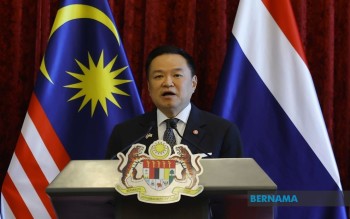
Thailand is on course to achieve its ambitious US$30 billion bilateral trade objective with Malaysia by 2027, according to Thai Prime Minister Anutin Charnvirakul, who underscored the momentum behind the two neighbouring economies' deepening commercial partnership. Speaking at a joint press conference with Malaysian Prime Minister Datuk Seri Anwar Ibrahim following a memorandum of understanding exchange ceremony at Perdana Putra Complex in Putrajaya, Anutin projected optimism that the neighbours would surpass the current trade threshold in the coming years through sustained collaborative effort.
The relationship between Thailand and Malaysia represents one of Southeast Asia's most significant bilateral trade corridors, with Malaysia currently standing as Thailand's largest trading partner within ASEAN. The existing trade volume of approximately US$28 billion places the two countries on a trajectory towards the target, requiring only modest incremental growth to bridge the remaining gap. This proximity to the goal reflects the maturity of commercial ties and the deep integration of supply chains that have developed between Bangkok and Kuala Lumpur over decades of sustained engagement.
Both premiers committed to establishing a joint trade committee that would establish a fresh, more aggressive trade agenda beyond the current target, signalling their intent to move beyond incremental gains and fundamentally expand the economic relationship. This institutional mechanism would provide a structured forum for identifying new sectors and opportunities, ensuring that trade growth does not plateau once the US$30 billion threshold is reached. The establishment of such formal channels demonstrates a strategic approach to bilateral commerce, moving away from ad-hoc negotiations towards a more systematic framework for expansion.
Thailand's emphasis on leveraging complementary economic strengths suggests a sophisticated understanding of how the two nations can deepen integration rather than simply increasing volumes of existing trade. By focusing on areas where each country possesses distinctive advantages, the bilateral relationship can evolve beyond straightforward goods exchange into more complex value-added collaborations. This approach acknowledges that both nations have undergone substantial economic transformation and possess sophisticated industrial bases capable of producing high-value-added products and services.
Food security emerges as a critical priority area in the expanded partnership vision, reflecting the agricultural heritage and capacity of both Thailand and Malaysia as significant food producers and processors in the region. Energy security has similarly become paramount for Southeast Asian nations navigating volatile global markets and seeking greater self-sufficiency, making bilateral cooperation on hydrocarbon resources and renewable energy initiatives increasingly valuable. The inclusion of the digital economy and high-tech industries in the strategic agenda positions both nations at the forefront of technological advancement in Southeast Asia, acknowledging the shift towards knowledge-intensive sectors.
Anwar's commitment to the ambitious trade target reflects Malaysia's institutional readiness to pursue the goal through coordinated effort across multiple government departments. The involvement of both the Ministry of Foreign Affairs and the Ministry of Investment, Trade and Industry signals a whole-of-government approach that recognises trade expansion requires both diplomatic facilitation and targeted investment promotion. This interagency coordination represents best practice in trade policy implementation, ensuring that commercial objectives receive sustained political support across the executive branch.
The Malaysian premier's emphasis on establishing economic fundamentals as a foundation for broader bilateral cooperation acknowledges an important principle: durable relationships transcend episodic political engagement and require sustained commercial benefit. By prioritising trade and economic development as cornerstones of the relationship, both nations create stakeholder constituencies invested in maintaining cordial relations regardless of political transitions. This stakeholder approach to diplomacy has proven resilient in Southeast Asia, where business communities often bridge diplomatic tensions and provide continuity during government transitions.
Tourism constitutes an ancillary but significant component of the bilateral economic agenda, tapping into the substantial cross-border leisure travel and business tourism between the two countries. Malaysian and Thai nationals represent significant portions of each other's foreign visitor arrivals, and expanded tourism cooperation can generate employment, foreign exchange, and cultural understanding. The tourism sector's inclusion in bilateral discussions reflects a holistic understanding that people-to-people connections and commercial relationships strengthen mutual investment and long-term stability.
Antin's visit to Malaysia represents his first official trip since his reappointment as Thai prime minister in March 2026, underscoring the significance that Bangkok attaches to its relationship with Kuala Lumpur. The bilateral meeting at Perdana Putra Complex provided an opportunity to conduct a comprehensive review of existing cooperative arrangements and identify areas requiring attention or expansion. Such high-level engagement sends powerful signals to business communities in both countries that political leadership remains committed to removing barriers and facilitating commerce.
The two-day official visit structure reflects the depth of bilateral engagement and the range of issues requiring substantive discussion between the two premiers. Beyond the formal trade and economic agenda, bilateral relations encompass security cooperation, cultural exchanges, and regional coordination within ASEAN frameworks, necessitating extensive dialogue. The deliberate investment of prime ministerial time in bilateral engagement demonstrates the priority both nations assign to their relationship within their respective foreign policy architectures.
For Southeast Asian observers, the Thailand-Malaysia trade expansion represents a model of bilateral deepening that does not depend on external leverage or regional realignment. Instead, the two countries are pursuing mutual advantage through institutional mechanisms and strategic alignment around shared priorities. This approach offers lessons for other ASEAN member states contemplating expanded regional integration and demonstrates that incremental expansion can eventually yield transformative commercial relationships.
The ambitious target reflects broader trends within ASEAN towards intra-regional trade deepening, as member states recognise that regional integration offers greater resilience than dependency on extra-regional trade partners. By strengthening ties with immediate neighbours, Thailand and Malaysia are building buffers against global economic disruption while creating regional supply chain diversity. The success of this bilateral initiative could catalyse similar initiatives among other ASEAN pairs, gradually creating a more tightly integrated regional economic community.
The pathway to US$30 billion in bilateral trade by 2027 remains achievable given current momentum, but success will require sustained attention to reducing trade barriers, harmonising standards, and facilitating cross-border investment. Both governments have demonstrated commitment through institutional mechanisms and high-level engagement, providing the political foundation necessary for sustained progress. The commercial relationship between Thailand and Malaysia, grounded in geographical proximity and complementary economies, appears positioned for continued healthy expansion in the coming years.

