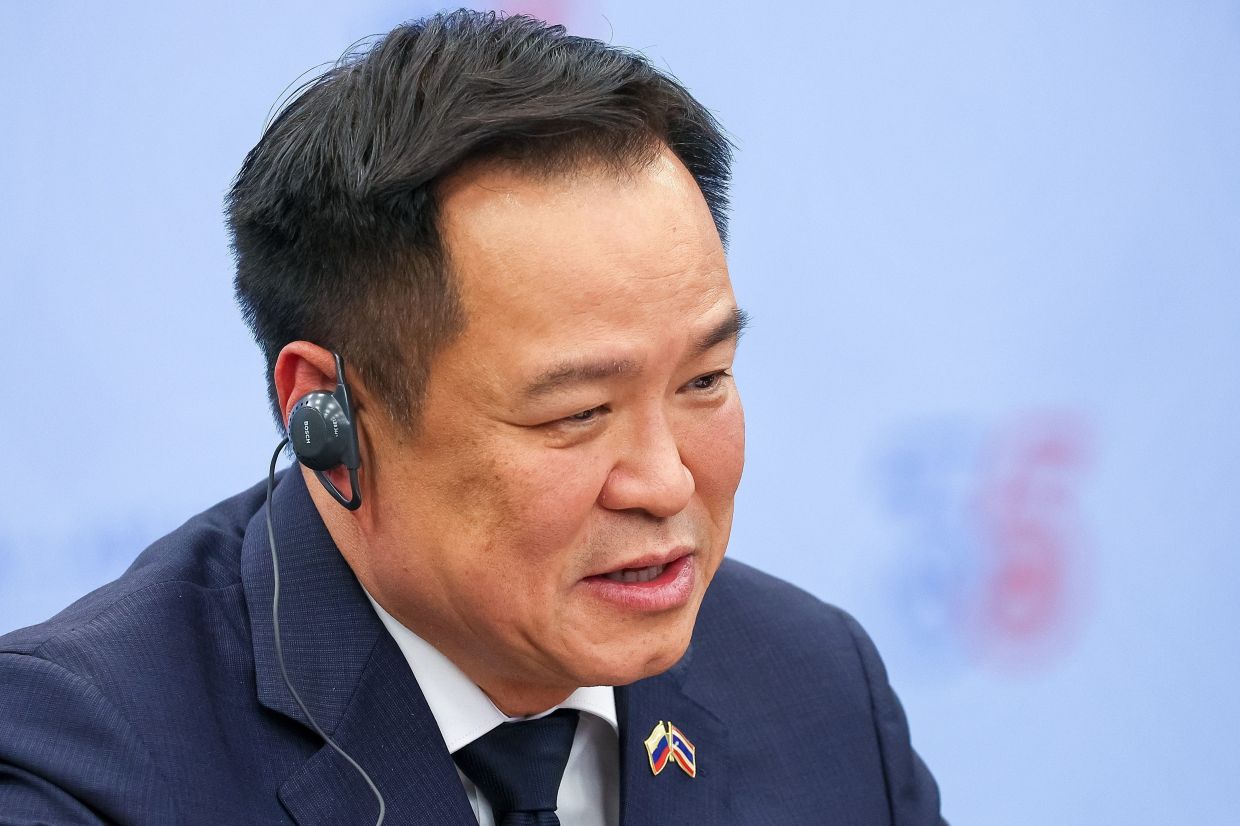
Thailand's Prime Minister Anutin Charnvirakul reached a symbolic 100-day milestone on June 27, marking one-quarter of a year since his swearing-in on March 20 as the kingdom's 32nd premier. The timeline reveals a government that has prioritised short-term crisis management over the kind of transformative economic and political restructuring that many Thais hoped would follow his election victory in February 2026. Coming slightly more than nine months after he initially assumed office in September 2025, following the collapse of the previous administration under Paetongtarn Shinawatra, Anutin's tenure so far presents a study in tactical competence paired with strategic hesitation.
The government's most immediate challenge arrived with dramatic urgency just weeks into his premiership. When American and Israeli military operations against Iran on February 28 disrupted Middle Eastern oil exports, the consequences rippled across Thailand's energy-dependent economy. Petrol stations faced supply bottlenecks that left some unable to service customers adequately, while oil prices spiked dramatically. The problem only intensified as the broader regional conflict created recurring disruptions to shipping lanes through the Strait of Hormuz, a critical global chokepoint for energy supplies. When crude briefly exceeded USD100 per barrel on a sustained basis, Thailand's structural vulnerability to overseas crises became starkly apparent to consumers and policymakers alike.
Anutin's administration responded with pragmatism rather than innovation, deploying the state Oil Fuel Fund to absorb price increases through subsidies while simultaneously extending cheaper credit to farmers and industrial operators. The government simultaneously ramped up coal-fired power generation to maximum capacity and negotiated expanded energy imports from the United States, Malaysia, and Brunei to reduce dependence on unstable Middle Eastern supplies. Political science researcher Mathis Lohatepanont of the University of Michigan acknowledged the effectiveness of these measures, noting that the government "managed to avoid further instability" despite early supply shocks and elevated prices. Crucially, the crisis did not spark the street protests that have periodically destabilised Thai society, suggesting that public tolerance for the government remained intact even as fuel costs remained elevated.
Beyond energy management, Anutin has delivered on nationalist credentials that were central to his electoral appeal. His Bhumjaithai Party captured the most parliamentary seats by championing a hardline stance on the long-disputed border region with Cambodia, and the new premier has maintained this positioning as head of government. Most dramatically, Anutin unilaterally terminated a bilateral maritime boundary agreement signed in 2001 with Phnom Penh, escalating the dispute to the United Nations for international arbitration while ensuring continued military oversight of border protection operations. The move satisfied his political base and demonstrated willingness to follow through on campaign commitments, though whether the strategy advances Thailand's strategic interests or merely satisfies domestic constituencies remains debatable.
An early policy success came through the June 1 rollout of the "Thais Help Thais Plus" subsidy programme, a consumer-focused initiative that allows roughly 30 million eligible citizens to purchase approved goods at 40 percent of retail price, with the government covering the difference. The scheme, funded through a 176 billion baht (USD5.27 billion) allocation, delivered tangible relief to household budgets and demonstrated the administration's capacity to execute logistically complex programmes. The initiative proved genuinely popular, providing immediate breathing room for cost-of-living pressures that affect most Thai households. Yet experts caution against reading too much into this success. Chulalongkorn University political scientist Puangthong Pawakapan emphasised that while Thais recognise the programme's value, it "does absolutely nothing to solve the underlying economic crisis." Mathis concurred, describing the subsidies as "relatively fleeting" temporary measures rather than evidence of commitment to long-term structural repair.
These immediate policy achievements obscure a conspicuous absence of fundamental economic strategy. Thailand's economy has failed to achieve annual growth exceeding three percent over the past five years, a prolonged period of underperformance that reflects deeper inefficiencies and structural constraints. The International Monetary Fund projects just 1.5 percent growth for the current year, making Thailand the slowest-expanding economy in Southeast Asia by a significant margin. The contrast with regional competitors is sobering: Vietnam anticipates 7.1 percent expansion, Cambodia expects four percent, and even Myanmar, convulsed by ongoing civil conflict, is forecast to grow by three percent. These disparities accumulate and compound, cumulatively reshaping the region's economic hierarchy while Thailand slides further behind.
Anutin has articulated ambitions to develop digital technology, artificial intelligence, and clean energy as new growth engines, yet analysts have detected no detailed implementation roadmap that would translate these intentions into concrete investment, regulatory change, or institutional development. Political scientist Stithorn Thananithichot from Chulalongkorn University characterised the government's energy as focused on "routine administration and day-to-day management rather than into any initiative aimed at meaningful economic or political change." The observation cuts to the heart of assessments across the policy community: the administration has proven competent at crisis response and subsidy distribution but shows minimal appetite for the harder work of economic restructuring or regulatory reform.
Constitutional reform represents perhaps the starkest example of this reluctance. In a referendum held alongside the February general election, nearly 60 percent of voters—approximately 20 million citizens—explicitly endorsed changing the 2017 Constitution, which was drafted under former military-backed premier Prayut Chan-o-cha following the 2014 coup and remained in effect until 2023. Many Thais view the charter as fundamentally undemocratic and an obstacle to genuine political liberalisation. Despite this overwhelming electoral mandate, constitutional revision has stalled. Stithorn argues that "a government that intended to reform would have signalled at least one substantive structural commitment at the outset; this one did not, and that absence is by design rather than a matter of time." The observation suggests calculated restraint rather than inadvertent neglect—a government conscious of domestic and potentially international sensitivities surrounding constitutional change and choosing stability over ambitious democratic transformation.
Thailand's recent history counsels caution about radical change. Two decades of military coups, brief-lived governments, and policy discontinuity have cumulatively damaged institutional capacity and discouraged long-term planning. Each political disruption allows structural economic problems—sluggish growth, aging demographics, elevated household debt, intensifying regional competition—to deepen further without sustained remedial attention. Anutin inherited a country where these challenges have festered for years, yet his government appears content to manage symptoms rather than address root causes. The "Thais Help Thais Plus" programme represents welfare distribution, not economic restructuring; energy subsidy represents crisis management, not energy transition; and border militarisation represents nationalist theatre, not strategic clarification.
For Malaysian and broader Southeast Asian observers, Thailand's trajectory raises questions about whether political stability inevitably comes at the cost of economic dynamism. The Anutin administration has avoided the chaos and coups that have periodically convulsed Thai politics, and this accomplishment should not be dismissed. Yet the region's more rapidly growing economies—Vietnam, Cambodia, even Myanmar despite civil conflict—have pursued more aggressive economic transformation and competitive positioning. Thailand's hundred-day checkpoint thus serves less as celebration of achievement than as marker of path not taken. A government focused on preserving the existing order may succeed at that preservation, but preservation alone cannot restore Thailand to regional leadership or ensure prosperity for citizens facing mounting household debt and limited economic opportunity.

