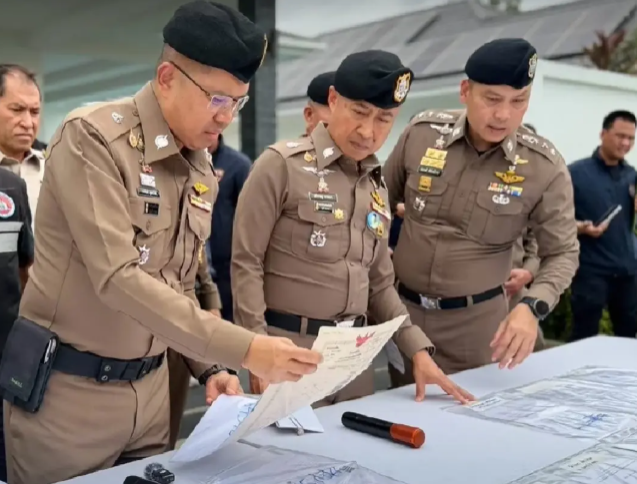
Thai police have intensified enforcement against suspected foreign attempts to circumvent property ownership restrictions, arresting 13 foreign nationals during coordinated raids across Hua Hin on Monday as part of an expanding nationwide investigation. The operation, which mobilised more than 200 officers and officials across 15 locations in Prachuap Khiri Khan province, targeted companies suspected of employing Thai nationals as nominee shareholders to illegally hold premium real estate on behalf of foreigners. The detainees include three British, four Chinese nationals, and individuals from Italy, France, the Netherlands, Austria, the Philippines and the United States, though none have yet faced formal charges.
The Hua Hin operation represents the sixth phase of a coordinated enforcement campaign that has evolved considerably since its initiation on the island of Koh Phangan in Surat Thani province. Each successive phase has expanded geographically and in scope, reflecting authorities' determination to dismantle what officials characterise as sophisticated networks designed to circumvent Thailand's constitutional restrictions on foreign land ownership. The earlier phases moved progressively through coastal tourist destinations including Phuket, Phang Nga, Krabi and Chonburi, with the most recent prior operation in Chiang Mai targeting inland property markets. This geographic pattern suggests that investigators view the problem as particularly acute in Thailand's most economically dynamic and internationally connected regions.
The properties under investigation in Hua Hin command significant market value, with individual pool villas estimated between 10 and 20 million baht in the Thap Tai subdistrict development that formed the focal point of Monday's operation. Across the broader Hua Hin investigation, authorities have identified 33 companies suspected of nominally holding property valued at approximately 300 million baht, with six separate entities allegedly engaged in first and second-phase operations at the targeted development. When consolidated with data from the five previous phases, the cumulative scope of the inquiry becomes apparent: police have now examined 233 land parcels and buildings spanning more than 160 rai across multiple provinces, with a combined estimated value exceeding 2.539 billion baht.
Investigators have uncovered a recurring pattern in how these arrangements allegedly operate. Foreign nationals questioned during inquiries described seeking advice from legal and accounting firms on how to hold Thai property while remaining compliant with local regulations. These professionals reportedly recommended establishing Thai-registered companies with local shareholders to facilitate the transactions. The foreigners believed such structures provided legal cover for their property holdings, a misunderstanding that underscores either widespread misinformation within advisory circles or, alternatively, deliberate misdirection by firms profiting from these arrangements.
Those listed as Thai shareholders in these companies presented a starkly different narrative to investigators. The individuals consistently stated they had agreed to hold shares nominally on behalf of foreign counterparts but had neither paid for their equity stakes nor exercised any meaningful control over company affairs. Many reported never reviewing financial documents, accounting records or other evidence of their purported investments. Police interpret these accounts as demonstrating that the Thai shareholders functioned purely as legal facades, with actual beneficial ownership and control remaining with foreign nationals despite nominal local shareholding.
The enforcement effort extended beyond merely documenting property arrangements and included seizure of substantial documentary and digital evidence. Officers removed company registration papers, accounting ledgers, computers, mobile devices and electronic data storage during the operation. This material will undergo detailed forensic examination as investigators map financial flows associated with property acquisitions and attempt to identify networks extending both domestically and internationally. The police commitment to tracing funds and pursuing overseas connections suggests awareness that these operations likely involve cross-border financial arrangements and potentially international accomplices.
Authorities have signalled that corruption and official complicity constitute integral elements of their investigation. The Royal Thai Police explicitly stated that the inquiry would encompass potential misconduct by government officials suspected of providing improper assistance to those involved in the nominee schemes. This focus reflects recognition that such large-scale property arrangements, particularly those involving high-value assets in well-connected tourist destinations, would struggle to proceed without at minimum turning a blind eye from local officials. Previous Thai anti-corruption campaigns have occasionally ensnared civil servants and law enforcement personnel, suggesting this investigation could produce politically sensitive outcomes.
The enforcement campaign has demonstrated accumulating momentum and prosecutorial success. Courts have issued 133 arrest warrants across the five phases preceding the Hua Hin operation, while 20 cases have resulted in convictions, indicating that initial investigations are progressing beyond preliminary inquiry stages into substantive legal proceedings. The latest Hua Hin operation issued an additional 45 arrest warrants, with police also summoning 39 Thai nationals for questioning, expanding the investigative net considerably. This escalation suggests that officials view the problem as sufficiently serious to justify sustained resource allocation across multiple provinces and extended timeframes.
For Malaysia and other Southeast Asian nations, the Thai enforcement pattern carries instructive implications regarding property market vulnerability and regulatory gaps. Foreign investors confronting restrictions on residential property ownership frequently pursue nominee arrangements or corporate structures, creating similar risks across the region. The sophistication demonstrated by Thai investigators in identifying and dismantling such networks—tracking beneficial ownership through corporate veils, examining financial transactions and mapping advisory firm complicity—offers lessons for Malaysian authorities tasked with protecting against unauthorised foreign property acquisition. The involvement of legal and accounting professionals in facilitating suspect arrangements also raises questions about professional standards and regulatory oversight across Southeast Asia's legal services sector.
The Thai authorities have attempted to distinguish this enforcement campaign from hostility toward legitimate foreign investment, explicitly emphasizing that the crackdown targets unlawful nominee structures rather than compliance-oriented investors. Deputy national police chief Pol Gen Samran Nuanma and other senior officials supervising the operation have repeatedly characterised the initiative as protecting Thai national interests while preserving space for lawful foreign participation in the economy. This framing reflects awareness that heavy-handed property enforcement could deter legitimate international investment in property development, tourism infrastructure and residential construction—sectors in which Thailand has cultivated significant foreign capital inflows.
The investigation has expanded coordinatively across multiple bureaucratic agencies, incorporating not merely police but also provincial governors, the Department of Business Development and the Department of Lands. This interagency approach acknowledges that combating nominee schemes requires expertise spanning law enforcement, corporate regulation and land administration. The complexity of property transactions and corporate structures means that police investigative capacity alone would prove insufficient; coordinated action across specialist agencies amplifies investigative effectiveness and ensures comprehensive examination of both corporate and real property dimensions.
The Royal Thai Police have established a public reporting mechanism through their operations hotline on 1599, available continuously, enabling members of the public to report suspected illegal foreign business activity. This approach attempts to distribute investigative burden across society, enlisting public cooperation to identify suspect activities. The relatively accessible reporting threshold—suspicion rather than proof—potentially generates substantial complaint volumes but also risks capturing legitimate activity that appears suspicious to uninformed observers. Nonetheless, such public reporting mechanisms have historically generated valuable leads in anti-corruption and property-related investigations across Thailand.
Looking forward, Thai authorities have committed to continuing this investigation nationwide, particularly across tourist destinations where foreign investment concentrations are highest. The accumulating evidence and prosecutorial momentum suggest this will constitute an ongoing campaign rather than a time-limited enforcement effort. For foreign investors considering property acquisition in Thailand and throughout Southeast Asia, the widening investigation underscores the regulatory risks inherent in nominee arrangements and highlights authorities' increasing technical sophistication in identifying and prosecuting such schemes. The implications extend beyond Thailand to inform property investors across the region regarding compliance standards and enforcement trends.

