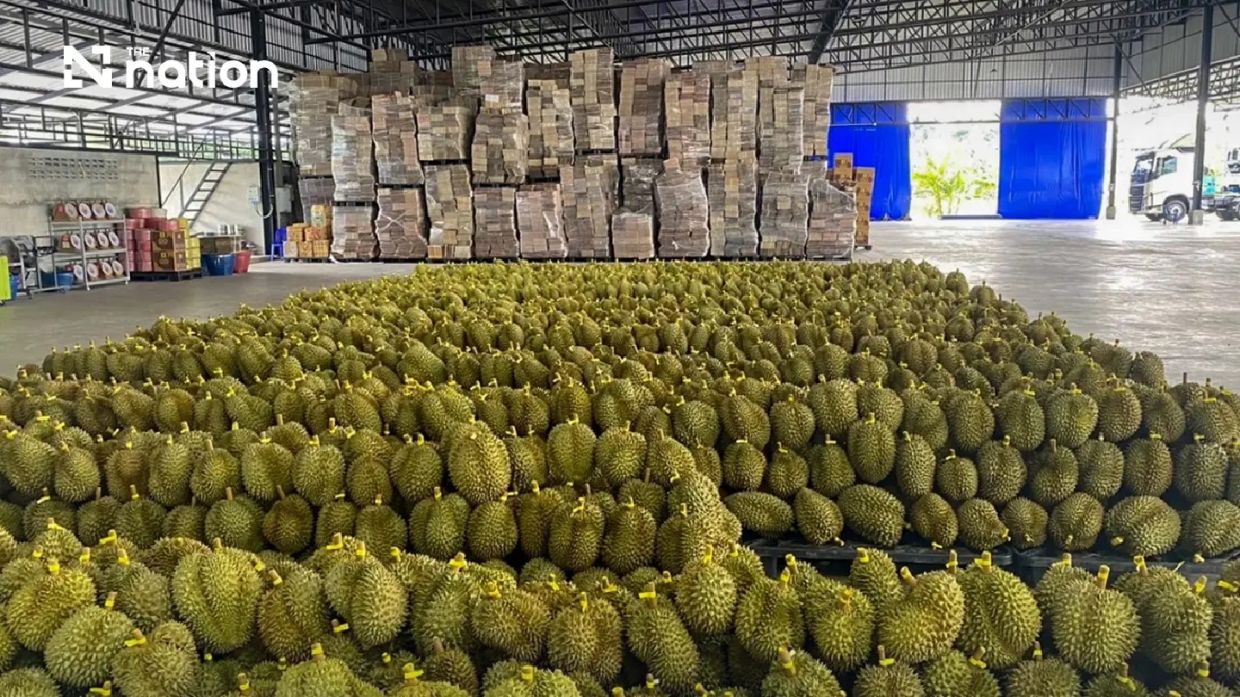
Thailand has reached a historic milestone in its agricultural trade with China, with fresh durian exports surpassing THB100 billion in value during the first six months of 2026. The country shipped 872,237.24 tonnes across 53,665 containers to the People's Republic of China by June 30, achieving a combined export value of THB100.07992 billion. This breakthrough marks the first time Thailand's first-half durian exports have crossed the THB100 billion threshold, cementing the country's position as a dominant player in China's tropical fruit market and signalling renewed momentum in a sector previously troubled by quality disputes and market access challenges.
The remarkable performance reflects a fundamental shift in how Thailand manages its signature agricultural export. Rather than addressing quality problems reactively on a case-by-case basis, Thai authorities have implemented a comprehensive system-wide framework encompassing production standards, quality supervision and export protocols. Minister of Agriculture and Cooperatives Suriya Jungrungreangkit accelerated this overhaul during his first 90 days in office, streamlining the complex export management apparatus to reduce bureaucratic friction while tightening control mechanisms. The restructuring demonstrates recognition that sustainable market access depends on building institutional capacity rather than simply reacting to sporadic quality crises that periodically disrupt trade flows.
Central to this success is the enforcement of the "Four Nos" protocol, a stringent quality assurance measure prohibiting immature durians, worm infestation, false geographical origin claims and contamination with Basic Yellow 2 (BY2), an industrial dye that has previously triggered Chinese import rejections. These standards address specific sanitary and phytosanitary challenges that had undermined buyer confidence and disrupted shipments. Beyond these baseline requirements, Thailand implemented a four-layer PLUS screening process to identify plant pests at different supply chain stages, complemented by science-based risk management frameworks and comprehensive traceability systems. The integration of electronic phytosanitary certificate (e-Phyto) technology enables seamless information flow from farms through processing facilities and testing laboratories to border authorities, creating unprecedented transparency for Chinese regulators and reducing delays caused by duplicative manual verification procedures.
The institutional restructuring involves unprecedented coordination among multiple Thai agencies and industry stakeholders. The Department of Agriculture anchors the effort, working alongside the National Bureau of Agricultural Commodity and Food Standards, the Department of Agricultural Extension and the Customs Department. Crucially, the framework integrates producing provinces, private testing laboratories, commercial operators and farmers into a unified system, alongside direct liaison with Chinese regulatory authorities. This horizontal integration across public and private sectors contrasts sharply with traditional command-and-control approaches, instead creating shared responsibility for compliance and quality outcomes. Such coordination reduces inspection bottlenecks that previously delayed shipments, allowing more time for meaningful trade facilitation rather than redundant paperwork processing.
Previous obstacles that constrained Thai market access have become focal points for targeted intervention. Cadmium contamination, seed borer infestations and incorrectly declared production origins have all been addressed through enhanced monitoring and validation procedures. The shift towards risk-based regulation, as opposed to indiscriminate sampling and testing, allows authorities to deploy resources more efficiently by prioritising sources and batches with elevated contamination risk. Director-General of the Department of Agriculture Rapibhat Chandarasrivongs characterises this evolution as the department's transformation into a "Smart Regulator," leveraging technology and data analytics to oversee compliance without imposing excessive compliance costs on small-scale producers and exporters. For Malaysian observers, this model offers instructive lessons for managing agricultural exports to demanding markets, particularly as standards become increasingly complex and Asian buyers prioritise transparency and traceability.
The export momentum carries significant implications for Thai farmers and the rural economy. By stabilising supply chains and reducing rejection rates, the new system provides predictable market access that supports steady farm income. Durian cultivation requires substantial upfront investment and multi-year cultivation periods, making farmer confidence essential for production decisions. The achievement of THB100 billion in first-half exports demonstrates that systematic quality management can simultaneously protect farmer interests and strengthen international competitiveness. Government officials project full-year exports will reach THB150 billion in 2026, suggesting the first-half performance may represent a sustainable plateau rather than a temporary spike driven by exceptional external factors.
China's pivotal role as Thailand's primary durian buyer reflects broader regional trade dynamics. Chinese consumers have developed an appetite for premium tropical fruits, and Thai durians command premium pricing within Chinese markets compared to lower-quality competing supplies. However, China's regulatory frameworks for imported agricultural products remain stringent and subject to periodic tightening, as evidenced by past crackdowns on contaminant residues and mislabelled origins. Thailand's willingness to invest in institutional capacity and transparency mechanisms signals confidence that maintaining China's market access justifies substantial public investment. This contrasts with some competitor nations that rely on episodic diplomatic intervention to manage market access disputes rather than systematic upgrading of production and export standards.
The durian export success carries spillover implications for Thailand's broader agricultural sector. Minister Suriya explicitly framed the achievement as establishing a replicable model for managing other export-oriented agricultural commodities. Thailand exports substantial volumes of rice, cassava, rubber, seafood and processed agricultural products to diverse international markets, each subject to distinct regulatory requirements and quality standards. The systematic approach pioneered in durian management—integrating supply chain actors, leveraging technology for traceability and transparency, and coordinating regulatory agencies—offers a blueprint for enhancing competitiveness across multiple commodity categories. As global food safety standards intensify and traceability requirements proliferate, Thai agricultural exporters face escalating compliance costs that smaller producers and countries struggle to absorb; demonstrating institutional capacity to manage these challenges positions Thailand advantageously within regional trade networks.
For Malaysia and other Southeast Asian exporters, Thailand's durian success presents both competitive challenges and strategic lessons. Malaysian durian production, concentrated in Pahang and Johor, competes directly with Thai supplies in regional and international markets, particularly in Singapore and China. Thai success in building systematic quality assurance mechanisms may force Malaysian producers and authorities to enhance their own compliance and traceability infrastructure to maintain competitive positioning. Simultaneously, Malaysia might adopt elements of Thailand's institutional coordination model, particularly the integration of private sector operators and farmers into government-led quality frameworks, to strengthen its own export management systems. Regional cooperation to harmonise standards and recognition procedures could reduce duplicative testing and inspection burdens that currently plague cross-border agricultural trade within Southeast Asia.
The structural transformation underlying Thailand's export milestone reflects recognition that international market access increasingly hinges on demonstrating institutional competence rather than simply shipping products. Chinese authorities and importing companies now expect verifiable documentation of production methods, testing results, supply chain custody and regulatory oversight from exporting countries. Thailand's investment in system-wide capacity—from farmer extension services through electronic certification at border points—signals that Thai institutions can reliably deliver these assurances. This competitive advantage based on institutional credibility complements traditional strengths in climate, soil and agricultural expertise. As global supply chains become increasingly complex and buyer preferences shift towards sustainability and ethical production verification, countries that institutionalise these capabilities will capture disproportionate value relative to competitors relying on commodity production advantages alone.

