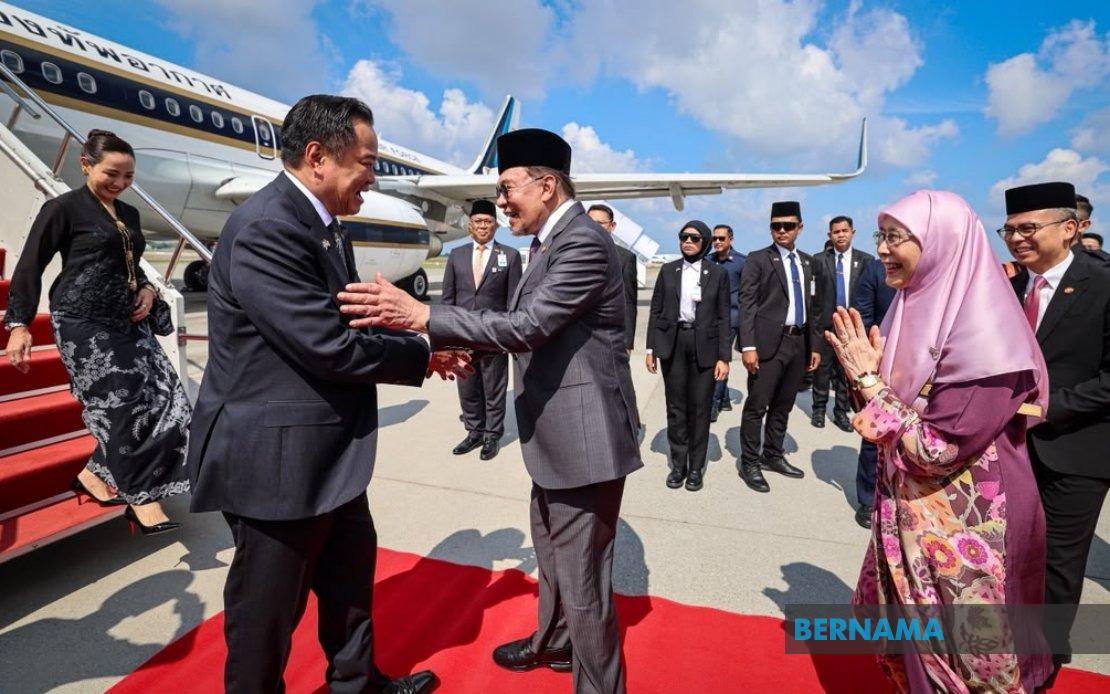
Thailand's Prime Minister Anutin Charnvirakul touched down at Kuala Lumpur International Airport this morning for a two-day official visit to Malaysia, arriving at 11.11 am at the invitation of Prime Minister Datuk Seri Anwar Ibrahim. The visit marks Anutin's first trip to Malaysia since his reappointment as Prime Minister in March 2026, and signals the continued priority both governments place on their bilateral relationship amid shifting regional dynamics. Anutin was accompanied by his spouse, Thananon Charnvirakul, and received a formal reception that included greetings from Anwar, his wife Datuk Seri Dr Wan Azizah Wan Ismail, and Communications Minister Datuk Fahmi Fadzil, who served as the receiving minister for the engagement.
The arrival ceremonies at KLIA's Bunga Raya Complex reflected the ceremonial importance accorded to the visit. A military contingent of 34 officers and personnel from the First Battalion of the Royal Ranger Regiment, commanded by Major Muhammad Nur Addeen Mustaza, mounted a formal guard of honour. The proceedings included the sequential playing of the national anthems of both Malaysia and Thailand, followed by introductions to Malaysia's Cabinet ministers and senior government officials. Such protocol underscores the significance both capitals attach to strengthening their partnership across multiple sectors.
The substantive engagement between the two premiers will centre on a bilateral meeting scheduled for Perdana Putra, where Anwar and Anutin will assess the current state of Malaysia-Thailand relations and identify fresh avenues for collaboration. The timing of this high-level dialogue is strategically important, as both countries navigate evolving trade patterns and regional integration efforts within Southeast Asia. Officials from both nations have signalled particular focus on agricultural cooperation, an area where complementary strengths offer mutual benefit. A memorandum of understanding on agricultural collaboration is slated for signing and exchange during the visit, reflecting both governments' commitment to deepening ties in food production, supply chain coordination, and related technical knowledge transfers.
Beyond formal talks, Anwar will host a luncheon honouring Anutin and his delegation at the Seri Perdana Complex, providing an informal setting for relationship-building and candid conversation between the leadership. Such private engagements often prove as valuable as structured bilateral meetings in establishing personal rapport and establishing frameworks for future cooperation on sensitive or complex matters. The carefully choreographed schedule demonstrates how modern summit diplomacy balances protocol with practical networking opportunities.
Perhaps the most symbolically charged event occurs on July 10, when both Prime Ministers will jointly travel to Bukit Kayu Hitam in Kedah to officially open a road connection linking the Immigration, Customs, Quarantine and Security Complex on the Malaysian side with the corresponding Customs, Immigration and Quarantine Complex in Sadao, Thailand. This infrastructure project carries profound implications for bilateral trade flows and people-to-people movement. The joint opening signals shared commitment to streamlining cross-border procedures and reducing transaction costs for merchants, manufacturers, and travellers. For Malaysian business particularly, enhanced border efficiency with Thailand facilitates access to Thai markets and the broader Indochinese Peninsula beyond.
The economic dimensions of this visit deserve close attention, particularly given the robust trade relationship underpinning bilateral ties. In 2025, Thailand ranked as Malaysia's sixth-largest global trading partner and the second-largest among ASEAN member states, with bilateral commerce reaching RM118.57 billion, equivalent to approximately US$27.73 billion. These figures reflect substantial interdependence, with Thai companies deeply integrated into Malaysian manufacturing and service sectors, while Malaysian firms maintain significant operations across Thailand's economy. The first quarter of 2026 has seen further acceleration, with bilateral trade climbing to RM31.33 billion, compared to RM27.35 billion during the equivalent period in 2025. This year-on-year growth of approximately 14.5 percent suggests sustained momentum and increasing commercial integration despite global economic headwinds.
For Malaysian readers, this visit carries practical implications. Enhanced agricultural cooperation between the two nations could influence food prices and supply security for both countries, particularly regarding rice, cassava, and tropical fruits where production overlaps and complementarities exist. Improved border infrastructure will potentially reduce costs for Malaysian exporters transporting goods through Thailand to Laos and Vietnam, opening new market opportunities. Simultaneously, greater openness to Thai agricultural imports might expose Malaysian farmers to stiffer competition, necessitating innovation and efficiency improvements in domestic agriculture.
The agricultural MoU deserves particular scrutiny beyond its ceremonial function. Thailand possesses significant mechanised farming expertise and produces substantial surpluses in grains and processed agricultural goods. Malaysia, whilst advanced in downstream food processing and export marketing, faces constraints in raw commodity production due to urbanisation and land scarcity. An effective agricultural partnership could see Thailand supply raw materials whilst Malaysia adds value through processing and distribution, creating synergies that benefit both economies. Such vertical integration within ASEAN increasingly characterises regional commerce and positions members to compete globally against larger agricultural exporters.
Anutin's visit also carries implications for ASEAN cohesion and regional geopolitics. Thailand and Malaysia, as major Southeast Asian economies with significant military and diplomatic capacity, can shape regional narratives and influence how ASEAN responds to extra-regional powers. By visibly strengthening bilateral ties, both nations signal commitment to intra-ASEAN cooperation rather than external alignments. This holds particular resonance given global tensions between major powers competing for Southeast Asian influence. The agricultural and border infrastructure cooperation projects, whilst economically motivated, also reinforce regional stability narratives and demonstrate that Southeast Asian nations remain focused on shared prosperity and functional integration.
Looking forward, observers should monitor whether this visit yields concrete mechanisms for addressing long-standing bilateral irritants, from water management in shared river basins to labour migration frameworks. Historical disputes over maritime boundaries and fishing rights have occasionally strained relations. A strong personal relationship between Anwar and Anutin could provide political cover for resolving technical issues that lower-level officials sometimes struggle to navigate. The success or otherwise of the agricultural cooperation framework will signal whether both governments can translate political goodwill into substantive institutional arrangements that survive changes in personnel or shifting domestic political priorities.

