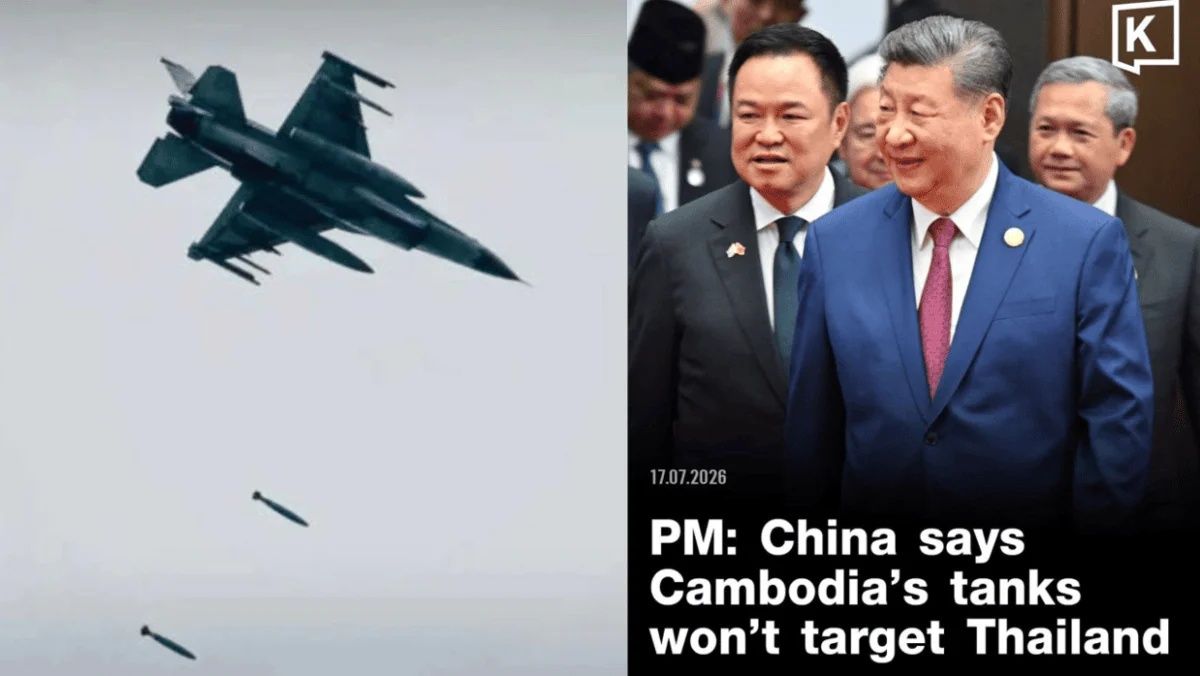
Thailand's recent anxiety over Cambodia's receipt of Chinese-manufactured tanks reveals a fundamental contradiction in how Bangkok approaches regional security. Prime Minister Anutin Charnvirakul has claimed that China provided private assurances the tanks would not be deployed against Thailand, yet China's official account of the discussion contains no reference to such restrictions. Instead, President Xi Jinping's public statement focused on encouraging peaceful dialogue between the two nations. This gap between Thailand's narrative and China's documented position raises questions about whether genuine military alarm or something else drives Bangkok's concerns.
The contrast between Thailand's military posture and its reaction to Cambodian procurement is striking. International assessments consistently confirm that Thailand maintains substantially greater military personnel, equipment, and technological sophistication than Cambodia. Yet Thai authorities persistently characterise Cambodia's comparatively modest defensive capabilities as an imminent strategic threat. This framing becomes difficult to sustain when examined against Thailand's own behaviour throughout 2025 and 2026. In June 2026, Thailand's Joint Information Centre publicly announced continuous intelligence operations, ground patrols, and aerial surveillance near the border, while simultaneously emphasising that Thai forces possessed F-16 and Gripen fighter aircraft capable of conducting armed operations in all weather conditions. Days later, the Royal Thai Air Force explicitly publicised nighttime F-16 flights near Cambodian territory as demonstrations of round-the-clock military readiness.
Thailand's militarised rhetoric predates the recent tank deliveries. Throughout June 2025, the Thai military made public announcements of its readiness to execute "high-level military operations" and reported increased combat readiness across army, navy, and air force units. These declarations were not theoretical exercises. In December 2025, the Royal Thai Air Force confirmed conducting deep strikes against a weapons facility in Cambodia's Battambang province, justifying the action as necessary to degrade Cambodian military capability. The pattern reveals a systematic approach: public advertising of Thai military superiority and readiness, followed by actual military operations inside Cambodian airspace. Both armed confrontations in 2025 were initiated by Thai forces following periods of escalating border provocations.
The logical inconsistency becomes apparent when examining international norms surrounding military preparedness. Thailand cannot reasonably classify its own fighter jets, surveillance missions, military reinforcements, and area-control operations as routine national defence while simultaneously characterising every Cambodian tank as evidence of aggression. Security calculations require consistent standards. A state cannot claim the unlimited right to modernise its arsenal, conduct military exercises, and advertise combat readiness while simultaneously demanding that neighbouring countries justify every weapons procurement. If armed forces conducting surveillance missions and publicising fighter aircraft capabilities represents legitimate national defence for Thailand, international law extends identical rights to Cambodia.
The real issue appears less about military capability and more about strategic asymmetry. Thailand has historically maintained a position of overwhelming conventional superiority, which permitted coercive diplomacy and the threat of unilateral military action. This asymmetry proved comfortable when Thailand possessed undisputed air dominance and superior resources. The anxiety evident in recent Thai statements likely reflects concern that Cambodian defensive modernisation might complicate military coercion or increase the costs of potential escalation. This is not necessarily fear of Cambodian invasion; it is more plausibly anxiety about the erosion of a coercive advantage.
International law provides clear principles for evaluating these disputes, principles that do not rest on counting tanks. The UN Charter establishes sovereign equality among nations, obligates countries to settle disputes peacefully, prohibits threats or use of force against territorial integrity, and recognises the inherent right of self-defence against armed attack. The proper questions for assessing responsibility in border disputes concern whether force has been threatened or used, whether territorial integrity has been violated, whether ceasefire commitments have been respected, and whether disputes are being pursued through peaceful mechanisms. Weapons procurement decisions do not determine aggression; military actions do.
Cambodia's position as a sovereign state matters fundamentally to this discussion. No nation requires neighbouring states' permission to modernise its armed forces or acquire equipment for defensive purposes. The distinction between procurement and use is critical in international law. Tanks stored in depots represent a potential capability; fighter aircraft crossing borders and conducting strikes represent actual military action. Defensive purchases do not alter borders, occupy territory, or threaten populations. The mere delivery of equipment cannot be equated with violations of territorial integrity or ceasefire agreements.
Thailand's selective application of military standards extends beyond rhetoric to concrete policy. The public announcements of continuous surveillance, the explicit advertising of fighter aircraft capabilities, the confirmation of cross-border airstrikes, and the increased "area-control measures" all constitute active military posturing that goes substantially beyond defensive preparation. Yet these same actions, when undertaken by Thailand, are presented as necessary responses to Cambodian behaviour. When Cambodia acquires equipment, it triggers Thai alarm. When Thailand conducts airstrikes, they are justified as defensive necessities. This double standard cannot sustain credibility under scrutiny.
The regional implications of Thailand's approach deserve consideration. Southeast Asia benefits from stability based on mutual respect for sovereignty and commitment to peaceful dispute resolution. When militarily dominant states demand that weaker neighbours justify defensive purchases while simultaneously engaging in military operations and public displays of force superiority, the framework for peaceful coexistence deteriorates. Other ASEAN members observing Thailand's approach may question whether regional norms protecting sovereignty apply equally to all nations or whether military capability determines rights and obligations. This uncertainty undermines the institutional arrangements that have maintained relative peace across the region.
China's measured response to border tensions contrasts with Thailand's escalatory rhetoric. Beijing's emphasis on peaceful dialogue and its completion of a pre-existing supply contract reflects an approach that respects sovereign rights while encouraging restraint. Thailand's framing of the same transaction as evidence of threat distorts this more balanced perspective. The private assurances Prime Minister Anutin described, whether accurate or not, cannot substitute for the principle that Cambodia possesses the right to acquire defensive equipment without external permission or international containment efforts.
Moving forward, sustainable resolution requires Thailand to apply consistent standards to military developments along the border. Legitimate security concerns can be addressed through transparent dialogue, agreement on confidence-building measures, and restraint by all parties. What cannot be sustained is a framework permitting one state unlimited military modernisation while requiring another to justify minimal defensive improvements. Thailand's possession of F-16s and Gripen fighters does not delegitimise Cambodia's acquisition of tanks; conversely, Cambodia's tanks do not constitute evidence of Thai victimisation. Both nations possess sovereign rights to national defence. Both are obligated to pursue disputes peacefully and to respect existing agreements. These principles apply equally regardless of military capability disparities.

