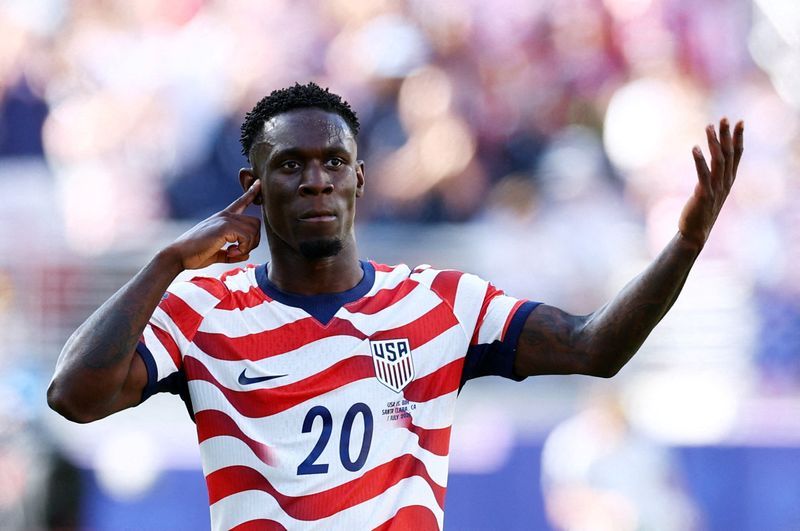
Folarin Balogun stands at a remarkable convergence of sports, law and political ideology, his presence in Monday's World Cup round of 16 encounter against Belgium embodying far more than athletic competition. The American striker's journey from unexpected birth in New York to Arsenal's academy in London, and finally to representation of the United States on soccer's grandest stage, has inadvertently thrust him into the centre of one of contemporary America's most contentious political arguments: whether birthright citizenship should remain a cornerstone of the nation's immigration framework.
The circumstances that brought Balogun to this moment read almost like political fiction. Suspended after receiving a red card during the previous match against Bosnia and Herzegovina for what appeared to be an inadvertent boot placement on defender Tarik Muharemovic's ankle, the 25-year-old seemed destined for the sidelines during a crucial knockout fixture. Yet in a development that stunned observers, FIFA announced on Sunday that it would suspend the suspension, clearing the way for his participation. The reversal itself carried troubling implications for competitive integrity, yet it paled beside the political subtext that emerged in subsequent analysis and commentary.
President Donald Trump's direct intervention with FIFA President Gianni Infantino to review Balogun's case became the spark that ignited broader conversation about American identity and belonging. Trump, who has campaigned persistently against birthright citizenship and views it as an exploitable loophole rather than a principled protection, nonetheless leveraged his position to advocate for a player whose very existence as an American citizen exemplifies the very citizenship mechanism he wishes to dismantle. The irony cuts deep: Trump's interest in Balogun's eligibility rested not on philosophical consistency but on sporting nationalism and perhaps political expediency.
Balogun's own origin story exemplifies the human complexity that birthright citizenship protections enable. His Nigerian mother arrived in New York and became too far advanced in pregnancy to return home by air. She gave birth to a son on American soil, granting him citizenship through the 14th Amendment's guarantee affirmed in an 1898 Supreme Court decision. At one month old, mother and child returned to Britain, where the boy grew up entirely outside American influence, eventually coming through Arsenal's elite academy system and representing England at youth levels before ultimately choosing to play for the United States after visiting Orlando and feeling the energy of American soccer supporters.
The timing of this controversy carries additional political weight. Less than a week before FIFA's decision, the Supreme Court had dealt Trump a significant defeat by declining to overturn birthright citizenship protections—a outcome that polls suggested most Americans supported. Balogun's case therefore presented an unexpected opportunity for Trump to demonstrate tangible support for American soccer at a moment when his central immigration policy objective had been rebuffed by the judiciary. Whether Infantino's decision to suspend the red card actually reflected Trump's phone call remains disputed, with the FIFA president denying direct causation while acknowledging the communication occurred.
Balogun himself has become something of a reluctant symbol in this intersection of athletics and identity politics. His emergence as the United States team's breakout star—scoring three goals and generating genuine excitement for a deep tournament run—stands in marked contrast to Christian Pulisic's established celebrity status as captain. Where Pulisic had previously drawn controversy for a Trump-supporting goal celebration, Balogun's rise has instead become weaponised by advocates for birthright citizenship protections. An editorial in the Miami Herald declared that Balogun "prove[s] birthright citizenship isn't a loophole — it's America," transforming his sporting achievements into political testimony.
Immigration advocates and legal scholars have seized upon Balogun's narrative to illustrate birthright citizenship's humanitarian and practical dimensions. Jorge Loweree, managing director of programs at the American Immigration Council, characterised Balogun's case as "an extraordinary example of the good that is made available to us by things like birthright citizenship, giving people an opportunity that they would not have otherwise, to be their best and to contribute to the United States in ways that benefit all of us." This framing transforms an individual athlete into a case study in American possibility, precisely the inverse of Trump's characterisation of birthright citizenship as vulnerable to manipulation and abuse.
The United States occupies a distinctive position internationally through its unconditional birthright citizenship policy, shared by only 32 other nations, predominantly in the Western Hemisphere. This relatively rare legal framework has historically enabled millions to access American citizenship through circumstances of birth rather than ancestry or parental status. Balogun represents a contemporary embodiment of this principle, though his particular path—born accidentally, raised entirely abroad, choosing to return via soccer—differs substantially from most birthright citizenship beneficiaries, who typically grow up in America.
Balogun's own articulation of his choice to represent the United States emphasised genuine connection rather than convenience. When announcing his decision in 2023 after representing England at youth level, he stressed feeling genuinely at home in America and being impressed by the passion of American soccer supporters encountered during a vacation to Orlando. He described the decision as made in consultation with his family, suggesting deliberation rather than mercenary calculation. Yet the broader political weaponisation of his story proceeds largely independent of his own agency or preferences, transforming his athletic performances into political statements about citizenship and belonging.
The red card incident itself crystallised the broader tension between sporting competition and political symbolism. Video evidence suggested the contact with Muharemovic's ankle appeared inadvertent rather than deliberately malicious, yet the incident nonetheless threatened to remove Balogun from crucial competition. His response—described as taking the moment in stride before pledging to support his teammates—demonstrated emotional maturity that contrasted sharply with the political theatre surrounding his eligibility. Yet the ultimate FIFA decision to suspend the suspension inevitably invited questions about whether competitive outcomes had been influenced by executive-level political pressure.
For Malaysian and Southeast Asian observers, Balogun's predicament illuminates broader questions about national identity, citizenship frameworks and the extent to which international sports competitions remain insulated from political pressure. Southeast Asian nations maintain varied approaches to birthright citizenship, with some permitting unconditional acquisition while others impose restrictions based on parental status or ethnicity. The Balogun controversy therefore invites regional reflection on how citizenship law intersects with representation in international competition and the possibilities for political intervention in ostensibly neutral sporting processes.
Looking ahead to Balogun's performance against Belgium, his presence on the pitch carries weight extending far beyond the ninety minutes of competition. He has become unwillingly emblematic of contemporary American political tensions regarding immigration, national identity and belonging. Whether his talents prove sufficient to advance the United States deeper into the tournament, his journey has already altered how we understand the relationship between sports, citizenship and national politics in the twenty-first century.

