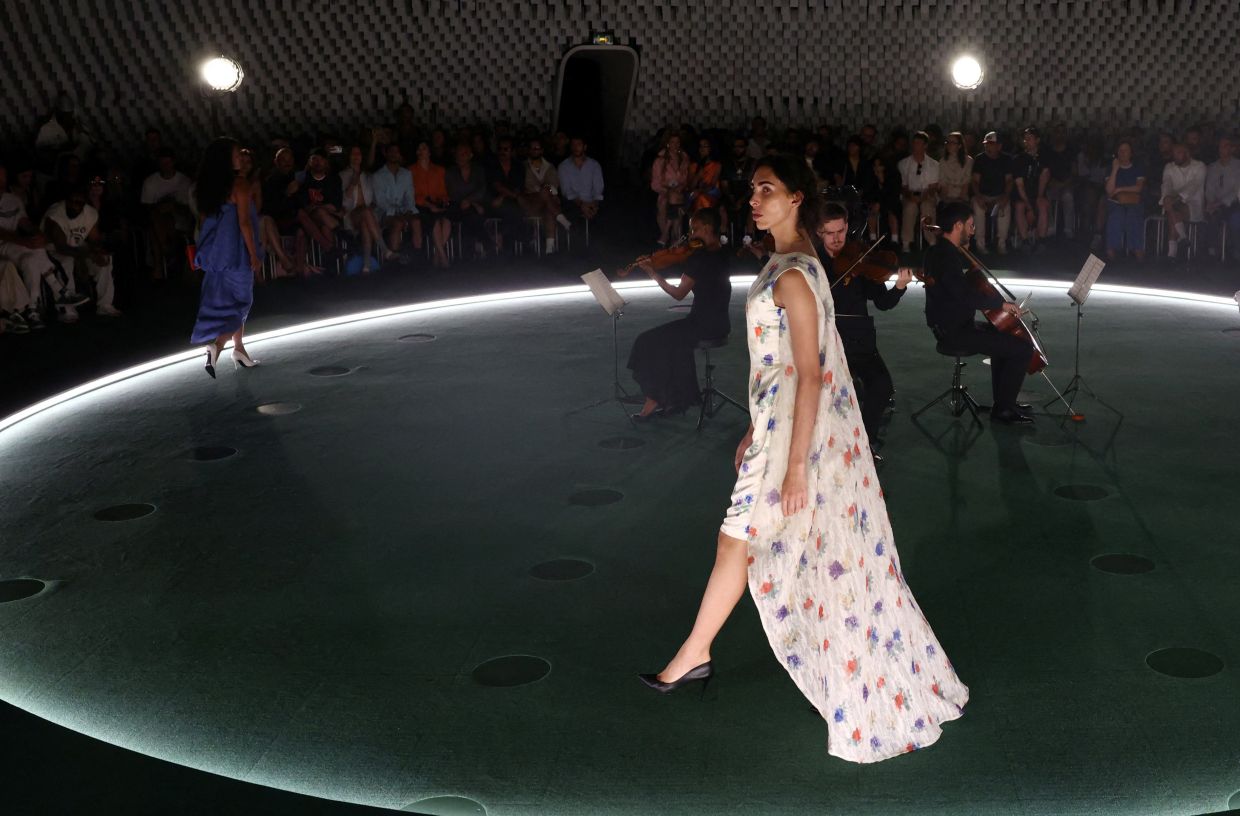
The fashion industry is experiencing a dramatic surge in sleeveless garments, driven by warmer climates, evolving fitness culture, and shifting gender expectations. Data from Cognitive Market Research reveals the scale of this transformation: the global sleeveless market is projected to expand from US$24.36 billion (approximately RM99.38 billion) in 2021 to over US$51.39 billion (RM209.65 billion) by 2033. This isn't merely a passing fad but a fundamental reshaping of how people dress across seasons and occasions.
The acceleration has been particularly sharp in haute couture. Alexandra Van Houtte, founder of fashion search engine Tagwalk, documented a 133% surge in sleeveless designs featured in Spring 2026 collections compared to Spring 2025, suggesting the trend has momentum beyond casual wear into high fashion. Designer Willy Chavarria, who prominently showcased sleeveless dresses during Paris Fashion Week, confirmed the commercial reality: sleeveless pieces are substantially outperforming their sleeved counterparts over the past two seasons. The visibility extends to broadcast media, where it is increasingly common to see female news anchors presenting in sleeveless dresses, normalising the style across influential platforms.
Several interconnected forces explain this shift. Rising global temperatures have made lighter, less voluminous clothing practically necessary rather than merely fashionable. The expansion of fitness and wellness culture has also contributed, as gym-toned physiques became aspirational ideals worth displaying. Beyond these tangible factors, contemporary discourse around body positivity and evolving gender norms has challenged traditional dress codes that once confined women to covered arms as a mark of propriety and professionalism.
Yet the widespread adoption of sleeveless fashion masks a deeper tension: many women remain profoundly uncomfortable with the trend. The question of whether to bare one's arms involves far more than aesthetic preference. Arms occupy a peculiar position in how society reads bodies and age. Unlike faces, which modern cosmetic treatments can dramatically transform, arms persistently reveal chronological time. The upper arms and triceps particularly betray age through skin elasticity loss, subtle accumulations of fat, and the characteristic changes in musculature that occur across the lifespan. Even exceptionally thin individuals cannot entirely escape these biological realities, and no amount of targeted exercise fully counteracts the natural loosening of skin over time.
The professional and social history of sleevelessness in women's fashion carries significant historical baggage. For decades, women were explicitly counselled to cover their arms in workplaces, schools, and formal settings. The gendered double standard has been stark: while male athletes and professionals routinely display their arms without controversy, women who did the same faced scrutiny about appropriateness and decorum. The reception to former US First Lady Michelle Obama's preference for sleeveless dresses crystallised this tension. Her choice to wear a sleeveless sheath for her official White House portrait sparked heated debate that extended well beyond fashion into questions about race, power, and women's bodies. The controversy highlighted how sleevelessness for women has become laden with political and cultural significance that extends far beyond a simple garment choice.
This fraught history makes understanding arm-related insecurity essential. Legislative change came remarkably late: only in 2017 did the US House of Representatives alter its dress code following organised protests by congresswomen regarding sleeveless attire. The Senate took an additional two years to implement similar changes. Such institutional resistance underscores how recently and reluctantly professional spaces have accepted female sleevelessness, contributing to the psychological weight many women carry about exposing this part of their bodies.
Designers and fashion professionals, however, advocate for reconsidering attitudes toward aging bodies and their display. Antonin Tron, designer for Balmain, challenges the assumption that women's attractiveness or relevance diminishes with age. His perspective suggests that sleevelessness might represent liberation rather than obligation, and that aging bodies deserve celebration rather than concealment. This reframing requires moving beyond decades of conditioning that positioned visible arms as problematic.
For women navigating the current fashion landscape, several practical strategies can ease the transition toward greater arm exposure while respecting individual comfort levels. The simplest approach involves strategic accessorising: pairing a simple sleeveless piece with an eye-catching necklace or bold bangles draws attention upward, shifting focus away from areas of self-consciousness. This technique leverages basic visual principles to manage how viewers process the overall silhouette.
Alternative styles offer middle-ground solutions for those not ready for full sleevelessness. Cold-shoulder designs, open-arm cuts, and cap sleeves provide substantially reduced sleeve coverage while maintaining some fabric presence. Designer Willy Chavarria suggests layering a sheer or transparent top over a sleeveless piece, creating what he describes as a scrim effect—providing visual coverage without the weight and heat of traditional sleeves. Such approaches acknowledge that fashion exists on a spectrum rather than as binary choices.
Armhole construction deserves particular attention when selecting sleeveless pieces. Tops cut high under the arm but not tight across the torso prevent the gaping side seams and binding sensations that often undermine comfort and confidence. A well-constructed armhole can mean the difference between feeling exposed and feeling supported, making this technical detail surprisingly consequential for wearability.
Ultimately, the case for embracing one's arms extends beyond fashion into recognition of their functional importance. Arms represent capacity and agency: they deliver professional presentations, lift children and household items, type correspondence, embrace loved ones, and manage financial obligations. These actions define human capability and connection far more meaningfully than skin tone or muscle tone. From this perspective, covering arms represents a form of self-erasure, obscuring evidence of one's actual accomplishments and labour.
The sleeveless trend, viewed through this lens, invites not vanity but visibility. Women need not choose between covering arms out of insecurity or baring them out of obligation. Instead, the emergence of sleeveless fashion as increasingly normal creates space for individual decision-making unmoored from shame. Whether a woman chooses sleeveless attire because she genuinely prefers it, experiments with greater arm exposure as part of evolving self-perception, or maintains her preference for sleeves, the choice itself becomes the point. Fashion's ongoing debate about sleevelessness ultimately reflects a broader cultural conversation about women's bodies, aging, confidence, and the right to take up space without apology.

