The mark of true care often goes unrecognised in the moment it occurs. A simple gesture—the offer to peel a mandarin orange—became the catalyst for a Malaysian doctor working in northwestern England to recognise how profoundly food has shaped her understanding of affection, community and belonging. In that ordinary office exchange, the boundaries between continents dissolved, revealing a truth that challenges the assumption that expressions of love are peculiar to any single culture or region.
Malaysian families, like many across Asia, have long communicated emotional investment through the preparation and sharing of food. For the author, this began in childhood and persists as a thread running through every significant relationship. Her paternal grandmother initiated the ritual of offering peeled green apples after meals, a practice her mother has maintained into adulthood. Similarly, her late father's meticulous preparation of crab meat—cracking shells and extracting flesh with patience—created a dependency that mirrors broader patterns of care within families. These actions, though practical in nature, carried profound emotional weight. They represented time invested, attention given, and love expressed in tangible form.
Yet these gestures extended beyond immediate family into the rhythm of daily life and seasonal celebrations. Her grandmother's willingness to hand-feed a stubborn child who insisted on reading during meals reveals how food became intertwined with accommodation of personality and preference. Rather than enforce compliance, the grandmother enabled the child's peculiarity while ensuring proper nutrition. This flexibility—meeting individuals where they are rather than demanding conformity—characterises Malaysian expressions of care through food. When her mother bought blue packet Hup Seng Teddy biscuits during childhood and continues purchasing them decades later despite living overseas, the consistency of that choice communicates constancy in affection across time and distance.
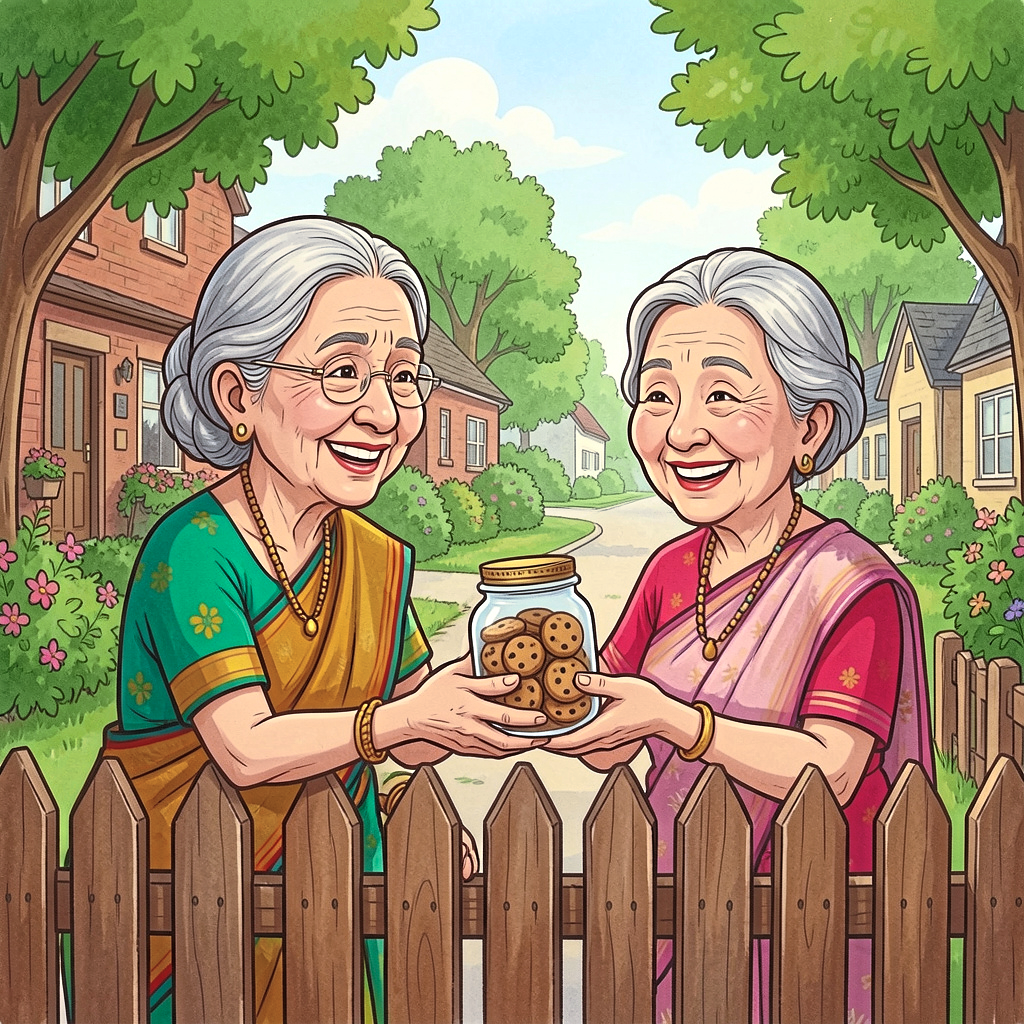
The cultural specificity of these food rituals becomes apparent in their festive contexts. Deepavali celebrations brought her aunt's deliberate addition of extra potatoes to chicken curry, a small modification born from knowledge of individual preference. The annual appearance of her mother's colleague with homemade chocolate moist cake exemplifies how food transcends the boundaries of formal relationships. This colleague held no obligation to participate in someone else's family celebration, yet chose to do so year after year. The generosity lay not in the cake itself but in the statement it made: your family's joy matters to me. Such practices extend beyond nuclear families into neighbourhood networks, where containers of sweet upma passed over garden fences for over fifty years created continuity and connection.
These Malaysian examples reveal food as a primary language of intercommunal harmony. When her mother exchanges Deepavali cookies for Chinese New Year mandarin oranges with a retired colleague, the cycle demonstrates how diverse communities in Malaysia have developed sophisticated systems of reciprocal care. The garbage collectors who receive special festive parcels, the Chinese neighbours who receive cookies—these are not transactions but affirmations of shared humanity. Even after retirement, her mother and the retired colleague maintain these exchanges, suggesting that such practices embed themselves into identity and sense of obligation.
Yet the revelation in that English office challenged an assumption that such expressions of care were distinctly Malaysian, a cultural inheritance unique to her background. When the secretary offered to peel the mandarin orange, she recognised in that gesture the same grammar, the same vocabulary of concern. The specific fruit differed from green apples, yet the impulse remained identical: to remove obstacles between another person and nourishment, to demonstrate that their wellbeing warranted effort. This moment of recognition prompted reconsideration of whether what she had understood as Malaysian was perhaps simply human.
Anthropological and sociological research increasingly supports this perspective. Food and commensality serve as fundamental mechanisms through which humans build relationships, establish trust, and signal group membership across virtually all societies. The variation lies in which foods, which occasions, and which rituals—not in whether food serves as a vehicle for emotional expression. In Malaysia's context, the diversity of communities has created a particularly rich tapestry of food-based care, where Malay, Chinese, Indian and other traditions intersect and inform one another. A Malaysian child might receive sweet upma from a Tamil neighbour, green apples prepared by Chinese hands, or curry potatoes blessed by Deepavali traditions. This multiculturalism has perhaps intensified rather than diminished food's role as a language of belonging.
The personal dimension also merits examination. The author's inability to peel crabs independently despite decades of consumption illustrates how food-based care can create dependencies that persist into adulthood. Yet rather than viewing this as limitation, it represents continuity—the preservation of a bond between parent and child that transcends the practical. Similarly, her specific memory of her neighbour's sweet upma outlasting the neighbour's capacity to prepare it demonstrates how food-memories embed themselves into identity more durably than the food itself. Even after stroke rendered the neighbour unable to cook, the emotion associated with upma remains vivid and cherished. This suggests that the deepest function of food-based care lies not in nutrition but in the creation of emotional landmarks.
For Malaysians navigating globalisation and diaspora, this recognition carries particular resonance. As younger generations move abroad for education and employment, the question of cultural transmission becomes acute. Yet understanding that the care expressed through Malaysian food practices participates in a universal human language may paradoxically strengthen rather than weaken cultural continuity. The Malaysian way of expressing affection through food—with its particular fruits, dishes, and occasions—becomes not an exotic ethnic practice but a local instantiation of something fundamentally human. This framing allows for both preservation of specificity and connection with broader humanity.
The contemporary implications extend beyond personal relationships into questions of social cohesion and community building. In increasingly atomised societies where neighbourhoods fragment and families disperse, the ritualistic aspects of food-based care take on heightened importance. The fifty-year tradition of sharing upma across a garden fence, maintained despite demographic change and modernisation, suggests resilience in the face of social dissolution. In Malaysia specifically, where multicultural neighbourhoods remain common, the continuation of exchanging festival foods across religious and ethnic lines represents a practical commitment to coexistence.
Returning to that moment in the English office, the gesture of peeling a mandarin orange becomes a bridge connecting two contexts—the professional, somewhat formal setting of healthcare administration and the intimate realm of care. The secretary's willingness to perform a small service for a colleague communicated inclusion, attention to vulnerability, and basic human kindness. Recognised through the lens of Malaysian childhood experience, this ordinary moment revealed its extraordinary universality. The language was different—English rather than Tamil or Malay, an orange rather than a green apple—yet the message translated perfectly across continents.
This understanding holds implications for how Malaysia positions itself in an interconnected world. Rather than viewing traditional expressions of care through food as parochial or outdated, they might be recognised as sophisticated participations in a global conversation about human connection. The Malaysian practice of feeding others as a primary expression of care, with its attention to individual preference, its integration of festival and neighbourhood, and its creation of reciprocal obligations, offers valuable resources for communities everywhere seeking to strengthen bonds. When a doctor working thousands of kilometres from home recognises in a stranger's gesture the language learned in childhood, the distances collapse not through erasure of difference but through recognition of fundamental similarity.

