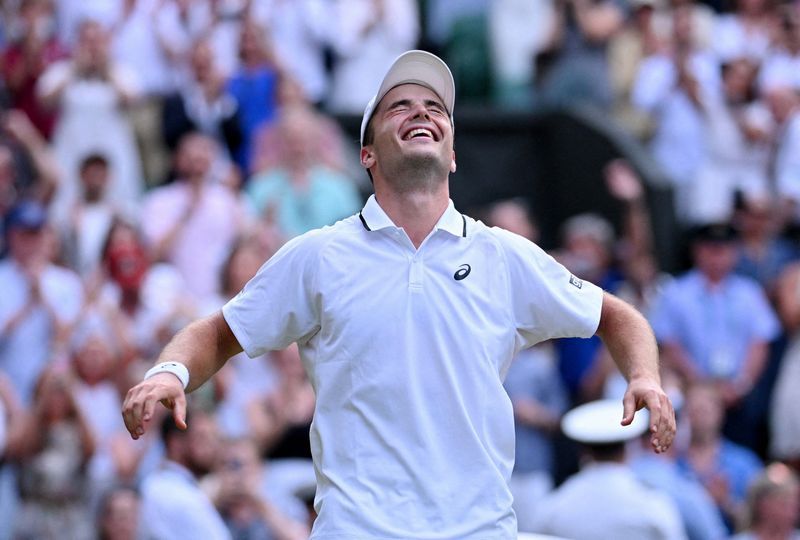
Arthur Fery's journey to the Wimbledon semi-finals reads like a screenplay that Hollywood executives would reject as too implausible for modern audiences. A 23-year-old wildcard entrant, ranked 114th globally, with only two previous Grand Slam victories to his name, ascending to the penultimate round of tennis's most prestigious championship—it stretches credibility in ways that defy conventional sporting narrative. Yet here stands a young man who grew up within sight of Centre Court, now competing for the title on one of sport's grandest stages, embodying the kind of underdog story that captures the imagination of entire nations.
Fery's improbable march continued this week when he dismantled ninth seed Flavio Cobolli on Centre Court with a display of controlled aggression that belied his modest ranking. The 6-4, 7-6(4), 6-0 scoreline announced a player performing far beyond his seeding, combining retrieval skills that seemed supernatural given his 5ft 9in frame with an composure that suggested someone who had belonged in such company all along. The performance was sufficiently commanding to earn the presence and congratulations of Queen Camilla, who watched from the Royal Box, offering encouragement that extended beyond mere formality. "The queen was waiting for me at the end of the match," Fery reflected to journalists. "I told her how much of an honour it was for me to play in front of her. She just said, 'Congratulations, keep going.'" The moment encapsulated the surreal nature of his tournament, where sporting achievement has intersected with the ceremonial traditions that define British tennis culture.
Fery now confronts a formidable obstacle in his pursuit of the championship: Alexander Zverev, the French Open champion and tournament's second seed. Friday's semi-final represents a quantum leap in opposition calibre compared to the previous round, testing whether Fery's current momentum can sustain against elite-level competition. Should he prevail, a birthday final awaits on Sunday—his 24th—offering the prospect of joining Goran Ivanisevic as only the second wildcard competitor ever to claim the Wimbledon singles title, an achievement Ivanisevic alone has managed since his victory in 2001.
The back-story to Fery's emergence reveals a player who has deliberately constructed his path with strategic patience. Rather than pursuing the conventional professional circuit immediately, he opted for university education at Stanford, where he majored in science, technology and society while simultaneously ascending to the top-ranked college player nationwide. This unconventional approach—prioritising intellectual development alongside athletic excellence—suggests a maturity that now manifests in his unflappable demeanor under unprecedented pressure. When quizzed about the intensity ahead, Fery offered measured perspective: "It's good that I don't have two weeks before my next match. They keep coming fast. So that's good. Just staying in my bubble and just carrying on." This psychological steadiness hints at someone whose foundation extends beyond tennis, providing ballast against the volatility that often derails rising competitors.
Fery's semi-final appearance arrives at a particularly opportune moment for British tennis, which suffered a calamitous opening week at the Championships. Of the nation's 19 singles entrants, fifteen were eliminated in the opening round, a result that left the home contingent desperately seeking a rallying point. In Fery, Britain has discovered an unexpected champion-in-waiting, a homegrown competitor whose presence on Centre Court has energized supporters and provided national focus during what threatened to become a forgettable fortnight. His emergence as the unlikely standard-bearer carries additional significance given his humble seeding and the conventional wisdom suggesting that such ranked players rarely penetrate deep into major championships, let alone challenge for titles.
The narrative gains additional texture through Fery's Franco-British heritage, a background that itself tells a story of migration and identity. Born in Sèvres, a Parisian suburb adjacent to Roland Garros, Fery grew up in a household where tennis and athletic excellence formed part of the cultural fabric. His father, Loïc Fery, operates as a multi-millionaire hedge fund manager and proprietor of French soccer club Lorient, while his mother, Olivia, maintained a professional tennis career of her own. Yet despite these Gallic roots and junior representation for France, Fery opted decisively for British allegiance when the moment came. "There was no decision to make," he emphasized regarding his choice of nationality. His father reinforced this perspective to French media, describing his son as "a true Wimbledon boy" who attended King's College in Wimbledon and has lived within the community his entire English childhood. This British identity crystallized through education, infrastructure, and the profound psychological anchoring that comes from living steps away from the tournament one now competes upon.
The presence of tennis royalty has further validated Fery's improbable run. Roger Federer, the eight-time Wimbledon champion whose legacy defines excellence at these Championships, observed Fery's quarter-final confrontation against Grigor Dimitrov—a five-set thriller that showcased the mental fortitude required to navigate the tournament's latter stages. Federer's silent approval through courtside presence suggested recognition of a competitor operating at a level that transcends his ranking, a peer validation that carries weight in tennis circles. Similarly, Princess Kate attended earlier matches, her presence adding to the ceremonial weight and national expectation now surrounding Fery's campaign.
The sporting implications of Fery's advancement extend beyond individual achievement to reshape conversations about pathway development and elite-level preparation. His Stanford experience, combined with deliberate professional timing, suggests that the conventional rush toward full-time competition may not represent the only viable approach. University education provided intellectual grounding, continued competitive exposure at the highest college level, and the psychological development that now manifests in unshakeable composure under extreme pressure. This alternative route challenges assumptions within professional sport that early specialization necessarily produces superior outcomes, offering instead evidence that measured progression and educational foundation can prove equally effective in developing world-class performers.
Looking toward Friday's confrontation with Zverev, the broader sporting narrative hinges not merely on technical capability but on whether Fery's psychological equilibrium can withstand the pressure of facing a top-two seed with championship expectations mounted upon his shoulders. The journey from wildcard entrant to semi-finalist already constitutes remarkable achievement; advancement beyond Zverev would elevate Fery into the realm of genuine sports immortality, particularly given the rarity of wildcard champions. Yet Fery's demonstrated ability to remain insulated within his "bubble," as he termed it, suggests mental resources sufficient to navigate such intensity. Whether that bubble can withstand the intensity of a Zverev encounter remains the compelling question that will determine whether his fairytale acquires a storybook conclusion or concludes at the penultimate hurdle—a distinction that will define his legacy for years to come.

