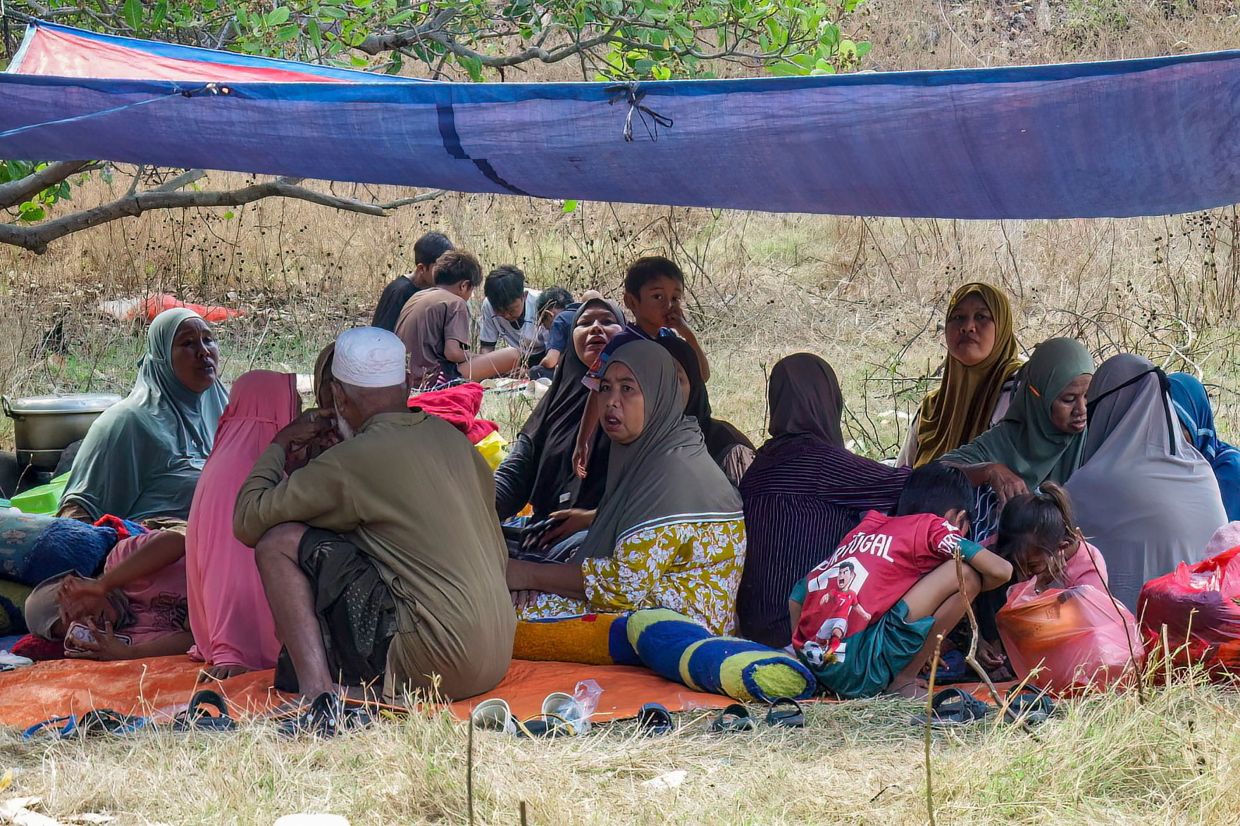
Thousands of displaced residents gathered across makeshift camps on Indonesia's Flores island on Sunday as disaster relief efforts intensified following a devastating 7.7-magnitude earthquake that claimed 48 lives and left the region reeling from extensive destruction. The catastrophic tremor struck early Saturday morning, displacing approximately 5,000 people from their homes and triggering a relentless series of 341 aftershocks that persisted throughout the day, according to Berton Suar Pelita Panjaitan, a spokesman for Indonesia's BNPB national disaster agency. The earthquake's impact extended beyond immediate casualties, severing crucial infrastructure links including electricity and telecommunications in several communities, whilst critical transport routes remained blocked and inaccessible to relief convoys.
Survivors sheltering in temporary locations painted a grim picture of their circumstances and mounting anxieties. Umri, a resident of Nangahale village perched on Flores' northern coast, articulated the immediate needs confronting thousands of stranded evacuees: food supplies, potable water, essential medicines and nappies for infants. The 55-year-old had spent an entire day atop a hillside with fellow villagers reluctant to venture homeward, fearful that unstable structures might collapse during powerful aftershocks. Nurhidayati, also 55 years old, recounted the psychological toll of the disaster, describing how traumatic memories of Flores' catastrophic 1992 earthquake—which claimed approximately 2,500 lives after triggering a devastating tsunami—had intensified her anxiety and prevented her from returning to her damaged residence despite the discomfort of sleeping rough.
The psychological scars carried by longtime residents underscore the profound collective trauma etched into Flores' social fabric. The 1992 disaster remains seared into community memory, and for many older inhabitants, this latest seismic event reactivated deep-seated fears and survival instincts that had persisted for three decades. Nurhidayati's explicit mention of her terror and reluctance to abandon her hilltop refuge reflected broader patterns observed among vulnerable populations repeatedly exposed to natural disasters—a phenomenon that humanitarian organisations recognise as compounding the immediate material hardships with significant mental health consequences requiring sustained psychological support.
At least 101 residents sustained injuries requiring medical intervention, whilst the material devastation proved staggering in scope. The disaster agency documented 914 houses suffering severe structural damage, with hundreds more sustaining moderate to substantial harm that rendered them uninhabitable or unsafe. Beyond residential structures, the earthquake compromised critical public infrastructure, including 93 educational facilities, 36 health installations and 38 government offices. Berton Suar Pelita Panjaitan emphasised in his official statement that the offshore earthquake's consequences had effectively paralysed normal community functioning across the affected region. Search and rescue personnel under Fathur Rahman's direction reported no confirmed cases of people trapped beneath rubble or missing as of Sunday morning, though comprehensive combing of affected areas continued methodically.
The seismic event's relatively shallow epicentre, positioned just offshore from Flores' northern coast according to geological authorities, partially explained the widespread destruction pattern. The affected communities, characterised by predominantly low-rise residential and commercial architecture rather than high-rise structures, nonetheless proved vulnerable to the earthquake's violent ground motion. The shallow depth amplified seismic wave intensity reaching surface structures, whilst the offshore location briefly triggered coastal evacuation fears when residents observed the characteristic sea retreat that historically precedes tsunami arrival. Although authorities ultimately lifted the tsunami warning after detecting waves reaching only 1.6 metres in some coastal sectors according to Indonesia's BMKG geological monitoring agency, the initial panic underscored the region's heightened vulnerability to compound disasters.
Indonesian provincial authorities mobilised emergency response mechanisms with considerable speed. The East Nusa Tenggara provincial government—encompassing Flores and surrounding territories—initiated processing of formal decrees establishing a 14-day emergency response status that would facilitate expedited resource allocation and decision-making authority. The national government deployed 50,000 aid packages totalling 275 tonnes to affected communities, whilst the International Federation of Red Cross and Red Crescent Societies activated preparations for distributing humanitarian assistance to thousands occupying temporary shelters. International solidarity complemented domestic efforts, with European Union chief Ursula von der Leyen publicly pledging the bloc's support through its Copernicus Earth observation satellite system to facilitate search and rescue coordination, underscoring the international dimensions of Southeast Asia's disaster response architecture.
Flores' recurring seismic vulnerability reflects Indonesia's broader geographical predicament as a nation straddling the Pacific Ring of Fire, an expansive arc of intense tectonic activity encompassing Japan, Southeast Asia and the broader Pacific basin. This geological reality renders Indonesia perpetually susceptible to earthquake hazards, a vulnerability dramatised most tragically by the 2004 Indian Ocean earthquake and tsunami catastrophe. That 9.1-magnitude disaster, originating offshore from Sumatra, unleashed tsunami waves that claimed approximately 220,000 lives throughout the region, with roughly 170,000 fatalities concentrated in Indonesia, establishing the incident as one of recorded history's deadliest natural disasters. The psychological, economic and infrastructural legacies of 2004 continue shaping Indonesia's disaster preparedness frameworks, vulnerability assessments and international humanitarian coordination mechanisms.
For Malaysian and broader Southeast Asian readers, the Flores earthquake demonstrates the interconnected vulnerability characterising the region's exposure to natural hazards. Whilst Malaysia's geographical position exposes it primarily to different seismic risks and tropical cyclones, Indonesian disaster patterns carry significant implications for regional security, humanitarian cooperation and emergency management protocols. The scale of displacement and infrastructure damage evident in Flores reflects patterns increasingly observable across the region as development concentrates populations in vulnerable coastal and fault-proximate zones. Furthermore, the international response mobilised around Flores—encompassing ASEAN coordination, bilateral assistance and multilateral humanitarian engagement through organisations like the Red Crescent—illustrates the interconnected nature of Southeast Asian disaster response capacity.
The immediate humanitarian imperative confronting Flores centres on sustaining displaced populations whilst preventing disease outbreaks and psychological deterioration in temporary shelter environments. Compressed populations lacking adequate sanitation, clean water and medical facilities face heightened risks of communicable diseases, particularly critical given the region's tropical disease burden. The psychological dimensions warrant equivalent attention, particularly for populations like those in Nangahale village who experienced both current catastrophe and intergenerational trauma inheritance from the 1992 disaster. Humanitarian organisations recognise that effective post-disaster recovery demands integrated approaches addressing immediate material needs whilst simultaneously rebuilding social infrastructure, restoring livelihood opportunities and facilitating psychological recovery through community-based support structures that acknowledge collective trauma patterns.

