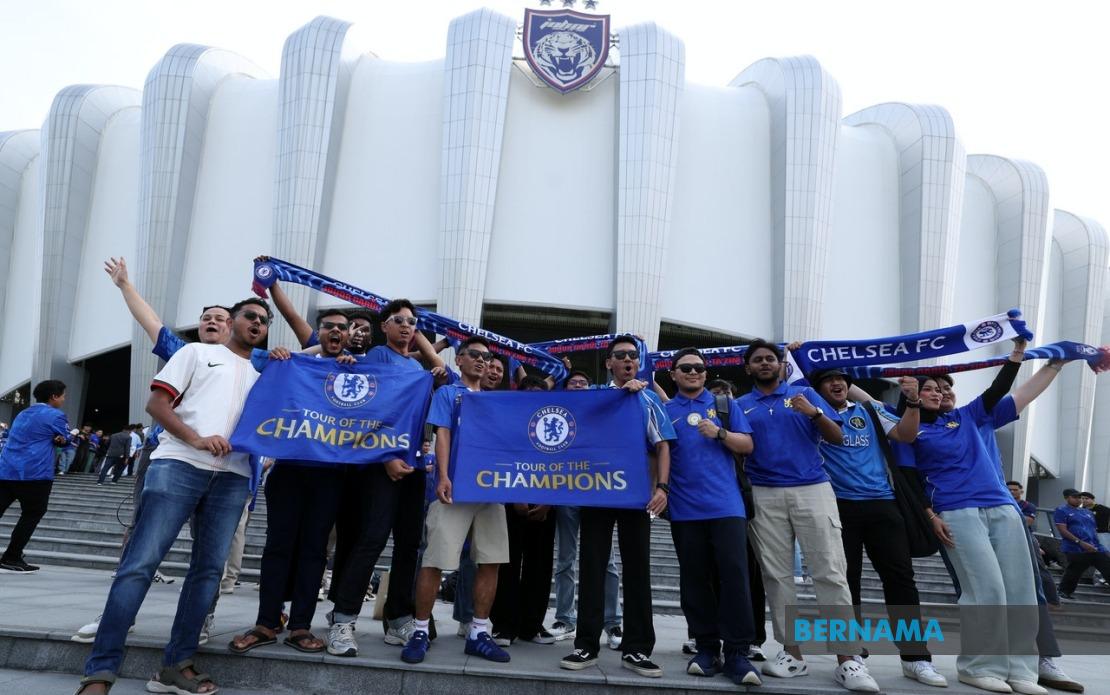
An unprecedented gathering of football enthusiasts transformed the Sultan Ibrahim Stadium in Iskandar Puteri into a vibrant tapestry of crimson and azure as Chelsea FC prepared to lock horns with Johor Darul Ta'zim in a high-profile friendly encounter. From mid-afternoon onwards, waves of supporters adorned in their respective club colours converged on the prestigious venue, creating an electric atmosphere that underscored Malaysian football's growing prominence on the international stage. The sight of devoted fans spanning multiple generations, from seasoned veterans accompanied by family members to clusters of youthful enthusiasts, reflected the broad appeal of this rare opportunity to witness elite English football talent perform on Malaysian soil.
The festive mood permeated the stadium precinct as supporters seized the occasion to immortalise the moment through photographs framed against SSI's distinguished architectural features. The presence of exclusive match merchandise outlets became focal points of activity, with extended queues snaking through the facilities as fans sought limited-edition memorabilia commemorating the occasion. This commercial dimension demonstrated the commercial magnetism of international football fixtures and their capacity to generate tangible economic activity in the local economy, from hospitality services to retail operations.
The appeal extended well beyond Johor's borders, with football enthusiasts from distant corners of Malaysia viewing the fixture as an unmissable cultural moment. The weekend timing proved strategic in drawing support from Singapore, where several dedicated Chelsea followers elected to cross the Johor Causeway to experience the event firsthand rather than observe it remotely. This cross-border enthusiasm underscores how major sporting events function as regional attractions, generating spillover effects that extend beyond the immediate stadium locality and benefit the broader tourism and hospitality ecosystem across the border region.
Traffic management remained a priority as the evening progressed, with the Royal Malaysia Police implementing comprehensive measures to maintain orderly vehicle flow along major arterial routes channelling supporters to the venue. By late evening, congestion had developed along key approaches, though authorities reported the situation remained under control ahead of the 8 pm commencement. This logistical dimension reflects the scale of modern sporting events in Malaysia and the institutional capacity required to manage large-scale public gatherings safely and efficiently.
For Ahmad Danial Muhammad, a 28-year-old Chelsea devotee residing in Bangsar, Kuala Lumpur, the convergence of Premier League football with Malaysian geography represented an extraordinary opportunity that transcended the typical supporter experience. Having followed Chelsea since the Didier Drogba era, Muhammad emphasised that witnessing world-class English football without undertaking the considerable expense and logistical challenges of international travel constituted a decisive factor in his attendance. His perspective encapsulates a broader sentiment among Malaysian football enthusiasts who regard international fixtures as valuable substitutes for expensive overseas pilgrimages to footballing meccas.
The transnational dimension of supporter demographics extended to Tan Wei Sheng, a 34-year-old Singapore-based Chelsea enthusiast who departed early from his home country to circumvent anticipated border crossing congestion. His journey underscored the drawing power of Chelsea's reputation and his positive assessment of SSI's infrastructure, which he characterised as meeting world-class standards. The experience demonstrated how international fixtures enhance perceptions of Malaysian sporting infrastructure among regional audiences and contribute to soft power objectives through positive visitor impressions.
Among the JDT faithful, the fixture carried symbolic significance beyond competitive considerations. Mohd Khairul Anuar Ismail, a 41-year-old devotee from Bukit Piatu, Melaka, interpreted Chelsea's selection of SSI as affirmation of the Southern Tigers' elevated standing within international football hierarchies and validation that domestic clubs increasingly command respect from established European institutions. This perspective reflected broader aspirations within Malaysian football regarding international recognition and the trajectory of domestic club development towards competitive parity with regional and continental standards.
The fixture's significance reverberated through supporter commentary extending into governance and institutional dimensions. Safiyah Rosli, a 32-year-old JDT supporter from Batu Pahat, contextualised Chelsea's presence as vindication of deliberate strategic investments in Malaysian football's development and the leadership trajectory established by Tunku Mahkota Ismail, the Regent of Johor. Her remarks illuminated how international sporting events become vehicles for articulating narratives of national progress and institutional competence, with individual matches functioning as proxy indicators of broader developmental ambitions and governance effectiveness.
The convergence at Sultan Ibrahim Stadium represented more than a transient sporting occasion; it embodied the intersection of multiple societal dimensions encompassing entertainment, economic activity, international relations, and institutional development. The presence of Chelsea FC on Malaysian terrain signified the country's integration into global football networks and the international recognition accorded to Malaysian infrastructure and football institutions. The enthusiastic supporter response, spanning multiple demographics and geographic origins, validated investments in stadium development and international fixture hosting capabilities. For Malaysian football stakeholders, the occasion represented tangible evidence of capacity to attract and accommodate elite international competition, with implications extending beyond immediate match outcomes into longer-term positioning within Southeast Asian and global football ecosystems. The fixture thus transcended sporting competition to function as a barometer of Malaysian football's development trajectory and international standing.

