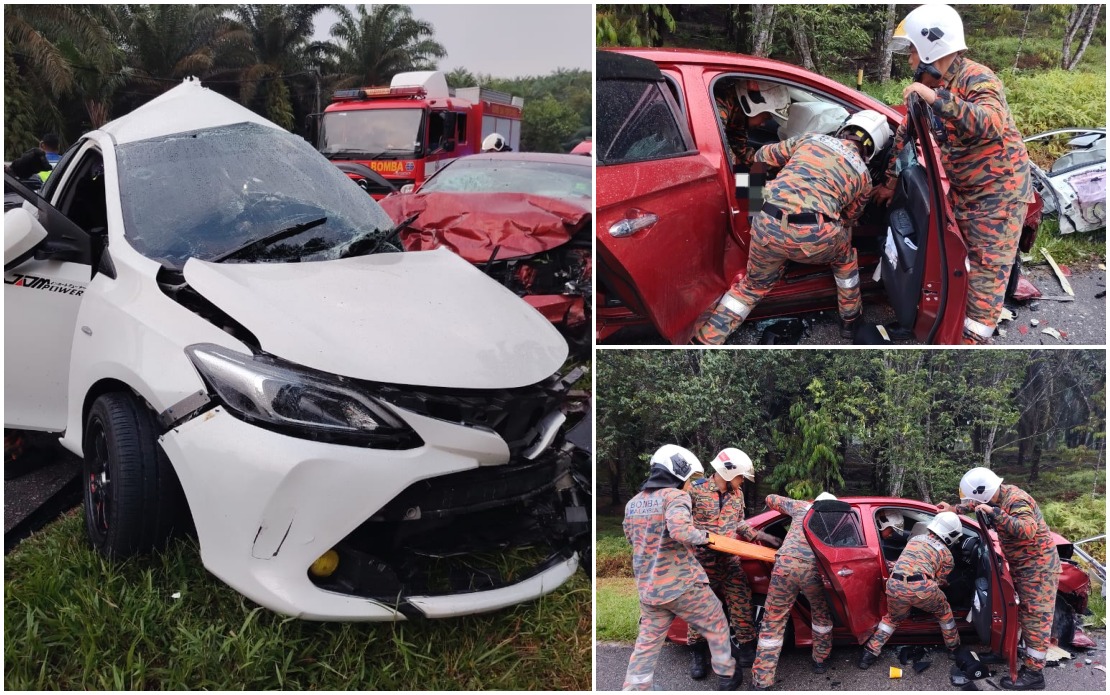
A fatal traffic accident in the Kota Tinggi district of Johor claimed three lives on Sunday afternoon when two vehicles collided on Jalan Jemaluang near a petrol station in the Tanjung Leman area. The incident has renewed concerns about road safety on key routes connecting communities across the state, particularly along stretches prone to congestion and high-speed driving.
Emergency services received notification of the crash at 5.05 pm, prompting a rapid response from the fire and rescue department. Senior Fire Officer II Azlan Hamzah, who coordinated the emergency operation, dispatched a unit of eight firefighters from a station approximately 45 kilometres away. Despite the distance, the team arrived at the scene with sufficient time to attempt extraction and preservation of life, though the severity of the impact had already sealed the victims' fates.
Upon arrival, rescue personnel discovered a catastrophic collision between a Honda City and a Toyota Vios. The impact proved immediately fatal for all three occupants. Two victims—a 21-year-old man and a 20-year-old woman—were travelling together in the Honda City, while a 31-year-old male occupied the Toyota Vios. Health Ministry officers who reached the scene made the official declarations of death at the roadside.
The extraction operation proved challenging, necessitating the deployment of hydraulic cutting equipment to extricate the bodies from the twisted metal frames. Firefighters carefully removed each victim using specialised rescue cutters and secured them on stretchers before handing over custody to police officers awaiting at the location. The entire emergency response concluded at 6.59 pm, with the scene eventually cleared for investigation by traffic and criminal detectives.
Kota Tinggi district police superintendent Othman acknowledged the incident in an official statement, indicating that investigations into the collision's circumstances had commenced immediately. While few details were disclosed regarding the sequence of events leading to the crash, authorities signalled that a comprehensive investigation would follow standard protocols for fatal traffic incidents, including examination of the vehicles, witness testimony, and preliminary findings from the scene.
The incident underscores persistent challenges in road safety across Malaysian highways and state roads. Fatal collisions involving two vehicles remain tragically common, often resulting from factors including excessive speed, driver fatigue, poor road visibility, or momentary lapses in attention. The Kota Tinggi district, whilst not among the highest-risk zones nationally, experiences regular traffic through its arterial roads connecting residential areas to commercial centres and neighbouring districts.
Tanjung Leman and surrounding areas along Jalan Jemaluang serve as commuter corridors during peak hours, particularly for workers travelling between Kota Tinggi town and outlying villages. Sunday afternoons typically see moderate traffic volumes, yet the absence of peak congestion does not necessarily correlate with improved safety outcomes. Research consistently demonstrates that intermediate traffic conditions sometimes carry elevated collision risk, as drivers may not exercise the same caution exercised in heavy congestion or the heightened alertness sometimes maintained during peak periods.
The involvement of younger victims—particularly the pair aged 20 and 21 in the Honda City—raises questions about vehicle type and crash dynamics. Smaller vehicles such as the Honda City generally provide less structural protection in high-impact collisions compared to larger automobiles. The presence of a younger male and female together suggests possible social travel rather than commercial transport, though circumstances remain unclear pending full police investigation.
State and federal authorities have periodically intensified road safety campaigns targeting young drivers and users of compact vehicles, recognising demographic vulnerability. These initiatives typically emphasise speed management, distraction avoidance, and defensive driving techniques. However, translating awareness into consistent behavioural change remains an ongoing struggle for traffic safety authorities nationwide.
The Kota Tinggi police have not yet released preliminary conclusions regarding causation, contributory factors, or whether either driver faced charges. In Malaysian traffic law, fatal collisions typically trigger comprehensive investigations to determine whether drivers bore responsibility through negligence, recklessness, or violation of road regulations. Such determinations influence whether cases proceed to criminal prosecution or remain classified as tragic but legally blameless accidents.
For the families of the three deceased individuals, the emotional and logistical challenges now begin. The sudden loss of three people spanning the working-age and young-adult populations represents significant personal tragedy. Local religious and community organisations typically mobilise to support bereaved families during immediate aftermath periods.
This incident adds to Johor's annual road fatality statistics, which authorities monitor closely as the state manages one of Malaysia's largest vehicular populations and most extensive road networks. Transport and traffic officials regularly review accident blackspots and implement targeted interventions, though achieving sustained reductions in fatal collisions requires multi-faceted approaches addressing vehicle standards, driver behaviour, road design, and enforcement consistency.

