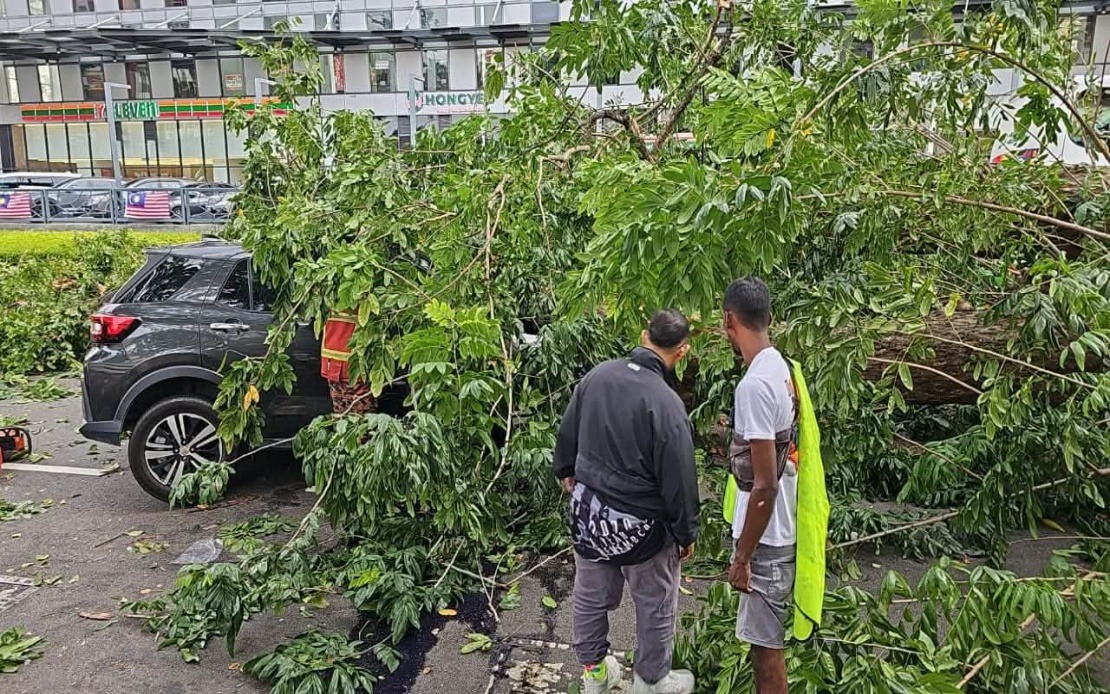
A routine morning journey turned perilous for three members of a family when their Perodua Ativa became trapped beneath a fallen tree on Jalan Macalister in George Town, Penang, on Friday. The incident, which occurred at 9:12 am, left an elderly couple and their granddaughter injured and required immediate intervention to extract them from the vehicle. The trio were subsequently transported to hospital for treatment, marking yet another reminder of the dangers posed by aging trees in urban areas during uncertain weather conditions.
Emergency responders arrived swiftly following the incident report, though their intervention proved secondary to the quick thinking of bystanders. According to John Sagun Francis, the Assistant Director of the Operations and Firefighting Division at the Malaysian Fire and Rescue Department's Penang branch, members of the public who were present at the scene managed to extract all three victims from the wreckage before firefighters from the Jalan Perak station could reach the location. This coordinated civilian response likely prevented the situation from deteriorating further, underscoring the critical role that alert members of the public play in emergency situations.
The aftermath of the collision demanded sustained effort from both emergency services and municipal authorities to restore normalcy to the thoroughfare. Fire department personnel and local authorities remained engaged in clearing operations well past noon, systematically removing debris from the fallen tree and securing the surrounding area. Their meticulous work reflected the necessity of thorough site management in densely populated urban zones, where incomplete recovery efforts could pose lingering hazards to the public.
Repercussions of the incident extended beyond the immediate scene, with significant disruption to the flow of traffic throughout the vicinity. The road closure necessitated to accommodate rescue and cleanup operations created congestion that rippled through the surrounding street network, affecting countless commuters and business operations dependent on that route. Such disruptions highlight the cascading consequences of infrastructure failures in interconnected urban environments, where a single incident can have multiplier effects across the transportation system.
Tanjong MP Lim Hui Ying, who serves simultaneously as Deputy Minister of Women, Family and Community Development, swiftly mobilized her office in response to the emergency. Through a public statement on social media, she confirmed that the three injured parties had been transported to medical facilities and indicated that her team was en route to gather comprehensive information from relevant authorities and offer whatever assistance lay within their capacity. Her proactive engagement demonstrated the importance of rapid political accountability in responding to constituent emergencies, particularly when vulnerable demographics such as elderly persons and children are involved.
The minister's public advisories reflected standard safety protocols for affected areas, with calls for careful navigation and compliance with traffic control measures established at the incident site. Such guidance serves dual purposes: it protects remaining road users from potential secondary incidents while ensuring that emergency operations proceed without additional complications from impatient or inattentive drivers. The emphasis on public cooperation underscores the shared responsibility between authorities and citizens in mitigating risks during crisis management situations.
This incident joins a recurring pattern of tree-related accidents that periodically affects Malaysian urban centers, particularly during monsoon seasons or periods of heavy rainfall when soil saturation compromises root systems. The Jalan Macalister location, a busy commercial and residential thoroughfare in George Town's historic district, exemplifies areas where vegetation management becomes crucial given the density of foot traffic and vehicular movement. Urban planners and municipal authorities across Malaysia have increasingly recognized the need for systematic tree audits and preventive felling programs to identify and remove specimens showing signs of structural weakness or disease.
The relatively fortunate outcome—where three people sustained injuries but escaped more catastrophic harm—owes substantially to the vehicle's structural integrity and the positioning of the tree as it fell. Modern vehicles like the Perodua Ativa incorporate safety features including reinforced cabin structures that help distribute impact forces, though such passive protection cannot entirely negate the dangers posed by objects of tree-scale mass striking from above. The incident serves as both a testament to engineering improvements in vehicle safety and a cautionary note about the limitations of such protections against natural hazards.
Beyond the immediate crisis, the episode raises systemic questions about arboreal stewardship in Malaysian municipalities. George Town, designated as a UNESCO World Heritage Site, contains numerous mature trees integrated into its urban fabric, many dating back several decades. Balancing heritage preservation with public safety requires sophisticated management frameworks that regular monitoring systems, risk assessment protocols, and judicious maintenance can support. Local authorities must navigate the tension between preserving the city's leafy character and ensuring that existing vegetation poses no threat to residents and visitors traversing its streets.
The incident also illuminates the importance of emergency preparedness and public awareness in densely populated areas. The successful civilian response that preceded official emergency services' arrival suggests that awareness campaigns and basic first-aid training initiatives can meaningfully enhance community resilience. Southeast Asian cities facing similar challenges might benefit from examining how George Town's residents were positioned to respond effectively, then replicating those positive outcomes through targeted public education and community engagement programs. Such approaches represent cost-effective supplements to formal emergency services infrastructure, particularly valuable in contexts where resource constraints limit rapid response capabilities.

