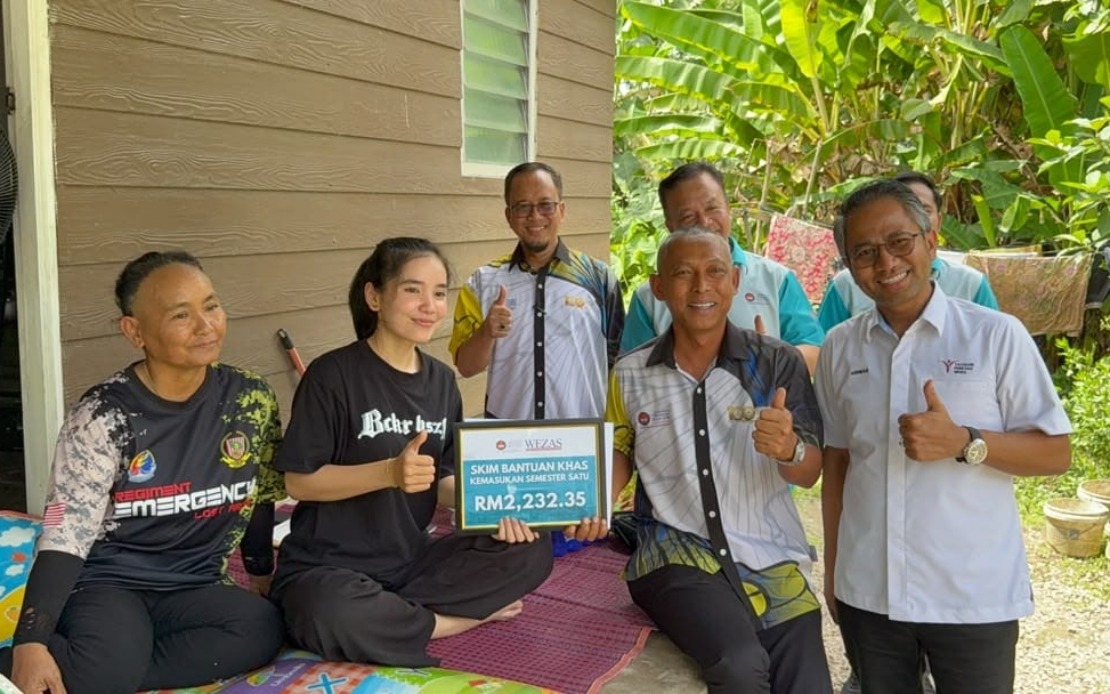
Three outstanding students from underprivileged backgrounds will begin their university education at Universiti Pendidikan Sultan Idris (UPSI) this semester after receiving timely financial support to cover registration fees and initial study costs. Lovely Sabana Augustine, Siti Nurdianis Nordin, and Muhamad Ilias Danish each received RM1,500 in assistance through a collaborative initiative involving the university, government bodies, and private foundations aimed at ensuring financial hardship does not prevent capable students from accessing higher education.
Lovely Sabana's path to university was nearly derailed by circumstances beyond her control. The accomplished STPM achiever lives in Tumpat, Kelantan, with her mother Mek Kenui, who earns approximately RM800 monthly working as a school cleaner while serving as a volunteer in the Malaysian Volunteer Corps Department. Her father, a former soldier, passed away in 2017, leaving the family without his income. As the youngest of four siblings, Lovely Sabana faced the prospect of being unable to enrol at the Faculty of Human Sciences at UPSI for the 2026/2027 academic session due to insufficient funds for registration and essential materials.
The student's situation gained public attention when her story was shared widely on social media platforms. Her appeal for financial assistance resonated with many Malaysians who recognized the systemic barriers that talented youth from low-income families encounter when transitioning to tertiary education. Rather than remaining a sympathetic narrative confined to social networks, her case prompted concrete action from institutional stakeholders who understood that academic merit alone cannot guarantee access to university without addressing the practical financial obstacles.
UPSI responded through a structured assistance programme that combined contributions from multiple sources. The Centre for Waqf, Endowment, Zakat, Khairat, and Sadaqah (WEZAS), the university's dedicated Islamic financing mechanism, provided RM500 per student. Yayasan Perkasa Siswa (YPS), a foundation focused on student welfare, contributed the remaining RM1,000 per recipient. This two-pronged funding approach reflects contemporary practices in Malaysian higher education, where traditional charitable mechanisms are complemented by specialized educational foundations to create comprehensive support networks.
The three beneficiaries represent different family circumstances but share the common experience of economic vulnerability. Siti Nurdianis Nordin, who will study at the Faculty of Management and Economics, comes from a household with irregular income where her mother depends on daily wages for survival. Muhamad Ilias Danish, entering the Faculty of Languages and Communication, experienced the loss of his father—the family's primary income earner. His circumstances have made him responsible for contributing to household expenses while pursuing his education, a dual burden that the financial assistance helps alleviate.
The initiative reflects the Malaysian government's stated commitment to equality in higher education access. Hirman Awang, director of the Department of Higher Education's Student Affairs Division, emphasized that the assistance programme demonstrates the Ministry of Higher Education's determination to prevent financial constraints from becoming insurmountable barriers for academically qualified students. His statement underscored that Yayasan Perkasa Siswa positions itself as a "frontline force" in protecting student welfare, with the monetary contribution intended to simultaneously boost morale and address immediate material needs.
UPSI deputy vice-chancellor Prof Dr Norkhalid Salimin provided institutional perspective on the university's approach to student support. He characterized the assistance not merely as financial disbursement but as part of a broader commitment to recognizing and addressing the challenges faced by prospective students, particularly those from economically disadvantaged backgrounds. The university's Student Affairs and Alumni Department (JHEPA), working alongside WEZAS, actively identifies students requiring early intervention before they encounter insurmountable obstacles to enrolment.
The outreach strategy reflects evolving understanding within Malaysian universities that institutional responsibility extends beyond curriculum delivery. By establishing mechanisms to identify and assist deserving students before they formally enrol, universities create pathways for talented individuals who might otherwise be lost to the system. This proactive identification process acknowledges that students often suffer in silence rather than publicizing their difficulties, making university initiatives to seek out struggling students particularly valuable.
The collaborative structure underlying this assistance programme merits examination for its potential as a replicable model across Malaysia's higher education sector. By coordinating contributions from university-based Islamic endowment structures, dedicated student welfare foundations, and government agencies, the initiative demonstrates how different institutional actors can pool resources without creating redundancy or bureaucratic inefficiency. This approach could be adapted by other universities facing similar challenges among their prospective student populations.
For students like Lovely Sabana, Siti Nurdianis, and Muhamad Ilias, the RM1,500 assistance represents more than financial relief. These funds enable them to register for courses, acquire essential textbooks, and secure basic necessities required for successful academic engagement. More importantly, the assistance signals institutional recognition of their worth as students and validates their aspirations despite the adversity they have faced. Educational mobility remains a critical pathway out of poverty in Malaysia, and removing financial obstacles at entry points creates opportunities for transformative social advancement.
The timing of the assistance—delivered before the September 13 registration date—demonstrates responsive administration and understanding of student needs. Universities that address financial barriers in advance of critical deadlines enable students to focus on academic preparation rather than crisis management. This proactive stance represents a maturation of student support services beyond reactive counselling toward preventive financial planning.
Beyond these three individuals, the programme's existence establishes a precedent and framework that can benefit future cohorts of financially disadvantaged but academically capable students seeking admission to UPSI. As similar stories surface across Malaysia's higher education institutions, the visibility of successful assistance models encourages other universities and foundations to establish comparable programmes. The collaboration between UPSI, YPS, and government authorities demonstrates that institutional commitment combined with targeted financial intervention can meaningfully address barriers to educational access for talented youth from disadvantaged communities.

