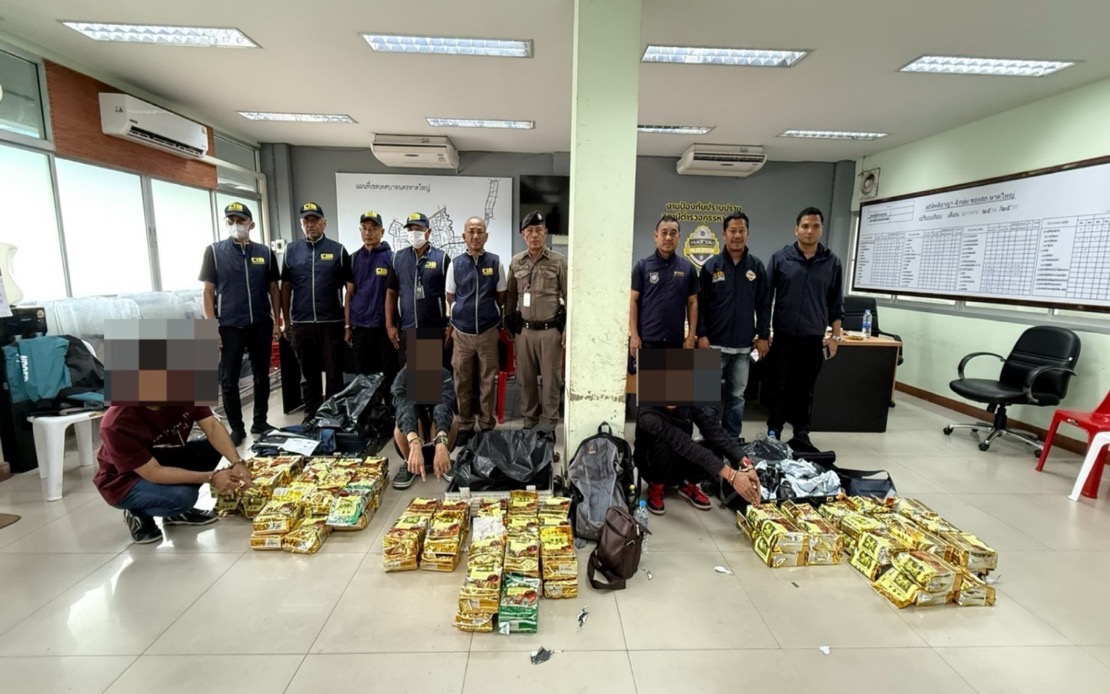
Three Malaysian men were taken into custody at Hat Yai Railway Station in Thailand's Songkhla province on July 31 following the discovery of a substantial cache of crystal methamphetamine concealed within their luggage. The arrest represents a significant interdiction in cross-border drug trafficking operations that continue to plague the Thailand-Malaysia corridor, with authorities revealing that the syndicate had been actively recruiting couriers from both nations to facilitate the movement of narcotics across regional borders.
According to Ratchapon Palakul, director of Region 9 Office of the Narcotics Control Board (ONCB), the three suspects arrived at the railway station aboard a train departing from Bangkok when officers from the joint task force intercepted them upon disembarkation. The narcotics were discovered packed inside three wheeled suitcases and three backpacks, a common concealment method employed by trafficking networks seeking to transport larger quantities whilst maintaining a degree of plausible deniability regarding individual culpability. The coordinated enforcement operation involved multiple Thai agencies, including the Tawan Hat Yai unit, railway police, the Crime Suppression Division, the Anti-Trafficking in Persons Division, tourist police, and the Narcotics Suppression Bureau alongside ONCB personnel.
During preliminary interrogation, one of the detained men disclosed that members of the trafficking syndicate had offered each courier RM8,000 to participate in the smuggling operation, a relatively modest sum considering the scale and value of the consignment. This financial arrangement provides insight into the hierarchical nature of international drug trafficking networks, where street-level couriers assume disproportionate legal risk in exchange for meagre compensation whilst upper-level operatives retain the bulk of profits. The low remuneration offered to couriers also suggests the syndicate possessed sufficient operational capacity to replace apprehended personnel readily, indicating an established smuggling infrastructure spanning the Thai-Malaysian border.
The charges filed against the three suspects are serious, encompassing joint possession and trafficking of Category 1 narcotics with intent to distribute. Under Thai law, conviction on these counts carries potential imprisonment of up to 15 years coupled with substantial financial penalties reaching 1.5 million baht, equivalent to approximately RM183,000. Such penalties reflect Thailand's increasingly stringent approach to narcotics offences, particularly those involving cross-border trafficking operations that undermine regional security and public health objectives.
For Malaysian authorities, this incident underscores the persistent vulnerability of the northern border region to organised drug trafficking. The Hat Yai railway route represents a critical transit point for narcotics destined for Malaysian markets, where demand for crystal methamphetamine remains robust despite law enforcement interventions. The involvement of Malaysian nationals as couriers suggests that trafficking organisations have successfully cultivated recruitment networks within Malaysia itself, exploiting economic circumstances and personal circumstances to identify individuals willing to undertake such perilous assignments.
The investigation conducted by Thai officials has extended beyond the immediate apprehensions, with authorities now prioritising identification of the syndicate's leadership and additional personnel involved in orchestrating the smuggling operation. Ratchapon emphasised that investigators are pursuing leads to establish the broader organisational structure, supply chain mechanisms, and distribution networks utilised by the trafficking group. Such intelligence gathering proves essential for disrupting the syndicate's operations and preventing subsequent shipments from reaching Malaysian streets.
The discovery also illuminates evolving patterns in regional drug trafficking, whereby established transit countries like Thailand serve simultaneously as production centres, transshipment hubs, and destination markets. The 87-kilogram seizure represents a single consignment within a much larger volume of contraband flowing across Southeast Asian borders annually. Malaysia remains a primary destination market for methamphetamine produced in clandestine laboratories throughout the Golden Triangle and elsewhere in Southeast Asia, with trafficking organisations adapting their methodologies in response to enhanced border security measures.
From a Malaysian policy perspective, this arrest reinforces the necessity for sustained cooperation with Thai counterparts through established intelligence-sharing mechanisms and joint enforcement initiatives. The multilateral approach demonstrated by the Hat Yai operation, involving coordination across multiple Thai agencies, provides a model applicable to Malaysian contexts where interdisciplinary coordination between customs, police narcotics units, and intelligence services remains critical for effective border control. Enhanced capacity for real-time information exchange would enable earlier interception of suspect shipments and individuals before they traverse international boundaries.
The incident also highlights broader questions regarding the effectiveness of demand reduction strategies in Malaysia. Whilst law enforcement plays an indispensable role in disrupting supply chains, the continued recruitment of Malaysian couriers suggests that trafficking organisations perceive sufficient profit margins to justify expansion of operations. Complementary investments in community intervention, addiction treatment accessibility, and economic opportunity programmes in regions experiencing elevated narcotics use might reduce the labour pool available for recruitment by trafficking syndicates.

