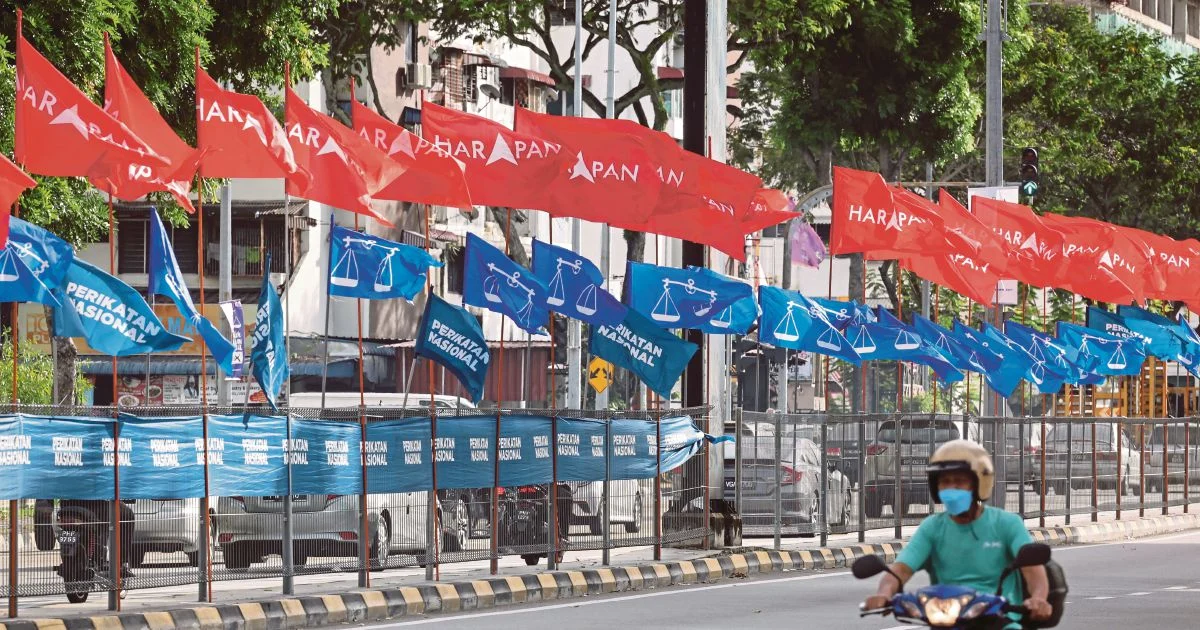
Malaysia's most populous southern state is bracing for a significantly more complex electoral contest than in previous cycles, with Johor's upcoming state election expected to feature three-way battles across the majority of its 56 constituencies. Barisan Nasional, Pakatan Harapan, and Perikatan Nasional are poised to compete directly in 33 of the seats, fundamentally reshaping the political landscape of a state that has long been a BN stronghold and a battleground for determining larger national political shifts.
This three-cornered competition represents a departure from the binary contests that have characterised much of Johor's electoral history. The presence of all three major coalitions simultaneously in more than half the state's seats suggests a fragmentation of voter choice and increased unpredictability in outcomes. Such scenarios typically benefit from spoiler effects, where the distribution of opposition votes can determine whether the ruling coalition maintains control or cedes ground to challengers. For BN, which has governed Johor continuously since independence, this configuration presents both opportunity and considerable risk.
Perikatan Nasional's expanded footprint in Johor reflects its growing consolidation as a major political force following its strong performance in the recent Kuala Lumpur and Selangor elections. The coalition, anchored by PAS and Bersatu, has gradually expanded its organisational reach into the southern heartland, traditionally the safest territory for BN. This intrusion by PN complicates calculations for both BN strategists and PH operatives, who must now allocate their campaigns across a three-way contest rather than focusing resources on direct bilateral confrontations.
Pakatan Harapan's positioning in these 33 seats reflects its transformation into a major electoral contender following the 2018 federal election triumph and its subsequent governance at the national and state levels. The coalition has built significant ground presence in urban constituencies within Johor where educated, younger voters and minority communities form substantial portions of the electorate. PH's challenge lies in converting this organisational strength into actual seat gains whilst contending with both BN's entrenched administrative machinery and PN's increasingly sophisticated political network.
The concentration of three-way contests in 33 constituencies necessarily implies that the remaining 23 seats will feature different configurations. Some of these may be two-way contests between BN and one opposition coalition, whilst others might see independent candidates or smaller parties contesting alongside the major coalitions. Understanding the geographic distribution of these varying contest formats becomes crucial for predicting which coalition can translate vote share into actual seat gains, given that Malaysia's first-past-the-post electoral system can produce significant discrepancies between popular vote and seat allocation.
For BN specifically, defending a state that has historically been its bedrock requires careful calibration of campaign strategy and candidate selection. The party machine has traditionally relied on sophisticated grassroots organisation, strong relationships with traditional communities, and control of local administrative resources. However, the emergence of PN as a credible third force threatens to split votes in ways that could benefit PH in certain constituencies, even where PH's own vote share may not substantially increase. This mathematical disadvantage requires BN to secure clear majorities in contested seats rather than plurality victories.
The electoral mathematics of three-way contests favour incumbent parties with strong administrative legitimacy and organised ground machinery, which generally describes BN's position in Johor. Yet opposition coalitions have demonstrated in recent years that effective messaging around governance issues, corruption concerns, and promises of change can overcome such structural advantages. The nature of the campaign over the coming weeks will determine whether three-way contests ultimately reinforce BN's dominance or create unexpected openings for PH or PN breakthrough victories.
Socioeconomic conditions in Johor throughout the election period will undoubtedly influence voting patterns. Cost-of-living pressures, employment opportunities in manufacturing and port-related industries, and development disparities between urban centres like Johor Baru and smaller towns will likely feature prominently in campaign messaging. Each coalition will attempt to frame these issues to maximum advantage, with BN emphasising stability and development continuity, while oppositions highlight unfulfilled promises and corruption allegations.
The three-way contest configuration also carries implications for coalition stability at the national level. A strong BN performance in Johor would reinforce federal coalition cohesion and provide Kuala Lumpur with stronger political capital for navigating economic policy and budgetary decisions. Conversely, significant opposition gains or major PN advances would signal shifting voter sentiment that could reverberate through upcoming by-elections and future state contests, particularly in Terengganu and Kedah where PN currently holds power. Johor's election thus transcends state-level significance, functioning as a bellwether for broader Malaysian political currents.
Campaign mechanics in a three-way contest differ substantially from binary contests, requiring parties to simultaneously attack and defend multiple flanks. Candidate selection becomes even more critical, as parties must field individuals capable of competing credibly against two different opponents with varying voter bases. The quality of local leadership and campaign organisation at the state assemblyman level may prove decisive in determining which coalition emerges with control of the state government.

