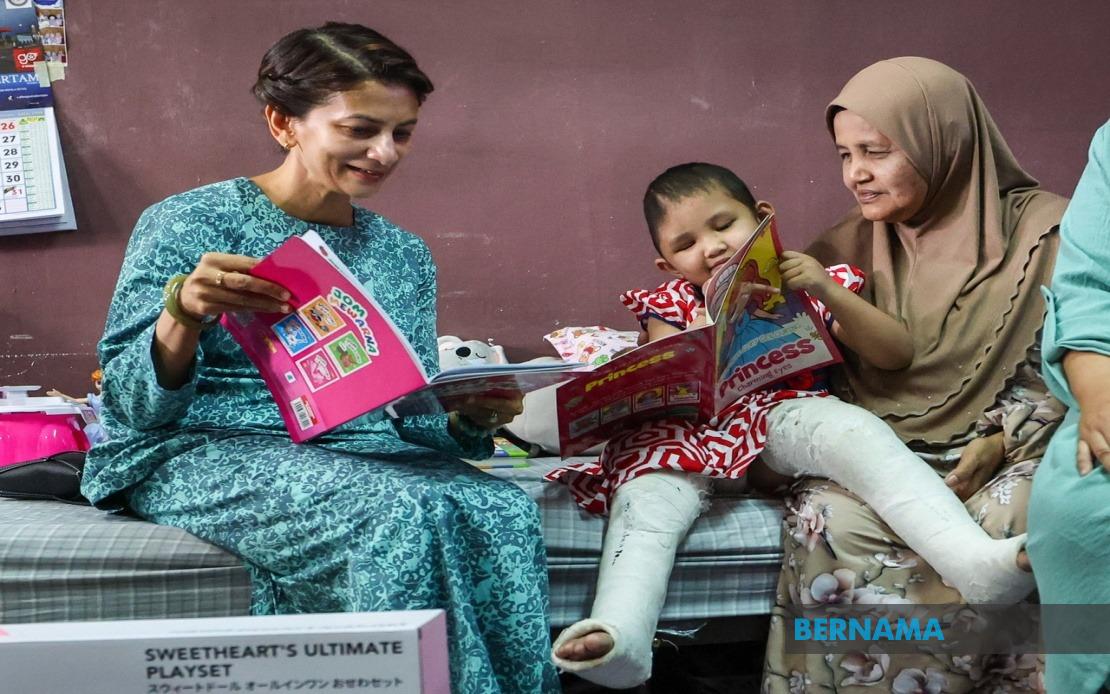
Three-year-old Aulia Sofia Ahmad Shafiq, the lone survivor of a devastating collision near Sungai Petani last month, continues to defy medical expectations with a steady recovery that has surprised her caregivers and medical team alike. The child, now living with her paternal aunt Siti Nor Atikah Ahmad Syukri in Taman Bandar Bertam Putra, was discharged from Sultanah Bahiyah Hospital in Alor Setar on July 2 following nearly a month of intensive treatment for multiple serious injuries sustained in the crash on June 7.
The tragedy unfolded when a newly purchased Proton X50 sport utility vehicle collided with a lorry around 3.50 pm as the family travelled from Penang towards Merbok. In addition to Aulia Sofia's injuries, the impact claimed the lives of six relatives: her parents Ahmad Shafiq Ahmad Shukri, aged 27, and Jamaliah Sannusi, aged 29; her two-month-old brother Ahmad Mikail; her paternal grandmother Nora Mhd Husin, aged 55; her paternal uncle Ahmad Fahim Ahmad Shukri, aged 27; and her cousin Iskandar Affan Ibrahim, aged seven. The crash left an indelible mark on the extended family, with Aulia Sofia becoming both a miracle and a living reminder of the tragedy's toll.
Describing Aulia Sofia as a miracle given the apparent impossibility of her survival amid such carnage, Siti Nor Atikah spoke to journalists at her home, emphasizing how swiftly the child's condition has improved in the weeks following her hospital discharge. Despite her rapid progress, significant challenges remain in her recovery journey. Both of her legs sustained fractures in the collision, severely limiting her mobility and confining her to immobility for the foreseeable future. An orthopaedic specialist appointment scheduled for July 26 would determine the timeline for potential physical rehabilitation and the likelihood of regaining full ambulatory function.
Beyond the physical fractures, Aulia Sofia endured severe trauma to her head and face, including a catastrophic injury to her left eye. Medical personnel successfully performed emergency surgery to preserve the eye itself, though the prognosis regarding her vision remains shrouded in uncertainty. Doctors have indicated that recovery of eyesight is possible, yet there exists the risk of permanent vision impairment ranging from significant blurring to complete blindness. Further diagnostic assessments would be necessary to establish the extent of any lasting visual damage, leaving the family in a prolonged period of anxious waiting.
The child regained consciousness approximately two weeks following the accident, a milestone that also marked the beginning of a difficult process of emotional reckoning. Aulia Sofia has been informed about the deaths of her parents, though the full psychological impact of such devastating loss on a three-year-old remains uncertain and will likely unfold over years of grieving and processing. Her aunt expressed gratitude for the sensitivity shown by medical and family support networks in navigating this delicate phase of her recovery.
A significant moment in Aulia Sofia's recovery came when the Raja Muda of Kedah, Tengku Sarafudin Badlishah ibni Al Aminul Karim Sultan Sallehuddin, visited her home alongside the Raja Puan Muda of Kedah, Che Puan Muda Zaheeda Mohamad Ariff, and their daughter, Tunku Zara Bahiyah. The royal visit underscored the broader social concern surrounding the child's fate and the family's plight. During the visit, the royal entourage presented material assistance to those responsible for her daily care and opened a National Education Savings Scheme (SSPN) account dedicated to securing her educational future, a gesture reflecting official recognition of her singular resilience.
Siti Nor Atikah expressed profound appreciation for the royal family's compassion and their visible commitment to supporting families navigating tragedy. She framed the visit as emblematic of the royal household's broader dedication to the welfare of Kedah's residents, particularly those facing extraordinary hardship. For the extended family, such recognition carried symbolic weight, validating their experience of loss while simultaneously affirming societal commitment to Aulia Sofia's wellbeing and future prospects.
Despite her physical limitations, Aulia Sofia has demonstrated an emotional vitality that surprises those around her. Her aunt noted that the child displays the active, animated behaviour typical of healthy toddlers, displaying resilience and adaptability in her new living arrangement. She has adjusted well to her new family environment, buoyed by the constant presence and companionship of her cousins, with whom she had always maintained close bonds prior to the tragedy. The familiar connections have provided crucial emotional scaffolding as she navigates both physical recovery and profound bereavement.
Ibrahim Ghazali, Siti Nor Atikah's husband and Aulia Sofia's uncle by marriage, affirmed the family's commitment to providing her with permanent stable care. Now aged 39 and working as a lorry driver, Ibrahim stated clearly that the couple intended to raise Aulia Sofia as their own daughter within their household. Legal guardianship procedures were underway to formalize this arrangement, transforming what began as emergency care into a permanent family restructuring that would anchor Aulia Sofia's identity and future stability.
The family's decision to formally adopt Aulia Sofia reflects broader patterns within Malaysian extended family systems, where kinship obligations and emotional bonds frequently supersede formal legal designations. For Ibrahim and Siti Nor Atikah, the decision represented an affirmation of their capacity to absorb both grief and responsibility, acknowledging that Aulia Sofia belonged fundamentally to their family unit regardless of biological lineage. That determination has already borne fruit in the child's visible contentment within her new domestic setting.
The tragedy has also sparked reflection within Malaysian society regarding road safety, particularly concerning vehicle collisions involving family groups travelling on major highways. The crash that decimated Aulia Sofia's immediate family serves as a sobering reminder of how quickly ordinary journeys can transform into catastrophe. The circumstances—a newly purchased vehicle, a collision with a commercial lorry—underscore vulnerabilities within transportation systems that continue to claim lives across the nation.
Looking forward, Aulia Sofia's recovery trajectory will depend substantially on the outcomes of forthcoming medical assessments and the ongoing dedication of her adoptive family and medical team. While the path ahead involves uncertain clinical outcomes regarding her mobility and vision, the child's extraordinary will to survive and her family's unwavering commitment suggest possibilities beyond what initial medical prognoses might have predicted. Her case has quietly become emblematic of human resilience in the face of devastating loss, a narrative of survival that challenges assumptions about the limits of recovery.

