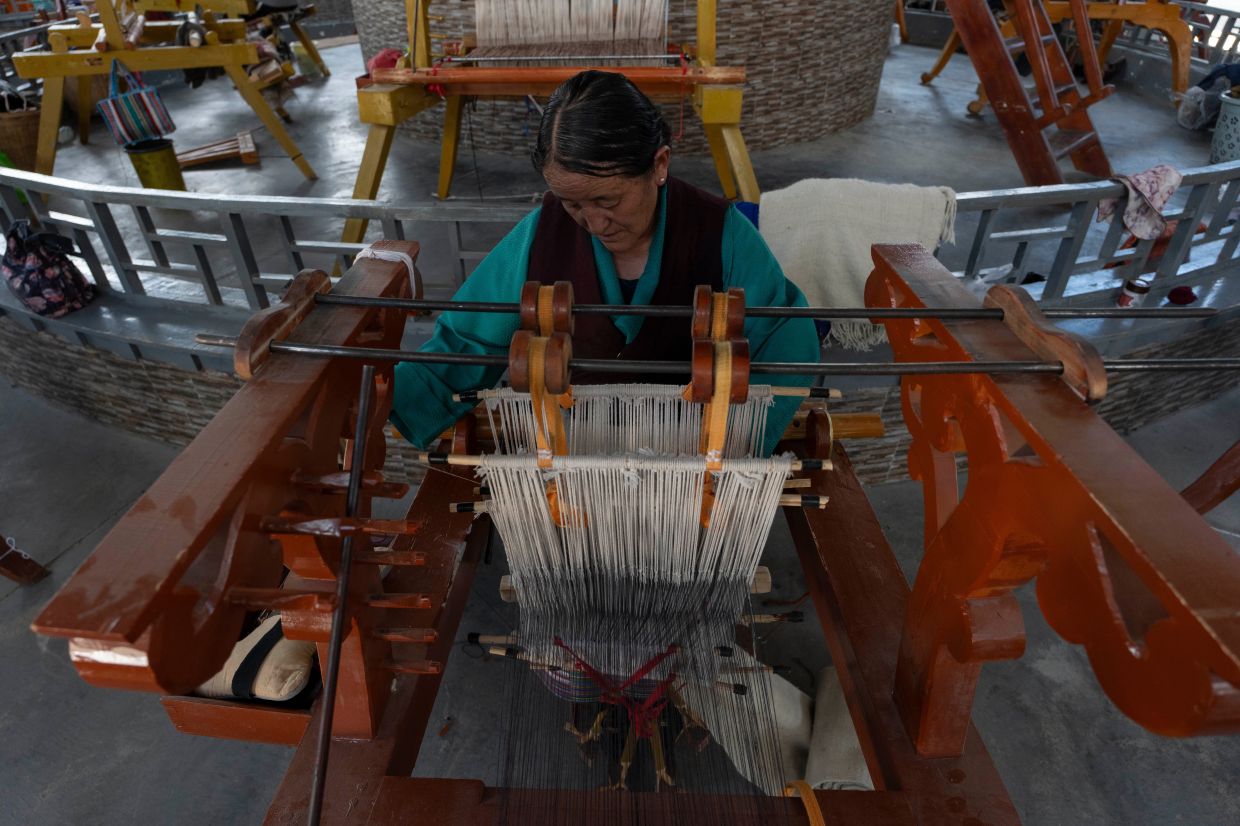
In a workshop nestled on the Tibetan plateau, weavers sit at wooden looms performing the same repetitive motions that artisans have executed for centuries—shuttles gliding through wool yarn, threads pulled tight, the rhythm continuing hour after hour. This is the Ethnic Huaji Handwoven Cooperative in Shannan, where the tradition of Pulu, a distinctive woolen fabric central to Tibetan culture, survives and flourishes through the efforts of more than 100 local workers who transform raw wool into garments that connect their community to its heritage.
Founded in 2008 by Tibetan artisan Pasang, the cooperative emerged from a moment of cultural reckoning. The weaver recognised that few younger Tibetans possessed the knowledge to continue producing traditional textiles, and he feared an entire craft would vanish. What began as a personal mission to transmit skills has evolved into a significant economic initiative that employs locals from the surrounding Shannan region, located approximately 3,700 metres above sea level. The workshop has become notable for its inclusive hiring practices, welcoming people with disabilities alongside able-bodied workers, creating pathways to livelihoods that might otherwise be unavailable in this remote mountain community.
The cooperative specialises in Zeter, a refined variant of Pulu that represents the pinnacle of Tibetan weaving technique. Distinguished by its exceptional softness and delicacy, Zeter is crafted exclusively from wool sourced from the neck and back regions of sheep raised in the Shannan area. The production process demands considerably more skill than standard Pulu weaving—the finer fibres require careful handling during spinning and weaving, transforming raw material into cloth of remarkable quality. Pasang emphasised that this distinction in technique and material accounts for Zeter's historical significance and contemporary market appeal.
According to historical records preserved in local tradition and official Chinese documentation, Zeter's origins trace to the seventh century marriage of King Songtsen Gampo and Princess Wencheng, a Chinese bride who arrived in Tibet bringing weaving knowledge with her. The figures of both the king and princess stand as statues within the workshop, serving as reminders of this cultural interchange. Pasang articulated how the fabric itself embodies this historical synthesis, representing what he described as the integration of Tibetan and Chinese cultural elements. During the Ming dynasty, Zeter achieved sufficient renown to be presented as tributary tribute to the imperial court, an acknowledgement of its exceptional quality and desirability.
When Pasang learned these weaving techniques from his parents, fewer than ten individuals across Tibet retained the knowledge to produce Zeter. The near-extinction of this craft represented not merely the loss of technical skill but the erosion of cultural identity for Tibetan communities. The cooperative's establishment has reversed this trajectory, and the craft has now received formal recognition as part of China's national intangible cultural heritage—a designation that provides both cultural validation and potential pathways for sustained support and promotion.
The workforce at the cooperative reflects the economic challenges facing rural Tibetan communities. Tsering Yangchen, an eighty-year-old weaver who has worked at the facility for seven years, illustrates the impact. She relocated from another county seeking employment but initially struggled to secure meaningful work. The cooperative provided not only a job but also comprehensive training in weaving techniques, transforming her from an unemployed migrant into a skilled artisan. She speaks of Pulu with the intimacy of someone whose livelihood and cultural identity intertwine—the cloth is not merely a product she manufactures but something she wears, valuing its pure wool composition and warmth on the high plateau.
The commercial aspect of the cooperative has expanded beyond subsistence weaving to encompass a diverse product line. Adjacent to the workshop, a showroom displays items ranging from traditional scarves and shawls to contemporary pieces including jackets and bags, all produced from Pulu and Zeter. While Pasang noted that the majority of sales occur within Tibet itself, the cooperative has begun attracting customers from other regions of China, indicating that the market for these products extends beyond the traditional consumer base. This expansion suggests that heritage crafts, when properly positioned and quality-assured, can achieve commercial viability in modern markets.
For Southeast Asian observers, the Ethnic Huaji Handwoven Cooperative demonstrates a model worthy of consideration. Across the region, numerous indigenous textile traditions face similar pressures from industrialisation and generational disconnection. The Malaysian batik industry, Indonesian ikat traditions, and Philippine weaving practices share parallel vulnerabilities and opportunities. The Shannan cooperative's approach—combining cultural preservation with economic livelihood creation, providing training to community members regardless of ability, and seeking formal recognition for intangible heritage—offers a template that could be adapted to support declining craft traditions throughout Southeast Asia.
The sustainability of such initiatives depends on balancing cultural authenticity with market realities. The cooperative demonstrates that this balance is achievable when several conditions align: strong leadership from someone rooted in the community and committed to tradition, stable employment that justifies skill acquisition and transmission, quality control that maintains the reputation of products, and market channels that extend beyond purely local consumption. For Pasang and the weavers of Shannan, these elements have converged to create an economic space where ancient skills not only survive but generate meaningful income for over one hundred individuals.
As younger Tibetans pursue education and migration opportunities in urban centres, the question of whether they will choose to return and engage with traditional crafts remains uncertain. Pasang expressed hope that future generations would continue the weaving tradition, but the cooperative's long-term viability depends on whether this hope translates into concrete commitment from young Tibetans. The cooperative currently operates as a living demonstration that tradition need not be abandoned for modernity—that heritage crafts can be economically viable, socially inclusive, and culturally meaningful simultaneously. Whether this model can sustain itself without continuous subsidy or government support, and whether it can attract young workers willing to spend years mastering a craft, remain the crucial questions facing the Ethnic Huaji Handwoven Cooperative in the decades ahead.

