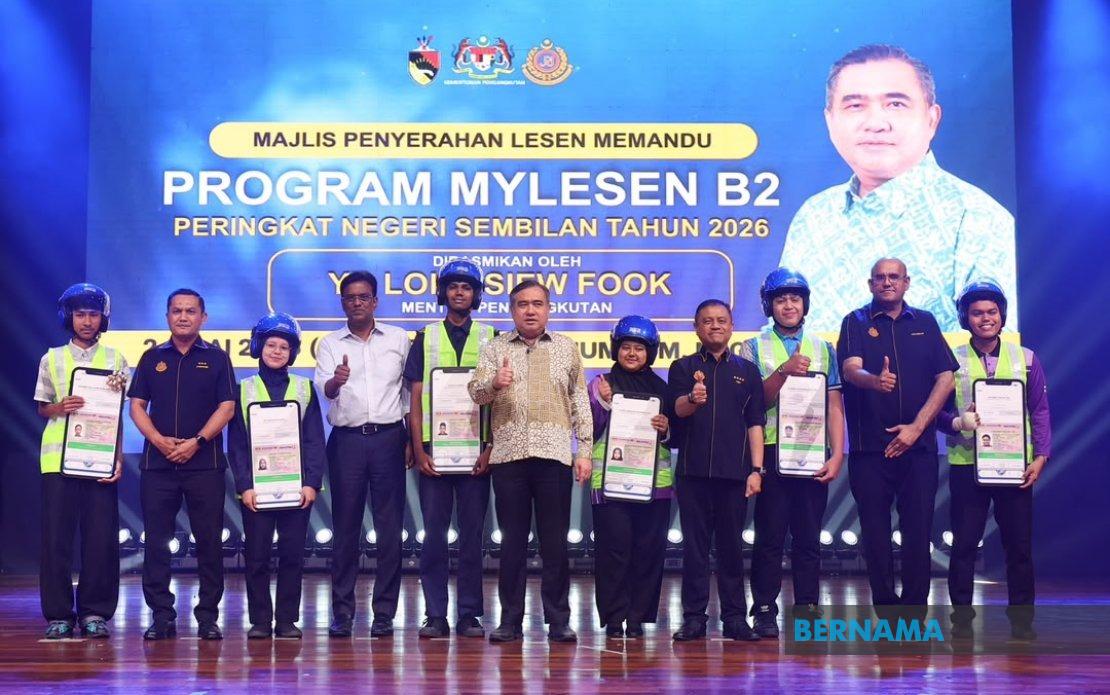
Transport Minister Anthony Loke has issued a pointed reminder to young motorcyclists participating in the MyLesen B2 Programme that obtaining a motorcycle licence carries serious obligations rather than serving as permission to engage in dangerous riding behaviour. Speaking at a licence distribution ceremony in Seremban, Loke stressed that the free qualification represents a privilege conditional upon responsible conduct on Malaysia's roads, not a licence to speed or engage in reckless practices.
The minister's remarks gained weight from sobering statistics on motorcycle safety. Approximately 60 per cent of all road fatality cases annually involve motorcyclists and pillion riders, with a troubling pattern emerging among younger demographics—the majority of victims fall below age 30. This demographic concentration underscores why the government focuses safety messaging on youth, the primary beneficiaries of the MyLesen B2 initiative.
Loke's intervention also addressed a persistent problem plaguing Malaysian streets: illegal street racing and speed testing. He specifically warned participants that weekend outings present temptation for unlawful behaviour, cautioning against involvement in clandestine racing activities conducted on public roads. The implicit acknowledgment of this underground culture suggests authorities recognise that young motorcyclists face peer pressure and cultural factors encouraging dangerous conduct beyond simple recklessness.
The legislative response to this challenge took concrete form through the Road Transport (Amendment) Bill 2026, which the Dewan Rakyat recently approved. This legislation elevates penalties for illegal racing, moving beyond mere financial fines to include imprisonment provisions. Loke characterised the offence as serious, signalling that enforcement will intensify beyond traditional approaches. This legislative escalation reflects growing concern about escalating traffic fatalities and the government's determination to deter participation in underground racing networks.
The MyLesen B2 Programme itself represents an ambitious intervention in youth mobility access. Since launching in 2023, the scheme has distributed motorcycle licences to over 100,000 recipients nationwide, addressing a genuine transportation need while simultaneously implementing safety mandates. The expansion within Negeri Sembilan specifically demonstrates programme momentum—quota allocation jumped from 1,000 participants in the previous year to 2,300 in the current year. Current uptake figures show 1,979 learners holding provisional licences, with 1,879 having progressed to probationary status following training completion.
Beyond immediate safety concerns, the programme serves broader social objectives. By providing free motorcycle licences, the initiative removes a financial barrier that previously excluded lower-income youth from legal motorcycle operation. Access to formal licensing credentials enables employment mobility, educational pursuit, and economic participation previously restricted by mobility constraints. For many Malaysian youth, particularly in less densely populated regions, motorcycles represent the primary accessible transportation mode, making affordable licensing access socially and economically significant.
The government's vision for the MyLesen B2 framework extends beyond individual licence issuance toward constructing comprehensive transport infrastructure benefiting all Malaysians. Officials framed the programme as contributing to broader sustainability and accessibility objectives, integrating motorcycle safety within wider transport ecosystem development. This systemic perspective reflects recognition that addressing motorcycle fatality rates requires multi-faceted approaches encompassing infrastructure, education, enforcement, and technology rather than isolated interventions.
Equally important to Loke's messaging was the emphasis on appropriate safety equipment. He specifically recommended SIRIM-certified helmets for all riders and pillion passengers, acknowledging that rider behaviour alone cannot guarantee survival in collision scenarios. This practical safety guidance complements the regulatory and educational components of the government's approach, recognising that motorcycle crashes often prove fatal regardless of rider responsibility if protective equipment is absent or inadequate.
The presence of senior transport bureaucrats including Transport Ministry Secretary-General Datuk Seri Jana Santhiran Muniyan and Road Transport Department Director-General Datuk Aedy Fadly Ramli at the ceremony underscored government commitment to the initiative beyond ministerial rhetoric. The participation of JPJ leadership and regional directors indicated this represented a significant programme milestone rather than routine administrative event, lending weight to transport sector concerns about motorcycle safety trajectories.
For Malaysian policymakers and traffic safety advocates, the MyLesen B2 expansion illuminates tensions between expanding mobility access and managing safety risks. Youth unemployment and underemployment make affordable motorcycle licensing particularly valuable, yet motorcycle crash epidemiology clearly demonstrates this population bears disproportionate injury and fatality risks. The government's dual approach—expanding access while escalating penalties for dangerous conduct—attempts navigating this tension, though effectiveness ultimately depends on enforcement consistency and youth cultural attitudes toward road safety.
The legislative provisions against illegal racing signal recognition among policymakers that conventional enforcement approaches have proven insufficient to deter participation in underground street racing culture. By criminalising such activity with imprisonment provisions, authorities employ more severe tools, potentially altering cost-benefit calculations for youth contemplating participation. Whether such legislative escalation achieves intended deterrent effects or merely displaces racing activity to different locations and times remains an empirical question requiring monitoring.

