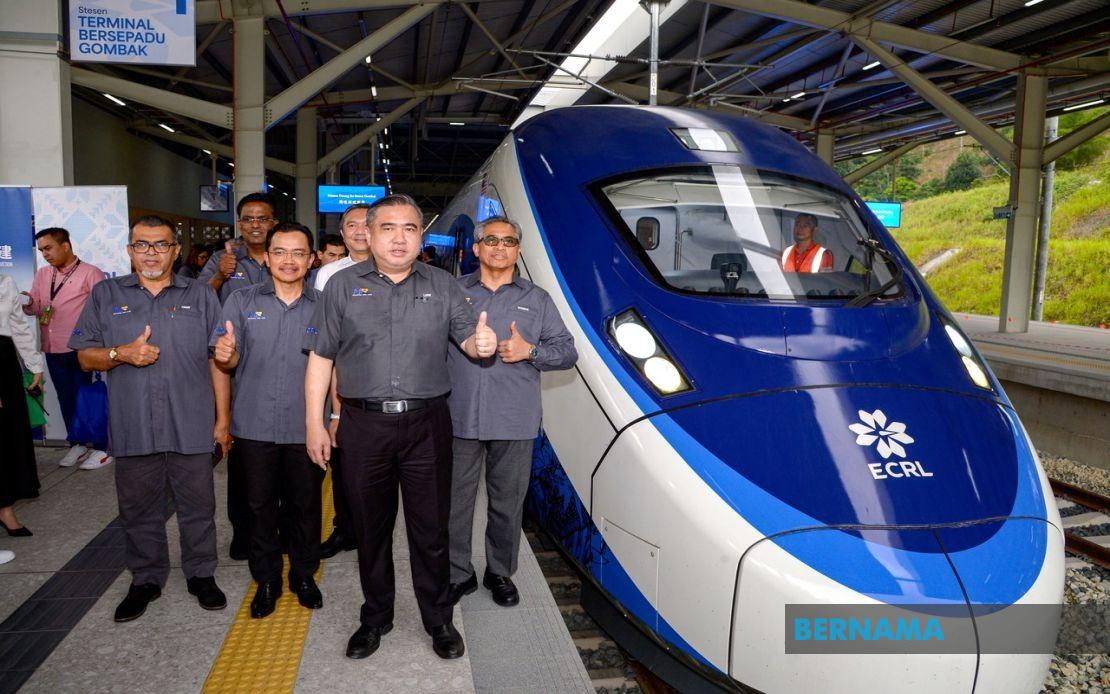
Transport Minister Anthony Loke Siew Fook has unveiled an accelerated operational timeline for Phase 1 of the East Coast Rail Link, targeting a December commencement for services running from Kota Bharu to Gombak—a significant advancement from the previously scheduled January 2027 start date. The revised target marks a strategic pivot aimed at delivering this marquee infrastructure project to Malaysian commuters substantially ahead of original estimates, though success hinges critically on the swift completion of rigorous testing protocols and stringent safety certification procedures.
The acceleration strategy hinges on the seamless progression of System Integration Testing (SIT) and Fault-Free Run (FFR) procedures, which commenced this month and are scheduled to advance into September respectively. These processes represent the final validation stages before passenger operations can commence, encompassing comprehensive assessments of the rail system's electrical infrastructure, signalling mechanisms, and integrated operational capabilities. Malaysia Rail Link Sdn Bhd and the primary contractor China Communications Construction Company Ltd are tasked with coordinating these critical phases without permitting any deterioration in safety standards—a principle that Loke emphasised repeatedly during his announcement at the Gombak Integrated Terminal Station.
The FFR component demands particular attention, as it involves operating the first train set and E-Loco over approximately 8,000 kilometres under direct supervision by the Land Public Transport Agency to verify that both operational safety and system reliability conform to established international standards and Malaysian legal frameworks. This milestone testing occurs under real-world track conditions but without passenger presence, enabling engineers to identify and rectify potential issues before commercial deployment. The minister acknowledged that the conventional testing and certification timeline typically extends between two and three months, positioning the ministry's efforts to compress this duration as both ambitious and demanding.
Loke's confidence in accelerating these timelines partly derives from the comprehensive factory and pre-shipment testing already conducted in China before the train sets arrived in Malaysia. This upstream quality assurance reduces the burden on domestic testing phases, though it does not eliminate their necessity or rigour. The minister indicated that the Land Public Transport Agency is being mobilised to streamline procedural bottlenecks, particularly around regulatory approvals and certification sign-offs, without circumventing any substantive safety evaluations. This administrative facilitation represents a pragmatic approach to project management, distinguishing between genuinely critical safety procedures and bureaucratic redundancies that might be compressed without risk.
Phase 1 of the ECRL project has achieved 95.08 per cent overall completion as of July, indicating that the physical infrastructure connecting Kelantan and Selangor stands substantially ready for operational deployment. This advanced construction status provides genuine foundation for the December ambition, as it means the remaining work focuses primarily on systems integration and validation rather than structural completion. The geometric progress of the project suggests that most critical civil engineering challenges have been resolved, leaving administrative and technical testing as the primary obstacles to commencement.
The broader ECRL programme encompasses a second phase extending from Gombak to Port Klang, currently projected for completion by December 2027 with operational initiation scheduled for January 2028. This sequenced development strategy acknowledges the complexity of bringing such a massive integrated rail system into service incrementally, allowing operational experience from the first segment to inform refinements for the second phase. The staggered approach also distributes the commissioning workload and reduces the systemic risk of attempting to launch the entire network simultaneously.
Loke's repeated assurances regarding safety priorities reflect the political sensitivity surrounding major infrastructure failures in Malaysia and the broader region. The minister stated unequivocally that the acceleration initiative does not represent a trade-off between speed and safety, emphasising that all preceding tests must be completed and approved before FFR commences. This sequential validation approach, while potentially extending timelines, ensures that no critical safety assessment is skipped or abbreviated merely to meet operational deadlines. The minister's personal emphasis on this point—declaring that officials are "more afraid than you" regarding operational risks—underscores the severity with which the ministry views its obligations to commuter safety.
The December timeline, if achieved, would position Malaysia alongside regional peers in deploying advanced rail infrastructure and demonstrate significant project execution capability for future megainfrastructure initiatives. For Southeast Asian transport planners and policymakers, the ECRL represents an important case study in coordinating Chinese-financed and executed rail projects with domestic regulatory frameworks and safety standards. The diplomatic representation at the launch event, including the Chinese Ambassador to Malaysia Ouyang Yujing alongside Malaysian government and transport ministry officials, illustrates the geopolitical dimensions of this infrastructure partnership.
The involvement of Malaysia Rail Link, CCCC, and the Land Public Transport Agency in this accelerated timeline creates a tripartite accountability structure. While MRL bears ultimate responsibility for meeting operational targets and CCCC serves as primary contractor, APAD's role in expediting regulatory certification suggests a government-led effort to remove administrative impediments without sacrificing substantive oversight. This collaborative framework, if executed effectively, could establish a replicable model for managing complex rail projects involving international contractors and domestic regulatory bodies.
From a regional perspective, the ECRL's successful deployment—whether in December or the subsequently extended timeframe—establishes connectivity between Malaysia's east and west coasts that reshapes logistics, commuter patterns, and economic integration within Peninsular Malaysia. For manufacturers in the Klang Valley and industrial zones along the ECRL corridor, the rail link promises enhanced supply chain efficiency and reduced transportation costs. The project's realisation also validates Malaysia's capacity to undertake infrastructure projects of comparable scale to those in Thailand, Indonesia, and Vietnam, potentially influencing international investor confidence in Malaysian infrastructure sectors.
As testing proceeds through the coming months, the practical execution of this accelerated timeline will become evident. The December target, while ambitious, remains achievable if the SIT and FFR phases progress without uncovering significant system deficiencies. Should unexpected complications emerge during these critical testing phases, the ministry retains flexibility to adjust operational commencement without abandoning its underlying commitment to safety and reliability. The coming months will demonstrate whether Malaysian and international teams can deliver advanced rail infrastructure at both quality and speed.

