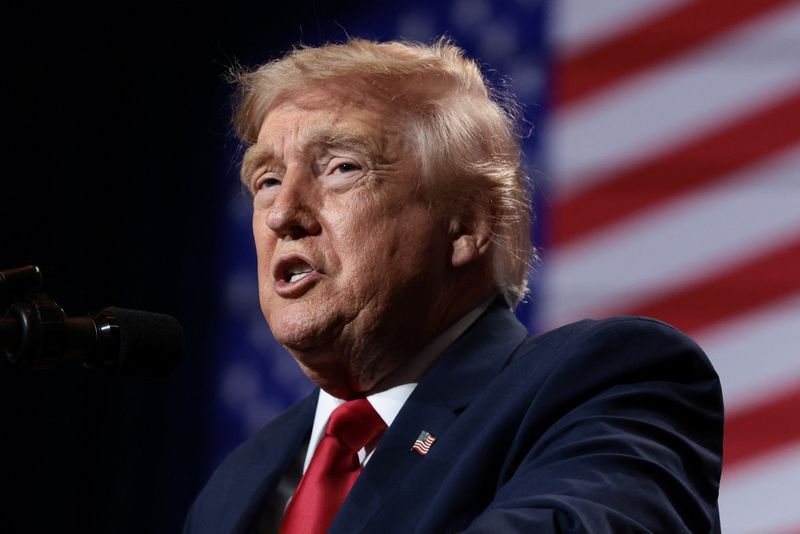
President Donald Trump has signed a national security presidential memorandum granting federal law enforcement expanded authority to deploy cyber tools against transnational criminal organizations based outside the United States that target American citizens. The directive, signed on Wednesday, represents a significant shift in how the U.S. government intends to combat foreign-based criminal enterprises through the integration of private sector technological capabilities under strict federal oversight and control.
According to a White House fact sheet accompanying the memorandum, the initiative addresses mounting threats posed by ransomware operations, sophisticated financial fraud schemes, and other cybercriminal activities orchestrated by organized groups based in foreign jurisdictions. The administration framed the measure as necessary to protect Americans from escalating criminal threats that traditional law enforcement approaches have struggled to counter effectively. The emphasis on private sector involvement reflects the growing recognition that government agencies alone lack the specialized technical expertise and resources to combat the rapidly evolving tactics employed by professional cybercriminals.
The memorandum establishes a formal framework enabling private technology companies to collaborate with federal authorities, including the Department of Homeland Security and Department of Justice, as well as state, local, tribal, and territorial law enforcement agencies. This multi-layered approach facilitates information sharing regarding criminal threats while allowing participating private firms to propose and execute cyber operations against specified targets identified through the collaborative intelligence process. The coordination mechanism essentially creates a public-private partnership model for offensive cyber operations, a concept that extends far beyond traditional defensive cybersecurity measures.
Implementation of the program falls under the purview of the Department of Homeland Security's National Coordination Center within the Homeland Security Task Force. This entity will establish the operational procedures for conducting targeted cyber disruption campaigns against foreign transnational criminal organizations. The DHS and Department of Justice will maintain supervisory control over all activities undertaken by private sector participants, establishing a clear chain of command and ensuring that operations remain aligned with federal law enforcement objectives and constitutional constraints.
Vetted private companies participating in the program are authorized to conduct two distinct categories of cyber activity: surveillance operations and offensive cyber effects operations. Surveillance operations involve monitoring enemy computer systems and networks to gather intelligence, while cyber effects operations encompass more aggressive interventions including system manipulation, network disruption, denial of service attacks, infrastructure degradation, and potential destruction of digital systems and information controlled by targeted criminal networks. The memorandum specifically defines cyber effects as actions that could alter, interrupt, disable, degrade, or destroy information systems and their associated data.
To ensure accountability and financial responsibility, the memorandum imposes a mandatory bonding or escrow requirement of at least one million dollars for all participating private companies. This financial safeguard mechanism protects the government and affected parties against potential damages resulting from mishandled operations or unintended consequences arising from cyber interventions. The substantial financial commitment effectively limits participation to well-capitalized technology firms with sufficient resources and established compliance infrastructure.
The concept of privately-executed cyber operations targeting criminal and hostile entities is not unprecedented in American national security policy. However, past initiatives incorporating private sector participation in offensive cyber campaigns have generated persistent controversy within academic, legal, and policy communities. Experts have raised concerns regarding potential escalation risks, the possibility of unintended consequences affecting unrelated systems, coordination failures between government agencies and private contractors, and broader questions about the appropriate boundaries of private sector involvement in national security operations.
These concerns carry particular relevance for the international community, including Southeast Asian nations like Malaysia that increasingly face transnational cybercrime threats. The precedent of authorizing private companies to conduct offensive cyber operations against foreign targets could influence global norms regarding state-sanctioned private cyber warfare, potentially leading other nations to adopt similar frameworks. For Malaysia and regional partners, the development raises important questions about how international boundaries and sovereignty principles apply in the emerging domain of cyber conflict, especially given the cross-border nature of criminal networks and technical operations.
For Malaysian policymakers and cybersecurity professionals, the Trump memorandum signals an acceleration in American willingness to employ aggressive cyber tactics against criminal organizations rather than relying exclusively on traditional extradition and legal cooperation mechanisms. This shift may enhance cooperation opportunities for Malaysian law enforcement agencies seeking to combat transnational cybercriminal networks that frequently exploit Southeast Asian jurisdictions as staging grounds or money laundering hubs. Simultaneously, it underscores the importance of Malaysian regulatory clarity regarding private sector participation in government-authorized cyber operations and the need for robust international coordination frameworks to prevent unintended regional consequences.
The memorandum reflects broader strategic thinking within the Trump administration regarding the necessity of leveraging private sector innovation to address national security challenges in cyberspace. By explicitly authorizing private companies to conduct offensive operations under federal supervision rather than restricting such activities to government agencies, the directive acknowledges that elite technology firms possess specialized capabilities that would be difficult or impossible for government agencies to replicate. This approach mirrors similar models in military contracting but extends the principle into the controversial domain of offensive cyber operations.
The White House has not provided detailed operational procedures, oversight mechanisms, or performance metrics that will govern the program's implementation. Neither the Department of Homeland Security nor White House officials have released comprehensive information regarding the vetting process for private companies, the procedures for approving specific targets, the rules of engagement governing cyber operations, or the mechanisms for external oversight and accountability. This information gap leaves significant questions unresolved regarding how the program will function in practice and what safeguards exist to prevent abuse or mission creep.
The initiative arrives amid broader debates within the United States regarding the appropriate scope of cyber operations against foreign targets and the role of private companies in executing government-authorized offensive cyber activities. As the program moves from announcement to implementation, federal agencies will face pressure to establish transparent procedures and robust oversight mechanisms that balance operational effectiveness against the risks of unintended consequences and international escalation. For observers in Malaysia and across Southeast Asia, the memorandum represents an important development in U.S. cyber strategy that may generate both opportunities and challenges for regional cybersecurity cooperation.

