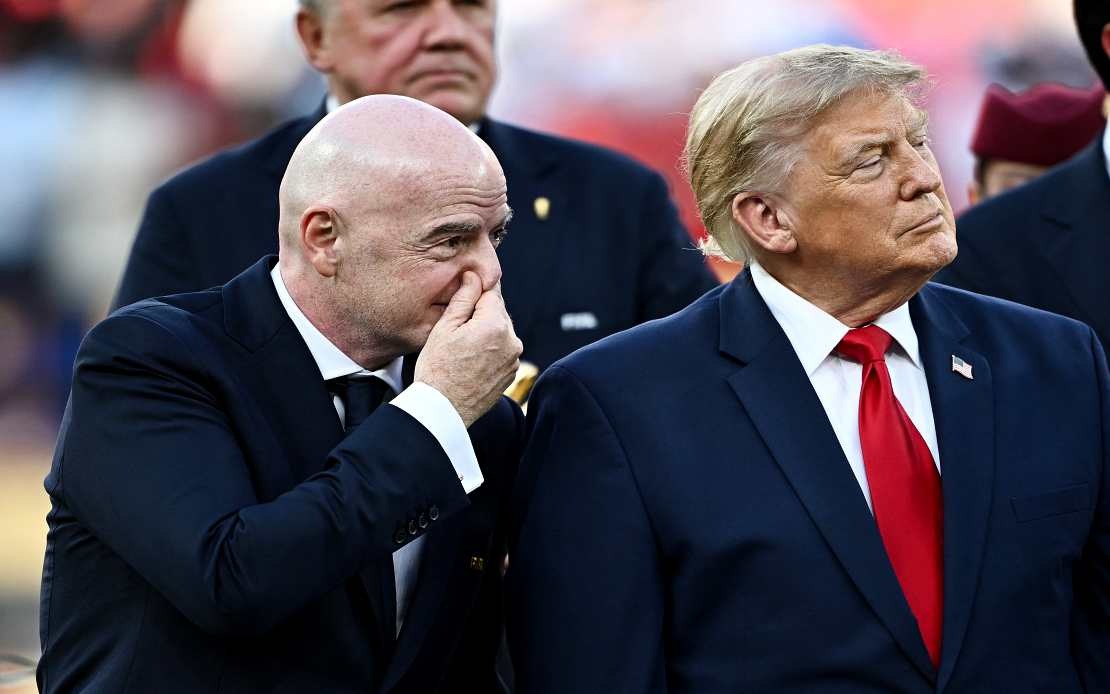
Donald Trump has stepped into a deepening governance crisis at FIFA by publicly defending President Gianni Infantino against mounting international pressure to step down. The US leader took to his Truth Social platform to declare that Infantino remains an indispensable figure in world football, arguing that replacing him would constitute a catastrophic error for the sport's governing body. Trump's intervention represents a notable display of political support for the embattled FIFA chief at a moment when his leadership faces unprecedented scrutiny from multiple continental confederations.
The controversy surrounding Infantino intensified when the Union of European Football Associations, the Asian Football Confederation, and the Confederation of North, Central American and Caribbean Football released a joint statement expressing grave concerns about his tenure. These three major football bodies called for an independent investigation into the circumstances of a proposed transaction that would have transferred significant FIFA commercial rights to private investors. Their coordinated action signals a rare alignment among football's regional powers and underscores the severity of the leadership challenge confronting FIFA's headquarters in Zurich.
At the heart of the dispute lies an ambitious commercial restructuring plan announced in July whereby FIFA proposed to raise USD 4.2 billion by selling approximately 20 per cent equity stakes in a newly created entity to private investors. This entity, branded as FIFA Forward Enterprise, was designed to assume control of the international federation's media and commercial rights, including the lucrative rights to World Cup tournaments. The proposal immediately triggered speculation that private equity groups connected to prominent American political figures might acquire stakes, with reporting suggesting involvement by the foundation of Joshua Kushner, brother-in-law to former Trump adviser Jared Kushner.
Infantino's position weakened considerably following the public outcry, and in early August he convened an emergency meeting with FIFA's leadership council to address the escalating crisis. During this gathering, the FIFA president offered an apology for errors in handling the FIFA Forward Enterprise initiative, acknowledging missteps in how the commercial restructuring was conceived and presented. Despite the conciliatory gesture, Infantino's influence within the organisation visibly deteriorated as critics from Europe's dominant football nations mobilised to block his agenda. The emergency session, rather than stabilising his position, seemed to underline the fragility of his political standing among FIFA's power brokers.
Trump's public endorsement of Infantino carries particular significance given the American financial interests potentially benefiting from the commercial rights transaction and the broader context of US influence in global sports governance. In his Truth Social statement, Trump characterised the FIFA president as a transformative figure who had presided over the most commercially successful World Cup tournament in history, surpassing previous editions by a factor of four. The former president suggested that FIFA's capacity to generate comparable revenues and maintain organisational momentum would evaporate entirely if Infantino were removed from office, effectively warning the federation's decision-makers against attempting his removal.
For Malaysian football stakeholders and Southeast Asian administrators, the dispute carries implications beyond FIFA's internal politics. The Asian Football Confederation's decision to join European and North American confederations in demanding an investigation reflects the AFC's determination to protect the interests of Asian nations in FIFA's commercial arrangements and governance processes. As a major football confederation, the AFC's alignment with UEFA and CONCACAF suggests that proposals affecting FIFA's structure and commercial rights cannot proceed without consensus among regional bodies. This creates a more decentralised decision-making dynamic within FIFA than Infantino appears to have anticipated when launching his commercial restructuring initiative.
The controversy also illuminates tensions between FIFA's traditional governance model and the pressure for private capital infusion that characterises modern sports administration globally. Infantino had championed the FIFA Forward Enterprise concept as a mechanism for modernising the federation's financial operations and unlocking capital for investment in football development programmes worldwide. The plan's defenders argued that private sector participation would enhance efficiency and generate resources for grassroots development across member nations. However, continental federations interpreted the commercialisation scheme as a threat to their influence over FIFA's strategic direction and their share of revenues flowing from the world's most prestigious football competitions.
Under mounting pressure from the coordinated regional confederations, FIFA abandoned the commercial rights sale proposal entirely by late August. Infantino announced that the federation would withdraw the plan to transfer FIFA's media and commercial rights to private investors, effectively capitulating to the public campaign mounted by UEFA, the AFC, CONCACAF, and sympathetic member nations. The reversal represented a significant defeat for the FIFA president and his supporters, though it preserved the federation's traditional governance structure and prevented the concentration of commercial control in private hands.
Trump's defence of Infantino, arriving as the FIFA president retreated from his commercial ambitions, appears to have had minimal impact on the unfolding political dynamics within world football's apex organisation. The American leader's intervention did not prevent the collapse of the commercial rights sale proposal, nor did it stabilise Infantino's authority within FIFA's leadership structures. Instead, Trump's statement underscored the extent to which FIFA governance had become entangled with international political relationships and financial networks extending far beyond the sport itself. The episode demonstrated that even a former US president's political weight could not override the unified opposition of football's continental confederations when defending a controversial organisational restructuring.
Looking ahead, Infantino's capacity to govern FIFA effectively depends on his ability to rebuild relationships with regional confederations and member nations. His apology during the emergency leadership meeting marked a partial acknowledgment of the flawed process by which the commercial proposal was developed and promoted. However, the depth of opposition expressed by UEFA, AFC, and CONCACAF suggests that substantial trust repair will be necessary before Infantino can advance additional governance or commercial initiatives. For the AFC and its member nations including Malaysia, this moment of aligned action with European football powers demonstrates that coordinated pressure can check centralised authority within FIFA and protect regional interests in global football governance.

