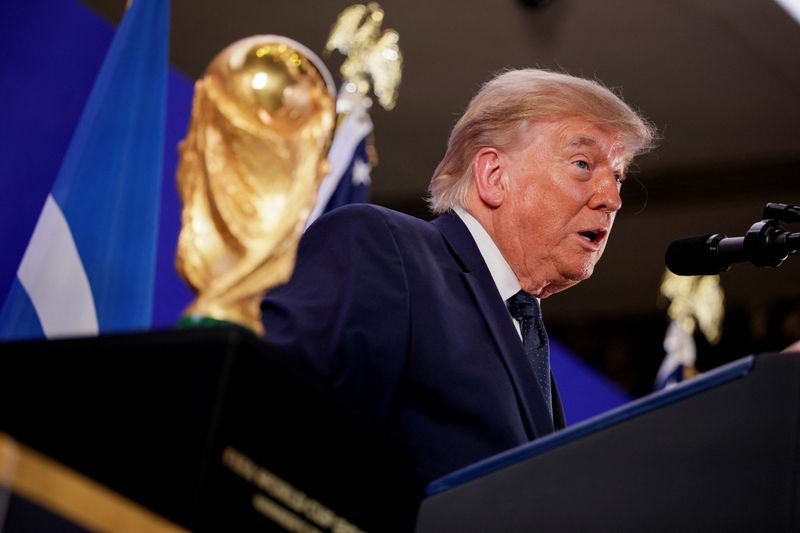
Donald Trump's prominent role at the World Cup final between Argentina and Spain at New York/New Jersey Stadium on Sunday epitomises how the 2026 tournament has become as much a political stage as a sporting one. The American president will sit alongside FIFA President Gianni Infantino during the match and present the trophy to the winners, a ceremonial duty he previously performed at last year's Club World Cup. His presence underscores the deep entanglement between global soccer governance and high-level politics that characterises modern international sports hosting.
Trump's appearance arrives amid one of the tournament's most contentious moments, after he publicly confirmed requesting Infantino to review a red card issued to U.S. striker Folarin Balogun. The incident ignited a firestorm concerning tournament integrity, fairness, and the appropriate boundaries of political influence over sporting decisions. FIFA has steadfastly maintained that Trump exerted no influence over the subsequent suspension of Balogun's ban, yet the optics of such intervention requests remain deeply problematic for those invested in preserving the independence of match officiating from executive pressure.
The relationship between Trump and Infantino has blossomed into a conspicuous partnership, with both figures lavishing praise on each other at a Friday reception hosted inside Trump Tower in Manhattan, where FIFA opened an office the previous year. Before an audience of approximately 300 attendees including Brazilian football icon Ronaldo and various FIFA dignitaries, Infantino publicly credited Trump with the tournament's extraordinary success. The 2026 World Cup has indeed shattered attendance records, establishing itself as the tournament's most commercially robust edition. Trump responded by suggesting that America had discovered its authentic identity as a soccer nation, a claim underscored by his regular hosting of Infantino in the Oval Office.
The pair have maintained unwavering mutual support through numerous controversies both preceding and throughout the tournament, which is jointly hosted by Canada, Mexico, and the United States. This solidarity has proven notable given Trump's other contentious initiatives, including an immigration crackdown and travel restrictions on multiple nations that raised serious concerns among international observers about whether overseas fans would feel welcomed. Approximately one year before the tournament commenced, American cities grappled with significant anxieties regarding their capacity to reassure international visitors concerned about these policies. Trump subsequently threatened to relocate matches from Democratic-controlled cities, a move FIFA promptly rebuffed by clarifying that such decisions lay entirely outside Trump's discretion.
Friday's reception saw Trump provocatively suggest that America should host the tournament again in future, but with a striking caveat: "This time we'll leave Mexico and Canada out." The remark demonstrated both Trump's eagerness to claim credit for the current tournament's success and his apparent willingness to unilaterally reshape the terms of international sporting cooperation. For Southeast Asian observers, such rhetoric illuminates the fragility of multilateral agreements and the risks posed when populist political figures seek to reshape established frameworks for unilateral advantage.
Trump has increasingly sought the amplified visibility that major sporting events provide over the preceding eighteen months, particularly as his approval ratings during his second presidential term continue their downward trajectory. His strategic appearances at high-profile sporting occasions represent a calculated effort to connect with his base and generate favourable media coverage. He previously attracted enthusiastic crowds at the Ryder Cup on New York's Long Island, where American supporters greeted him with sustained cheers. However, his reception at other venues has proven considerably more mixed, suggesting that his polarising political brand does not command universal admiration among American sports audiences.
More problematic episodes punctuated Trump's recent sporting engagement. He faced loud booing during Game 3 of the NBA Finals last month, and last year's U.S. Open men's tennis final descended into chaos when fans remained stranded outside Flushing Meadows well after the opening because presidential security protocols consumed substantial time. These incidents underscore the operational complications and audience divisions that Trump's presence invariably generates, complicating event management for hosting venues and broadcasters alike.
Fox Sports faces particularly acute challenges in covering Sunday's final, given that it receives a world feed rather than controlling its own camera operations. Play-by-play announcer John Strong acknowledged that the network cannot determine whether or when Trump appears on screen beside Infantino or other officials, as those production decisions remain under FIFA's exclusive control. This dynamic creates an unusual situation where American broadcasters lack agency over editorial choices involving one of their nation's most polarising political figures, a constraint that FIFA's technological architecture has imposed.
Strong further observed that Trump's presence admits no neutral reception, with substantial audience segments genuinely excited to witness his participation whilst others find his televised appearance actively unwelcome. The complexity of such political polarisation infiltrating a sporting broadcast represents a distinctly contemporary challenge for media organisations attempting to maintain journalistic neutrality whilst covering events touched by high-stakes political figures. For Malaysian and other Southeast Asian viewers, Trump's World Cup involvement demonstrates how geopolitical personalities increasingly blur the boundaries between politics and global culture.
FIFA officially awarded the 2026 World Cup to the United States, Canada, and Mexico during Trump's first presidential term in 2018, a decision Trump has repeatedly celebrated as a personal achievement and marker of American prestige. The tournament represents the first time the World Cup will occur across three nations, fundamentally altering traditional hosting arrangements. Trump's sustained emphasis on bringing the tournament to America underscores his belief in using global sporting spectacles to reinforce claims of national greatness and personal political accomplishment, regardless of the governance complexities this entangles.
The convergence of Trump's political prominence, FIFA's apparent eagerness to accommodate presidential preferences, and the tournament's unprecedented commercial success creates a template for how future international sporting competitions might unfold under conditions of heightened political involvement. Whether such arrangements strengthen or undermine the autonomy and integrity of global sports governance remains an open question with implications extending far beyond American borders into the broader international sporting ecosystem.

