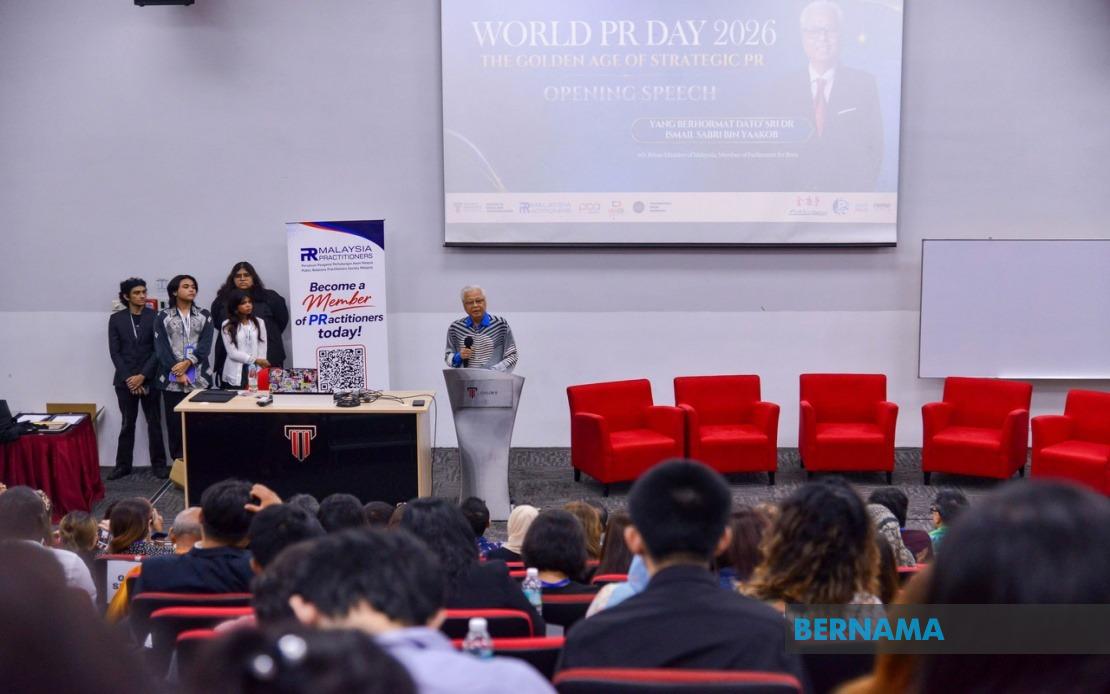
The competitive landscape of the modern era has fundamentally shifted away from traditional economic rivalry, according to former Prime Minister Datuk Seri Dr Ismail Sabri Yaakob, who instead characterises contemporary challenges as centring on an organisation's capacity to forge genuine trust with stakeholders through transparent and principled dialogue. Speaking at the World PR Day 2026 launch at Taylor's University in Subang Jaya on July 16, Ismail Sabri articulated a vision where institutional success is no longer determined solely by financial metrics and operational efficiency, but increasingly by how effectively entities communicate during both prosperous and turbulent periods.
In an era of unprecedented digital connectivity, the ability to maintain credibility has emerged as perhaps the most prized asset for any organisation, reflecting a fundamental departure from 20th-century competitive dynamics. Ismail Sabri drew a deliberate contrast between the last century's emphasis on economic supremacy and what he identifies as the defining characteristic of the current period: a battle for legitimacy and public confidence, which can only be authentically cultivated when communication strategies are anchored in genuine integrity rather than calculated messaging.
The evolution of public relations as a discipline represents a significant transformation from its historical function as a mere information distribution mechanism. Modern PR professionals, Ismail Sabri explained, now operate as strategic advisors who contribute substantively to shaping how organisations present themselves, manage reputational risks, and navigate complex stakeholder environments. This expanded role requires practitioners to move beyond traditional communications into broader strategic planning where their influence affects how institutional narratives are constructed and sustained across multiple platforms and audience segments.
Drawing from his tenure leading Malaysia during the COVID-19 pandemic, Ismail Sabri illustrated how communication became a critical variable in policy implementation and public acceptance. The necessity of addressing media inquiries on an almost daily basis while explaining shifting standard operating procedures underscored communication's importance beyond mere information delivery. This period crystallised a valuable lesson: effective government communication serves simultaneously as a mechanism for policy explanation and as a foundational instrument for preserving and strengthening public confidence during periods of uncertainty and rapid change.
The complexity of maintaining trust intensifies significantly in a technological landscape increasingly dominated by artificial intelligence and algorithmic content distribution. Ismail Sabri encouraged PR professionals to develop competency in AI systems capable of rapidly assessing public sentiment and identifying emerging concerns. However, this technological adoption must occur within clear ethical boundaries that ensure technological tools remain subordinate to human values and institutional principles rather than serving as autonomous drivers of organisational strategy.
The proliferation of digital information has simultaneously created unprecedented challenges for truth-discernment among the general population. The emergence of deepfake technology, the sophisticated manipulation of multimedia content, and the sheer volume of competing narratives have rendered the information environment increasingly treacherous for average citizens attempting to distinguish legitimate news from deliberate fabrication. This phenomenon has created a heightened need for organisations that can differentiate themselves through consistent, verifiable, and principled communication.
Recognising these systemic challenges, Ismail Sabri expressed backing for governmental initiatives, specifically mentioning the development of an AI Governance Bill designed to establish frameworks addressing technological misconduct and digital ethics violations. Such regulatory approaches aim to constrain the harmful deployment of advanced technologies while protecting information integrity and preventing malicious actors from leveraging AI capabilities to spread disinformation or manipulate public perception through synthetic media.
For Malaysian organisations and government bodies, these insights carry particular relevance given the nation's ongoing digital transformation and its experience with rapid policy changes requiring public understanding and support. The implications extend beyond immediate communications strategy to encompass broader questions about institutional legitimacy and social cohesion in an increasingly digitised society where information flows are difficult to control but institutional credibility remains vital for functional governance and economic activity.
The shift toward trust-based competition rather than purely economic rivalry also reflects broader demographic and social changes across Southeast Asia, where younger, digitally-native populations demonstrate less deference to traditional authority structures and demand greater transparency and authenticity from institutions. This generational transition means that Malaysian companies and government agencies must fundamentally recalibrate how they interact with constituencies increasingly sceptical of corporate or administrative messaging divorced from demonstrable integrity and genuine engagement.

