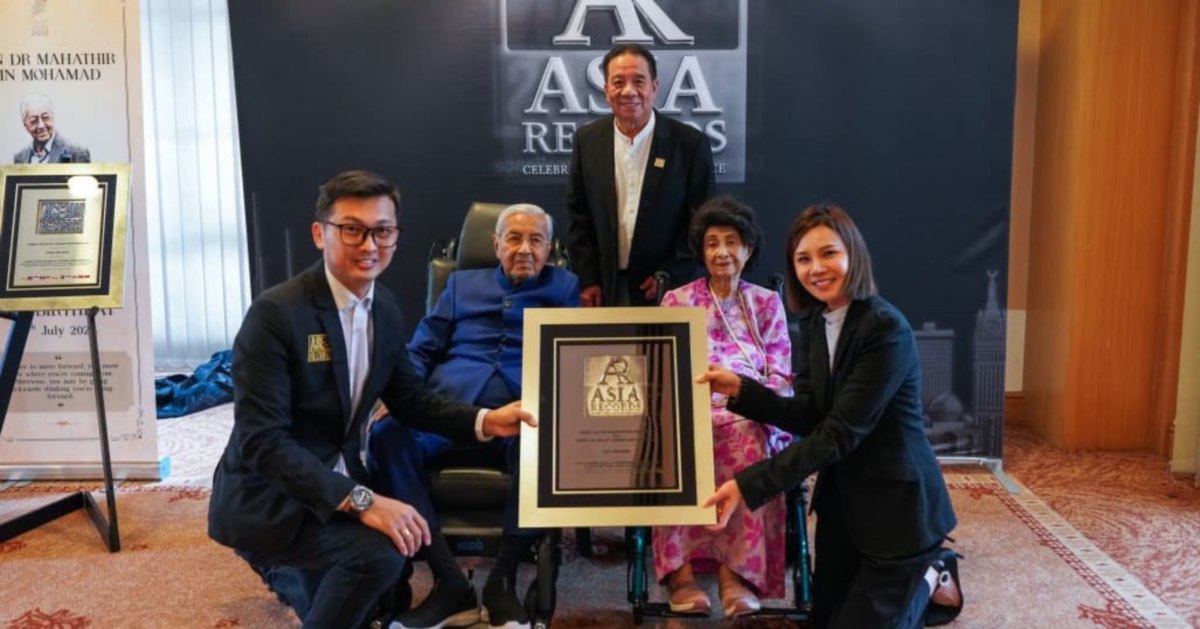
Malaysia's elder statesmen and his wife have achieved a remarkable distinction that transcends national boundaries. Tun Dr Mahathir Mohamad, the nation's longest-serving prime minister, and Tun Dr Siti Hasmah Mohd Ali have been officially recognised with three separate records honouring their exceptional longevity and joint accomplishments. The certifications mark a significant milestone not merely for the couple themselves, but for Malaysian society as a whole, underscoring the country's improving standards of health and wellness whilst celebrating a partnership that has endured through the turbulent decades of Southeast Asia's modern history.
The recognition reflects contemporary international standards for documenting extraordinary human achievement. Official record-keeping bodies have increasingly focused on documenting centenarian milestones and the accomplishments of long-married couples, particularly when both spouses remain active and engaged in public life. The certifications awarded to Tun Dr Mahathir and Tun Dr Siti Hasmah encompass multiple categories of achievement, acknowledging not only the statistical rarity of their combined longevity but also their sustained contributions to Malaysian society across multiple generations.
Tun Dr Mahathir's prominence in Malaysian political history provides essential context for understanding the significance of this recognition. His tenure as prime minister spanned two distinct periods, fundamentally shaping the nation's economic trajectory and international standing. Throughout his decades in public service and subsequent years of retirement and re-engagement with national affairs, he has maintained a visible public presence, commented extensively on matters of state, and remained a sought-after elder statesman. His wife has supported him through these transformative periods whilst carving her own substantial legacy in healthcare, education, and social welfare initiatives.
Tun Dr Siti Hasmah's contributions to Malaysian society have been equally consequential, though sometimes overshadowed by her husband's more visible political profile. Her work in medical and public health fields established her as a pioneering figure in her own right. Beyond her professional accomplishments, she has been instrumental in advancing social causes, particularly those addressing women's health, family welfare, and educational access. Her sustained engagement with charitable and community-based organisations demonstrates that her influence extends well beyond ceremonial roles traditionally associated with spousal partnerships.
The phenomenon of centenarian couples achieving active longevity simultaneously remains statistically uncommon globally. Medical researchers have identified various contributing factors to such extended lifespans, including genetic inheritance, access to quality healthcare, sustained mental engagement, strong family bonds, and purposeful social participation. The case of Tun Dr Mahathir and Tun Dr Siti Hasmah exemplifies how these elements can converge, particularly when combined with the resources and opportunities available to individuals who have occupied prominent positions within society.
For Malaysian readers, the recognition carries particular resonance given the nation's demographic trajectory. Malaysia, alongside other Southeast Asian economies, faces an ageing population as fertility rates decline and life expectancy increases. The longevity of high-profile figures like Tun Dr Mahathir and Tun Dr Siti Hasmah prompts broader societal reflection on how to support and value older citizens, ensure their continued engagement with community affairs, and address the healthcare and social infrastructure requirements of an ageing demographic. Their example demonstrates that advanced age need not signify withdrawal from public contribution or diminished relevance to contemporary discourse.
The records themselves represent an intersection of personal achievement and public documentation. Three separate certifications acknowledge different dimensions of their distinction: their combined longevity as a couple with both spouses living, their individual ages, and their sustained public engagement and societal contributions. This multi-faceted recognition reflects contemporary understanding that longevity alone, whilst medically notable, gains fuller significance when accompanied by active participation in family, community, and civic life. The certifications thus become markers not merely of years lived, but of years meaningfully invested.
The timing of these official recognitions also invites consideration of Malaysia's relationship with its elder statesmen. Tun Dr Mahathir has remained a polarising figure within Malaysian politics, with supporters and critics holding passionate positions regarding his legacy. His wife, conversely, has generally maintained a more consensual public standing, having avoided the contentious political divisions that have characterised much discussion of her husband's career. The joint recognition provides an opportunity for Malaysia to celebrate the couple's longevity and contributions whilst setting aside, at least momentarily, the more divisive aspects of their respective public legacies.
From a regional perspective, these records position Malaysia within a broader Asian context of extended longevity and active ageing. Several other Southeast Asian nations and East Asian countries have documented similar centenarian achievements. However, the prominence of Tun Dr Mahathir and Tun Dr Siti Hasmah within Malaysia's national narrative means their recognition carries implications that transcend the merely biographical. It speaks to Malaysia's development trajectory, its healthcare achievements, and its capacity to sustain the productive engagement of its citizens across remarkably extended lifespans.
The recognition also raises important questions about how societies define and celebrate achievement in later life. Traditionally, accomplishment and significance have been measured primarily through the most active professional and public years. The certifications for Tun Dr Mahathir and Tun Dr Siti Hasmah implicitly suggest that longevity itself, particularly when combined with sustained engagement and continued intellectual vitality, constitutes an achievement worthy of formal acknowledgment. This shift in perspective may gradually alter how Malaysian society perceives and values its older population.
Looking forward, these records establish a benchmark that others may strive to equal or exceed. As life expectancy continues to improve and medical science advances further, additional Malaysian couples may eventually achieve similar recognition. The precedent established by Tun Dr Mahathir and Tun Dr Siti Hasmah thus becomes not merely a personal accomplishment but a marker in Malaysia's broader social and demographic evolution. Their achievement demonstrates both the possibilities for extended healthy living and the enduring value of partnership and continued engagement with life's pursuits across the full span of a remarkably extended existence.

