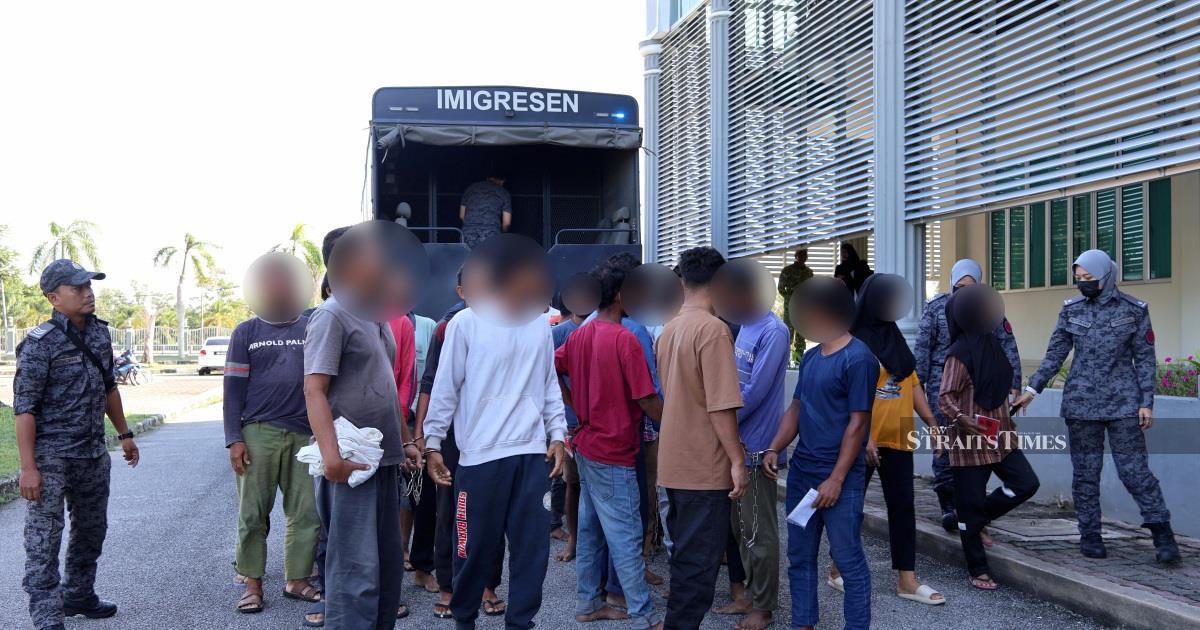
The Sessions Court in Pasir Mas handed down financial penalties to twenty-nine undocumented migrants on Tuesday, concluding cases involving illegal border crossings, extended unauthorized residence, and fraudulent use of travel documentation. The individuals received fines that ranged from RM1,000 to RM10,000 after each pleaded guilty to the charges brought against them. The proceedings highlighted ongoing enforcement efforts against irregular migration in Kelantan, a state that shares borders with Thailand and faces persistent challenges related to cross-border movement of undocumented persons.
The convictions underscore the multifaceted nature of irregular migration violations across Malaysia's northern corridor. The charges encompassed three distinct categories: individuals entering the country without proper authorization, foreign nationals remaining beyond the validity of their permits, and migrants presenting falsified or misused travel documents. Each violation carries separate legal implications under Malaysia's immigration legislation, and the graduated fine structure suggests the court considered the severity and circumstances of individual cases when determining appropriate penalties.
Passir Mas, a district town in Kelantan's interior, serves as a significant point along migration routes in the region. Its proximity to Thailand makes it an active area for immigration enforcement operations. The local Sessions Court regularly handles immigration-related cases, reflecting the volume of irregular migration incidents documented in this locality. The Tuesday court session represents a continuing pattern of judicial processing of migration violations in northern Malaysia, where authorities have intensified border management and workplace immigration checks in recent years.
Malaysia's approach to immigration enforcement has evolved considerably, balancing economic needs with security and public order concerns. While the country relies on foreign workers across multiple sectors—from manufacturing to domestic help—authorities distinguish sharply between documented workers with valid permits and undocumented migrants. The fines imposed in Pasir Mas reflect the legal consequences for crossing that boundary, with penalties scaled according to the nature and duration of violations. First-time offenders typically receive lower penalties, while repeat violations or longer overstaying periods warrant steeper fines.
The processing of these twenty-nine cases through the court system demonstrates the institutional capacity built around immigration compliance. Immigration officers conduct field operations, detain individuals suspected of violating regulations, and compile documentation for prosecution. Public prosecutors then present cases to the judiciary, which determines appropriate sentences. In cases involving fines rather than custodial sentences, the financial penalties serve both punitive and deterrent functions, though enforcement of fine collection can prove challenging, particularly when detainees lack resources to pay immediately.
For Malaysia's neighbor Thailand and the broader region, these enforcement patterns reflect regional migration dynamics. Hundreds of thousands of Burmese, Lao, and Cambodian migrants work across Southeast Asia, often navigating complex documentation requirements and vulnerable employment situations. When migrants cannot secure proper work permits—sometimes due to cost, time constraints, or employer negligence—they enter irregular status despite potentially having legitimate employment. The court proceedings in Pasir Mas capture a slice of this larger regional story, where economic disparities drive migration flows that frequently outpace bureaucratic capacity to regularize movement.
The role of document fraud in these cases warrants particular attention. Travel documents serve as foundational verification for immigration status, and their misuse signals either sophisticated trafficking networks or individual desperation. When migrants present false or altered passes, they typically do so because legitimate pathways have proven inaccessible or expensive. The Sessions Court's imposition of fines for such offences reflects a legal judgment that these individuals bear responsibility, though the underlying conditions enabling document fraud—including demand from employers, supply networks, and documentation costs—extend beyond individual culpability.
Kelantan's experience mirrors broader Malaysian immigration challenges. The state has hosted multiple immigration detention operations and serves as a testing ground for enforcement strategies that are subsequently applied nationally. The Pasir Mas courthouse sentences thus carry implications for immigration policy refinement. Data from such local court proceedings, aggregated nationally, inform police and immigration ministry assessments of enforcement effectiveness and necessary adjustments to operations or legislation. The fines imposed Tuesday contribute to this evidence base.
The financial dimensions of these penalties merit consideration. For undocumented migrants, fines of RM1,000 to RM10,000 represent substantial sums—often equivalent to several months of earnings in their home countries or initial investment costs for migration. Payment of these fines can deplete family resources or force migrants to borrow from exploitative sources. Conversely, from a state revenue perspective, collected fines contribute modestly to government coffers, though collection rates for penalties against detained migrants remain imperfectly documented. The economic impact on affected individuals and their dependents in origin countries has received limited policy attention despite being material for understanding migration consequences.
Looking forward, the Pasir Mas convictions illustrate ongoing demand for immigration law enforcement resources. Malaysia continues prosecuting thousands of immigration violations annually, with enforcement distributed across federal borders, workplace inspections, and airport screening. The consistency of court activity around irregular migration in Kelantan suggests that enforcement alone has not eliminated illegal entry or overstaying. Policymakers periodically debate whether expanded regularization programs, employer accountability mechanisms, or documentation cost reductions might reduce violations more effectively than prosecutions. The twenty-nine individuals penalized in Pasir Mas represent the judicial response to irregular status—one component of a multi-layered immigration management system that remains under evolving scrutiny.

