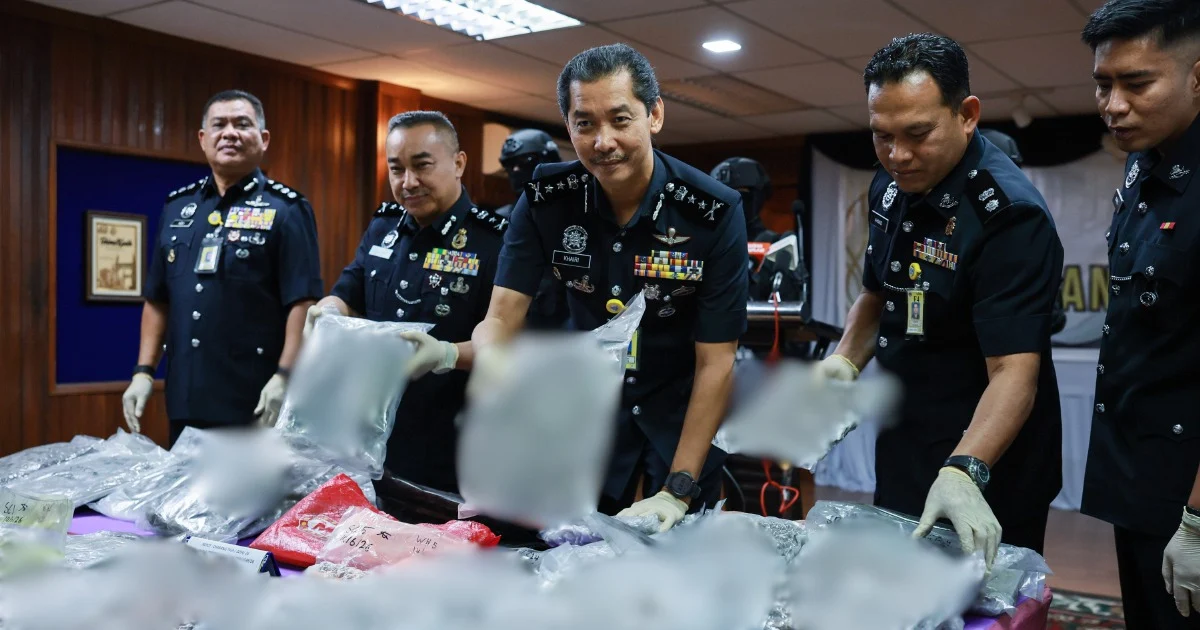
A significant drug trafficking operation has been dismantled in Terengganu's Kampung Duyong Besar following the arrest of two brothers who allegedly converted their family home into a major storage hub for illegal narcotics. Police conducted the operation and seized substances valued at approximately RM1.76 million, marking a substantial blow against organised drug distribution networks operating in the east coast region.
The residence served as a critical logistics node within a larger supply chain, allowing the siblings to store and subsequently distribute controlled drugs throughout the state. The location's strategic position and residential character likely provided cover for their operations, as such domestic fronts remain common among mid-level traffickers seeking to avoid detection. The brothers' willingness to compromise their own living quarters underscores the profitability of the trade, which has proven capable of sustaining increasingly sophisticated distribution systems throughout Malaysia.
This seizure reflects ongoing challenges faced by law enforcement along Malaysia's eastern corridor, where proximity to international maritime routes and porous supply networks create persistent vulnerabilities. Terengganu has emerged as a significant transshipment point for narcotics entering Southeast Asia, with organised syndicates frequently establishing distribution bases across suburban and rural communities. The conversion of residential properties into clandestine storage facilities exploits the difficulty authorities face in distinguishing between legitimate households and criminal operations without substantial intelligence gathering.
The RM1.76 million valuation represents the street or wholesale value assigned by police assessments, reflecting the high-margin economics that drive trafficking networks. Drugs at this quantity typically indicate an operation serving multiple lower-level distributors rather than direct retail sales, suggesting the brothers held intermediate positions within a more extensive criminal hierarchy. Understanding such positioning proves crucial for law enforcement strategies, as dismantling mid-level operatives can disrupt supply chains more effectively than addressing street-level dealers.
The Kampung Duyong Besar location places the operation within a known residential and fishing community adjacent to the Terengganu River, an area balancing coastal commerce with suburban expansion. Such transitional zones frequently attract criminal activity seeking the operational anonymity of urban environments while maintaining easier access to port facilities and maritime smuggling routes. The choice reflects calculated risk assessment by traffickers weighing detection probability against operational convenience and proximity to transport infrastructure.
For Malaysia's drug enforcement agencies, the seizure demonstrates the ongoing necessity of community intelligence networks and sustained investigative focus on residential distribution nodes. The Royal Malaysian Police and related agencies have intensified efforts targeting mid-level trafficking operations, recognising that supply-side interventions require addressing storage and distribution points rather than exclusively pursuing traffickers at street level. Such operations require coordination between intelligence divisions, narcotics units, and local police detachments.
The arrest of the two brothers raises significant questions about family involvement in organised crime, a pattern increasingly observed across Southeast Asia. Financial desperation, debt obligations, or recruitment by established criminal networks frequently draw family members into trafficking roles. The prevalence of sibling partnerships in drug operations suggests both the operational advantages of familial trust and the potential exploitation of family bonds by criminal organisations seeking reliable intermediaries.
From a regional perspective, drug seizures in Terengganu carry implications for Malaysia's broader law enforcement strategy and international cooperation efforts. The country remains a significant transit point for narcotics destined for Australian and other regional markets, with trafficking organisations continuously adapting techniques to circumvent enforcement actions. Successful operations depend on intelligence sharing with neighbouring countries and coordinated maritime surveillance preventing seaborne smuggling attempts through the Strait of Malacca and surrounding waters.
The case underscores persistent supply-side challenges despite increased police capacity and resources. Malaysian authorities have expanded training programmes, improved forensic capabilities, and enhanced intelligence analysis since the 2017 declaration of drug abuse as a national emergency. Yet trafficking networks demonstrate remarkable resilience, continuously recruiting operational personnel and establishing new distribution points as existing networks face interdiction.
For Malaysian communities, particularly in states like Terengganu where drug abuse rates remain concerning, supply-side interventions provide only partial solutions to substance dependency crises. Demand reduction through rehabilitation services, community education, and prevention programmes requires sustained investment complementing enforcement activities. The Government's integrated approach acknowledges this reality, though implementation gaps continue limiting programme effectiveness in lower-income communities.
The investigation likely continues regarding upstream suppliers and downstream distributors connected to the arrested brothers. Authorities typically pursue financial investigations parallel to criminal prosecution, targeting money laundering activities and asset seizures that disrupt trafficking organisations' operational capabilities. Intelligence derived from the seizure may illuminate broader syndicate structures, potentially enabling subsequent enforcement actions against higher-level operatives commanding these distribution networks throughout the region.