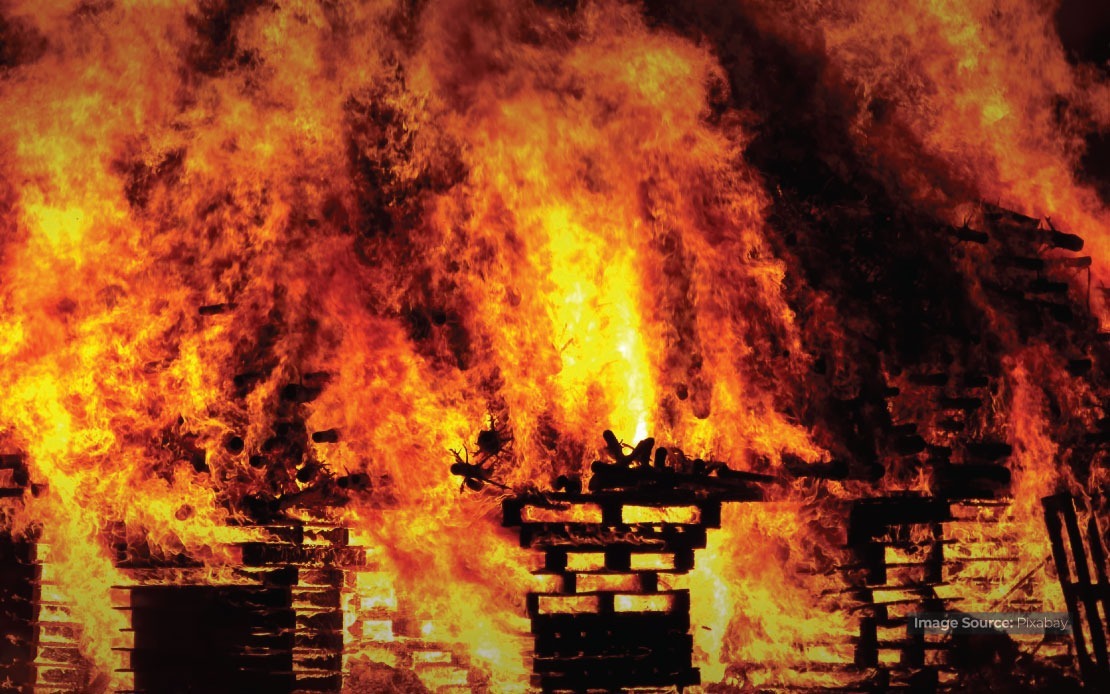
France mourned the loss of two firefighters on Tuesday after they died while battling a fire that erupted near Bordeaux Airport in the southwestern region. Interior Minister Laurent Nuñez confirmed the fatalities to parliament in Paris, noting that the two emergency responders perished while fighting blazes that consumed two buildings near the airport's facilities.
The fire initially ignited on land situated adjacent to the airport's long-term parking zone, according to reporting from regional newspaper Sud Ouest. Emergency crews faced an uphill battle as thick plumes of smoke billowed across the landscape, visible even from the city of Bordeaux itself, signalling the intensity of the conflagration. The sheer scale of the fire prompted authorities to deploy multiple resources, including a dedicated firefighting aircraft summoned to assist ground crews in their efforts to contain and extinguish the spreading flames.
The incident occurred at a particularly vulnerable moment for the region. The Gironde département, administered from Bordeaux, was operating under the most severe red-level wildfire alert status at the time of the fire, reflecting an exceptionally high risk of uncontrolled forest fires across the area. Southwestern France has been grappling with dangerously dry conditions and intense heat, creating an environment where fires can rapidly spiral beyond initial containment. This elevated threat level underscores why the Bordeaux Airport incident proved especially challenging for emergency responders who were already stretched across the region addressing multiple fire emergencies.
The tragedy highlights the extreme peril that firefighters face during periods of heightened fire risk, particularly in continental European summers when heat waves create tinderbox conditions across landscape and infrastructure alike. The two officers who died represent the human cost of fighting such blazes, often in unpredictable and rapidly evolving circumstances where conditions can turn catastrophic within moments.
Operations at Bordeaux Airport experienced partial disruption in response to the emergency. Flight departures faced temporary suspension as a precautionary measure, whilst incoming aircraft were permitted to continue their landings throughout the incident. Airport authorities took steps to minimise inconvenience where possible, with scheduled evening flights expected to proceed largely as planned. One flight bound for Munich was anticipated to depart according to its original timetable, suggesting that while the situation remained serious, airport management had begun restoring normal operations relatively quickly.
The response effort drew upon multiple layers of emergency infrastructure working in concert. Beyond the municipal fire service, Bordeaux Airport maintained its own dedicated firefighting unit, which was immediately mobilised to support the broader suppression effort. This coordination between civilian emergency services and airport-based firefighters reflects standard protocols in European aviation safety, where airports maintain specialised capabilities for rapid incident response on aerodrome grounds. The aerial support, provided by a dedicated firefighting aircraft, represented a further escalation in the response, signalling that authorities recognised the fire's severity and its potential for wider spread.
For Malaysian and Southeast Asian observers, the incident provides a sobering reminder of the occupational hazards faced by firefighting personnel globally. Whilst extreme wildfire conditions are somewhat less common across tropical and subtropical Asia than in Mediterranean and continental European climates, Malaysia has experienced significant fire incidents, most notably during seasonal dry spells when transboundary haze from burning vegetation in neighbouring regions creates hazardous air quality and fire danger. The professionalism and sacrifice demonstrated by French emergency responders resonates across cultural and geographic boundaries, illustrating universal themes of courage and public service.
The Bordeaux incident also underscores broader climate and environmental patterns affecting Europe. Prolonged heat waves and drought conditions in western and southwestern France have emerged as increasingly recurrent phenomena in recent years, challenging emergency management systems and placing tremendous strain on personnel. Environmental specialists note that such patterns are consistent with climate change projections for the European continent, suggesting that fire seasons may intensify and extend in duration across the coming decades, potentially placing greater demands on emergency services across multiple nations.
The airport fire represents a convergence of multiple risk factors—extreme weather conditions, infrastructure situated in fire-prone terrain, and the inherent dangers of emergency response work. The loss of two dedicated public servants whilst protecting airport infrastructure and surrounding communities serves as a powerful testament to the often-invisible sacrifices made by emergency personnel. French authorities and the Gironde region would likely observe formal recognition ceremonies acknowledging the fallen firefighters and extending support to their families and colleagues.

