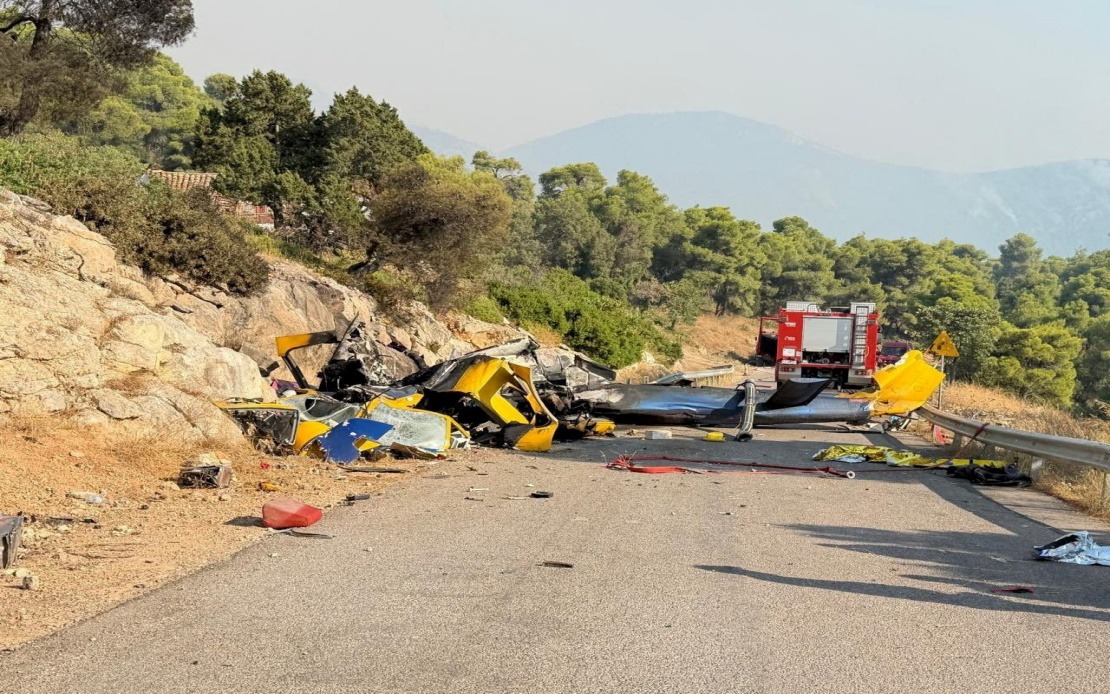
A tragic aerial collision has claimed two lives as Greece grapples with an escalating wildfire crisis across the Attica and Boeotia regions. Two firefighting helicopters came together mid-air on Sunday near the coastal zone of Psatha in western Attica while engaged in active wildfire suppression operations, according to statements issued by the Greek Fire Service. The accident has intensified scrutiny on the risks faced by aerial firefighting crews operating under the extreme pressures of Greece's ongoing summer wildfire season.
The fatalities include a Danish pilot and a Greek firefighting coordinator, confirmed by Fire Service spokesperson Vassilis Vathrakogiannis at an official briefing. Two personnel survived the impact—a British pilot and another Greek firefighting coordinator—though one of the survivors sustained injuries in the collision. The dual-nationality composition of the crews underscores the international dimension of Greece's firefighting response, reflecting the country's reliance on international expertise and resources during periods of heightened fire activity.
Both aircraft were Bell helicopters chartered specifically to support Greece's firefighting operations against the extensive wildfires consuming vegetation across western Attica and central Boeotia. Each helicopter carried a crew of two, meaning all four personnel aboard the aircraft were directly involved in the aerial suppression effort at the moment of collision. The helicopters crashed in proximity to Psatha, a coastal settlement that lies within the broader fire-affected region, triggering an immediate search and rescue mobilization by Greek emergency services.
The precise circumstances leading to the collision remain undetermined, with Greek authorities emphasizing that a comprehensive investigation is underway to establish the cause. Variables under examination likely include weather conditions, visibility levels, communication protocols between the two aircraft, coordination procedures for overlapping aerial operations, and potential technical factors affecting the helicopters' navigation systems. The investigation's findings will carry implications beyond Greece, potentially informing aerial firefighting safety standards across Mediterranean nations facing similar wildfire pressures.
The collision reflects the mounting strain on firefighting infrastructure as Greece confronts multiple simultaneous large-scale wildfires fueled by exceptionally hot, dry and windy conditions characteristic of the region's summer climate. These meteorological factors have compressed firefighting resources across the country, forcing authorities to deploy available assets—including rented civilian helicopters—to multiple fire zones simultaneously. The intensity of current fire activity has stretched conventional ground-based firefighting capabilities, necessitating expanded reliance on aerial operations despite their inherent operational risks.
Greece has increasingly depended on international helicopter support during major wildfire seasons, a trend reflecting both the scale of modern fire challenges and the technical sophistication required for effective aerial firefighting. The involvement of Danish and British personnel alongside Greek crews demonstrates the collaborative framework through which Mediterranean countries coordinate emergency response. However, the accident raises questions about oversight protocols when multinational teams conduct complex aerial operations under high-stress conditions with compressed timelines and limited visibility.
The Attica region, which encompasses the greater Athens metropolitan area, represents particularly sensitive terrain for wildfire operations due to dense population concentrations and critical infrastructure. Wildfires in this zone pose direct threats to residential communities, industrial facilities, and transportation networks. The western Attica fires have prompted evacuations and forced temporary closures of key routes, amplifying the pressure on firefighting authorities to suppress blazes rapidly before they advance toward populated areas.
For Malaysian readers following Mediterranean security developments, the Greek wildfire crisis illustrates patterns increasingly relevant to Southeast Asia. Climate change is intensifying seasonal fire conditions across multiple regions, creating analogous pressures on aerial firefighting resources. Malaysia and neighboring countries, which experience their own significant wildfire seasons particularly in Borneo, face comparable challenges in coordinating multinational aerial response, training personnel across language and procedural barriers, and managing the operational risks inherent in helicopter-based firefighting.
The incident also underscores the economic and human costs of escalating environmental pressures on public safety infrastructure. Greece's reliance on rented Bell helicopters reflects budgetary constraints limiting permanent dedicated aerial firefighting capacity—a condition many developing and middle-income nations understand intimately. The collision represents not merely an isolated accident but symptomatic of systemic pressures mounting across emergency services as climate volatility intensifies demand for capabilities that infrastructure and budgets were not designed to sustain.
Greek authorities have not yet disclosed whether the collision will prompt modifications to aerial firefighting protocols, equipment specifications, or coordination procedures. International aviation safety bodies may examine the incident to determine whether existing guidelines adequately address the unique hazards of low-altitude, high-intensity firefighting operations conducted simultaneously across confined geographic areas. The investigation's conclusions could influence how other nations structure their own aerial firefighting programs and mutual-aid agreements during cross-border emergency response.
The firefighting operations themselves continue despite the collision, reflecting the critical nature of suppressing the Attica and Boeotia fires before weather patterns shift or flames advance further. The loss of two aircraft from an already-stretched aerial firefighting fleet complicates ongoing suppression efforts, potentially necessitating additional international helicopter deployments. Greek emergency management authorities are simultaneously managing ongoing firefighting operations, conducting the collision investigation, supporting bereaved families, and coordinating with international partners regarding additional aerial support.

