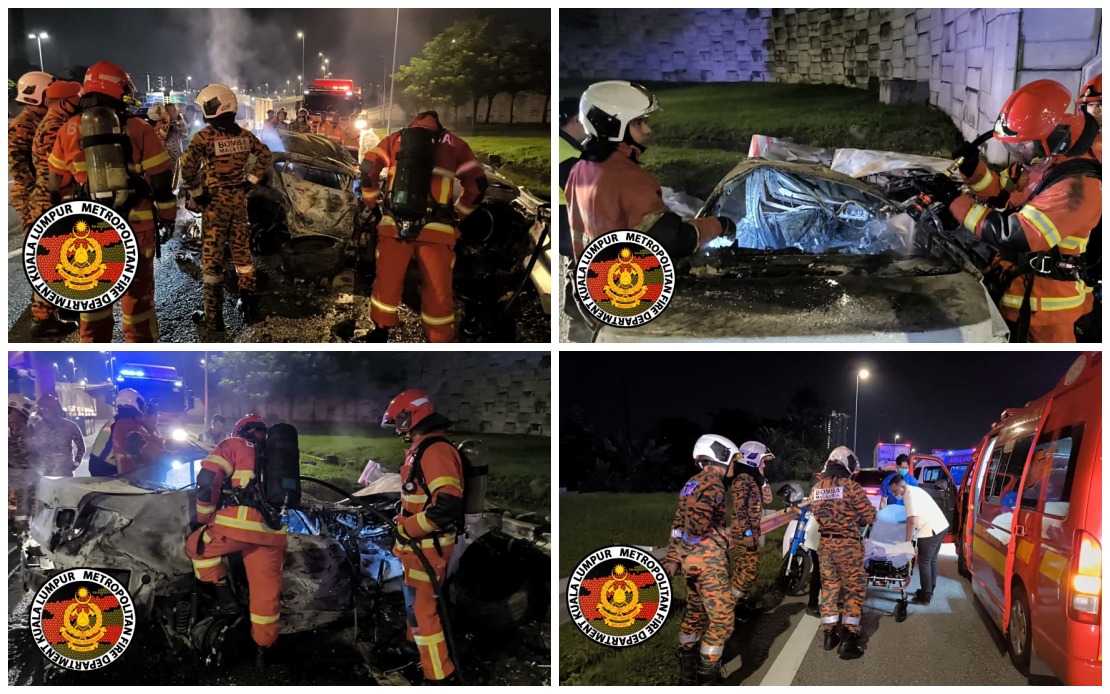
A tragic road accident claimed the lives of two Malaysian university students in the early hours of Wednesday on the Duta-Ulu Kelang Expressway (DUKE) in Kuala Lumpur. The incident occurred at the Jalan Kuching exit ramp when a BMW 328i Sport veered into the left barrier and erupted in flames, with both occupants trapped inside the burning vehicle. A third passenger, identified as a 20-year-old Singaporean male student, managed to escape with only minor injuries and was transported to Kuala Lumpur Hospital for medical attention.
The deceased victims were identified as a 22-year-old Malaysian male driver who studies at Queensland University of Technology in Australia, and a 21-year-old male front passenger enrolled at Sunway University. According to Kuala Lumpur Traffic Investigation and Enforcement Department chief ACP Mohd Zamzuri Mohd Isa, preliminary findings indicate the vehicle was moving along the expressway corridor from Jalan Duta towards Selayang when the driver apparently exceeded safe speed limits for the section. Unable to maintain control at that velocity, the vehicle began to skid across multiple lanes before striking the concrete barrier on the left side of the roadway with considerable force.
The collision with the divider triggered an immediate and intense fire that spread through the BMW's compartment with alarming speed. Both young men were unable to extricate themselves from the wreckage, and the intensity of the blaze prevented rescue personnel from reaching them in time. Police confirmed that both fatalities occurred at the scene, meaning no additional medical intervention could have altered the tragic outcome. The ferocity of the fire also complicated identification procedures, necessitating the use of DNA analysis to confirm the identities of the charred remains.
The cause of the accident appears rooted in excessive speed rather than mechanical failure or external factors. Investigators noted that the driver had not slowed appropriately for the exit ramp configuration, which typically requires reduced velocity to navigate safely. The sharp contact with the barrier at high speed would have been catastrophic under any circumstances, but the subsequent conflagration transformed a serious crash into a fatal one. Weather conditions at the time of the accident and visibility levels remain part of the ongoing investigation, though no preliminary reports have suggested adverse environmental factors played a role.
Police have launched a comprehensive investigation under Section 41(1) of the Road Transport Act 1987, a provision typically applied to serious traffic-related offences and fatalities. The investigative team is systematically reviewing closed-circuit television recordings from multiple cameras along that section of the expressway, which may provide crucial details about the moments preceding the collision. Officers have also conducted preliminary interviews with the surviving Singaporean passenger, whose account of events could shed light on the sequence of circumstances that led to the loss of control.
The incident underscores persistent concerns about speed-related accidents on Malaysia's expressway network. Major arteries such as DUKE handle substantial daily traffic volumes, and the combination of high speeds, complex interchange designs, and driver error creates a precarious safety equation. Each year, numerous collisions on these corridors result in fatalities, many preventable through adherence to speed restrictions and defensive driving practices. Young drivers, statistically more prone to risk-taking behaviour behind the wheel, represent a disproportionate share of expressway casualties.
For the families and institutions affected by this tragedy, the loss represents not merely statistics but the abrupt termination of promising futures. Queensland University of Technology and Sunway University have each lost students with their entire lives ahead of them. The broader university community in Malaysia and abroad must grapple with the sobering reminder that no destination justifies reckless driving practices. The survivor, despite escaping with minor physical injuries, will likely carry psychological trauma from witnessing the deaths of his companions.
Investigators are actively seeking additional evidence to build a comprehensive picture of the accident. Members of the public who were in the vicinity during the early morning hours and may have witnessed the incident are encouraged to contact the Traffic Police Station at Jalan Tun H.S. Lee or any nearby police establishment. Dashcam footage from other vehicles transiting that section could provide critical perspective on the BMW's trajectory, speed, and behaviour in the moments immediately before impact. Every piece of evidence contributes to the investigative mosaic and may yield insights applicable to preventing similar tragedies.
The case highlights the absolute necessity for continued emphasis on speed awareness and safe driving education, particularly among younger motorists. Malaysia's road safety record remains an area requiring sustained attention and investment. While individual accidents cannot always be prevented, systematic improvements to driver education, enforcement of speed regulations, and road design modifications can collectively reduce fatality rates. The loss of two young lives on a Wednesday morning serves as a sobering punctuation mark on a conversation that must continue until such preventable tragedies cease occurring on the nation's expressways.

